
热门标签
热门文章
- 1c++ 全局数组_c++ 怎么使数组全局化
- 2比较稳妥的荣品 rk3399刷机,顺便解决无法进入刷入系统问题以及短接针脚刷机麻烦的问题
- 3python转换八进制用取余数方法_python 二、八、十六进制之间的快速转换
- 4多少并发量算高并发_高并发解决方案之秒杀
- 5Django实现接口自动化平台(十四)测试用例模块Testcases序列化器及视图【持续更新中】_python django自动化测试平台源码
- 6斯坦福 Stats60:21 世纪的统计学:第十五章到第十八章
- 7VMware虚拟机和主机之间无法复制粘贴,移动文件,重新安装vmware-tools变灰,VMware Tools继续运行脚本未能在虚拟机中成功运行。_vmware无法复制到主机
- 8基于GPT-4的 IDEA 神仙插件,亲测可用!
- 9【debug】error: subprocess-exited-with-error
- 10MyBatis-Plus QueryWapper 满足多个条件Or另一个条件_querywrapper 多个条件or匹配
当前位置: article > 正文
【keras】一台设备上同时使用多张显卡训练同一个网络模型_如何两张显卡跑一个网络
作者:代码探索者 | 2024-02-01 12:24:07
赞
踩
如何两张显卡跑一个网络
Reference:
【简述-zzw】Keras同时用多张显卡训练网络
以 tensorflow 为后端,有两种方法可以在多张GPU上运行一个模型:数据并行和设备并行,参考keras中文文档。
数据并行:
数据并行将目标模型在多个设备上各复制一份,并使用每个设备上的复制品处理整个数据集的不同部分数据。Keras在keras.utils.multi_gpu_model中提供有内置函数,该函数可以产生任意模型的数据并行版本,最高支持在8片GPU上并行。 请参考utils中的multi_gpu_model文档。 下面是一个例子:
- from keras.utils import multi_gpu_model
-
- # Replicates `model` on 8 GPUs.
- # This assumes that your machine has 8 available GPUs.
- parallel_model = multi_gpu_model(model, gpus=8)
- parallel_model.compile(loss='categorical_crossentropy',
- optimizer='rmsprop')
-
- # This `fit` call will be distributed on 8 GPUs.
- # Since the batch size is 256, each GPU will process 32 samples.
- parallel_model.fit(x, y, epochs=20, batch_size=256)
设备并行:
设备并行是在不同设备上运行同一个模型的不同部分,当模型含有多个并行结构,例如含有两个分支时,这种方式很适合。这种并行方法可以通过使用TensorFlow device scopes实现,下面是一个例子:
- # Model where a shared LSTM is used to encode two different sequences in parallel
- input_a = keras.Input(shape=(140, 256))
- input_b = keras.Input(shape=(140, 256))
-
- shared_lstm = keras.layers.LSTM(64)
-
- # Process the first sequence on one GPU
- with tf.device_scope('/gpu:0'):
- encoded_a = shared_lstm(tweet_a)
- # Process the next sequence on another GPU
- with tf.device_scope('/gpu:1'):
- encoded_b = shared_lstm(tweet_b)
-
- # Concatenate results on CPU
- with tf.device_scope('/cpu:0'):
- merged_vector = keras.layers.concatenate([encoded_a, encoded_b],
- axis=-1)

以keras框架使用两张GPU训练 inception_v4 模型为例:
- # -*- coding: utf-8 -*-
- import numpy as np
-
- from keras.models import Sequential
- from keras.layers import Input, Dense, Convolution2D, MaxPooling2D, AveragePooling2D, ZeroPadding2D, Dropout, Flatten, merge, Reshape, Activation
- from keras.layers.normalization import BatchNormalization
- from keras.models import Model
- from keras import backend as K
- from sklearn.metrics import log_loss
- # from load_cifar10 import load_cifar10_data
-
- from keras.preprocessing.image import ImageDataGenerator
-
- from keras import optimizers
- import keras
- import tensorflow as tf
-
- from keras.utils import multi_gpu_model
-
-
-
- def conv2d_bn(x, nb_filter, nb_row, nb_col,
- border_mode='same', subsample=(1, 1), bias=False):
- """
- Utility function to apply conv + BN.
- (Slightly modified from https://github.com/fchollet/keras/blob/master/keras/applications/inception_v3.py)
- """
- if K.image_dim_ordering() == "th":
- channel_axis = 1
- else:
- channel_axis = -1
- x = Convolution2D(nb_filter, nb_row, nb_col,
- subsample=subsample,
- border_mode=border_mode,
- bias=bias)(x)
- x = BatchNormalization(axis=channel_axis)(x)
- x = Activation('relu')(x)
- return x
-
- def block_inception_a(input):
- if K.image_dim_ordering() == "th":
- channel_axis = 1
- else:
- channel_axis = -1
-
- branch_0 = conv2d_bn(input, 96, 1, 1)
-
- branch_1 = conv2d_bn(input, 64, 1, 1)
- branch_1 = conv2d_bn(branch_1, 96, 3, 3)
-
- branch_2 = conv2d_bn(input, 64, 1, 1)
- branch_2 = conv2d_bn(branch_2, 96, 3, 3)
- branch_2 = conv2d_bn(branch_2, 96, 3, 3)
-
- branch_3 = AveragePooling2D((3,3), strides=(1,1), border_mode='same')(input)
- branch_3 = conv2d_bn(branch_3, 96, 1, 1)
-
- x = merge([branch_0, branch_1, branch_2, branch_3], mode='concat', concat_axis=channel_axis)
- return x
-
-
- def block_reduction_a(input):
- if K.image_dim_ordering() == "th":
- channel_axis = 1
- else:
- channel_axis = -1
-
- branch_0 = conv2d_bn(input, 384, 3, 3, subsample=(2,2), border_mode='valid')
-
- branch_1 = conv2d_bn(input, 192, 1, 1)
- branch_1 = conv2d_bn(branch_1, 224, 3, 3)
- branch_1 = conv2d_bn(branch_1, 256, 3, 3, subsample=(2,2), border_mode='valid')
-
- branch_2 = MaxPooling2D((3,3), strides=(2,2), border_mode='valid')(input)
-
- x = merge([branch_0, branch_1, branch_2], mode='concat', concat_axis=channel_axis)
- return x
-
-
- def block_inception_b(input):
- if K.image_dim_ordering() == "th":
- channel_axis = 1
- else:
- channel_axis = -1
-
- branch_0 = conv2d_bn(input, 384, 1, 1)
-
- branch_1 = conv2d_bn(input, 192, 1, 1)
- branch_1 = conv2d_bn(branch_1, 224, 1, 7)
- branch_1 = conv2d_bn(branch_1, 256, 7, 1)
-
- branch_2 = conv2d_bn(input, 192, 1, 1)
- branch_2 = conv2d_bn(branch_2, 192, 7, 1)
- branch_2 = conv2d_bn(branch_2, 224, 1, 7)
- branch_2 = conv2d_bn(branch_2, 224, 7, 1)
- branch_2 = conv2d_bn(branch_2, 256, 1, 7)
-
- branch_3 = AveragePooling2D((3,3), strides=(1,1), border_mode='same')(input)
- branch_3 = conv2d_bn(branch_3, 128, 1, 1)
-
- x = merge([branch_0, branch_1, branch_2, branch_3], mode='concat', concat_axis=channel_axis)
- return x
-
-
- def block_reduction_b(input):
- if K.image_dim_ordering() == "th":
- channel_axis = 1
- else:
- channel_axis = -1
-
- branch_0 = conv2d_bn(input, 192, 1, 1)
- branch_0 = conv2d_bn(branch_0, 192, 3, 3, subsample=(2, 2), border_mode='valid')
-
- branch_1 = conv2d_bn(input, 256, 1, 1)
- branch_1 = conv2d_bn(branch_1, 256, 1, 7)
- branch_1 = conv2d_bn(branch_1, 320, 7, 1)
- branch_1 = conv2d_bn(branch_1, 320, 3, 3, subsample=(2,2), border_mode='valid')
-
- branch_2 = MaxPooling2D((3, 3), strides=(2, 2), border_mode='valid')(input)
-
- x = merge([branch_0, branch_1, branch_2], mode='concat', concat_axis=channel_axis)
- return x
-
-
- def block_inception_c(input):
- if K.image_dim_ordering() == "th":
- channel_axis = 1
- else:
- channel_axis = -1
-
- branch_0 = conv2d_bn(input, 256, 1, 1)
-
- branch_1 = conv2d_bn(input, 384, 1, 1)
- branch_10 = conv2d_bn(branch_1, 256, 1, 3)
- branch_11 = conv2d_bn(branch_1, 256, 3, 1)
- branch_1 = merge([branch_10, branch_11], mode='concat', concat_axis=channel_axis)
-
-
- branch_2 = conv2d_bn(input, 384, 1, 1)
- branch_2 = conv2d_bn(branch_2, 448, 3, 1)
- branch_2 = conv2d_bn(branch_2, 512, 1, 3)
- branch_20 = conv2d_bn(branch_2, 256, 1, 3)
- branch_21 = conv2d_bn(branch_2, 256, 3, 1)
- branch_2 = merge([branch_20, branch_21], mode='concat', concat_axis=channel_axis)
-
- branch_3 = AveragePooling2D((3, 3), strides=(1, 1), border_mode='same')(input)
- branch_3 = conv2d_bn(branch_3, 256, 1, 1)
-
- x = merge([branch_0, branch_1, branch_2, branch_3], mode='concat', concat_axis=channel_axis)
- return x
-
-
- def inception_v4_base(input):
- if K.image_dim_ordering() == "th":
- channel_axis = 1
- else:
- channel_axis = -1
-
- # Input Shape is 299 x 299 x 3 (th) or 3 x 299 x 299 (th)
- net = conv2d_bn(input, 32, 3, 3, subsample=(2,2), border_mode='valid')
- net = conv2d_bn(net, 32, 3, 3, border_mode='valid')
- net = conv2d_bn(net, 64, 3, 3)
-
- branch_0 = MaxPooling2D((3,3), strides=(2,2), border_mode='valid')(net)
-
- branch_1 = conv2d_bn(net, 96, 3, 3, subsample=(2,2), border_mode='valid')
-
- net = merge([branch_0, branch_1], mode='concat', concat_axis=channel_axis)
-
- branch_0 = conv2d_bn(net, 64, 1, 1)
- branch_0 = conv2d_bn(branch_0, 96, 3, 3, border_mode='valid')
-
- branch_1 = conv2d_bn(net, 64, 1, 1)
- branch_1 = conv2d_bn(branch_1, 64, 1, 7)
- branch_1 = conv2d_bn(branch_1, 64, 7, 1)
- branch_1 = conv2d_bn(branch_1, 96, 3, 3, border_mode='valid')
-
- net = merge([branch_0, branch_1], mode='concat', concat_axis=channel_axis)
-
- branch_0 = conv2d_bn(net, 192, 3, 3, subsample=(2,2), border_mode='valid')
- branch_1 = MaxPooling2D((3,3), strides=(2,2), border_mode='valid')(net)
-
- net = merge([branch_0, branch_1], mode='concat', concat_axis=channel_axis)
-
- # 35 x 35 x 384
- # 4 x Inception-A blocks
- for idx in xrange(4):
- net = block_inception_a(net)
-
- # 35 x 35 x 384
- # Reduction-A block
- net = block_reduction_a(net)
-
- # 17 x 17 x 1024
- # 7 x Inception-B blocks
- for idx in xrange(7):
- net = block_inception_b(net)
-
- # 17 x 17 x 1024
- # Reduction-B block
- net = block_reduction_b(net)
-
- # 8 x 8 x 1536
- # 3 x Inception-C blocks
- for idx in xrange(3):
- net = block_inception_c(net)
-
- return net
-
-
- def inception_v4_model(img_rows, img_cols, color_type=1, num_classes=None, dropout_keep_prob=0.2):
- '''
- Inception V4 Model for Keras
- Model Schema is based on
- https://github.com/kentsommer/keras-inceptionV4
- ImageNet Pretrained Weights
- Theano: https://github.com/kentsommer/keras-inceptionV4/releases/download/2.0/inception-v4_weights_th_dim_ordering_th_kernels.h5
- TensorFlow: https://github.com/kentsommer/keras-inceptionV4/releases/download/2.0/inception-v4_weights_tf_dim_ordering_tf_kernels.h5
- Parameters:
- img_rows, img_cols - resolution of inputs
- channel - 1 for grayscale, 3 for color
- num_classes - number of class labels for our classification task
- '''
-
- # Input Shape is 299 x 299 x 3 (tf) or 3 x 299 x 299 (th)
- if K.image_dim_ordering() == 'th':
- inputs = Input((3, 299, 299))
- else:
- inputs = Input((299, 299, 3))
-
- # Make inception base
- net = inception_v4_base(inputs)
-
-
- # Final pooling and prediction
-
- # 8 x 8 x 1536
- net_old = AveragePooling2D((8,8), border_mode='valid')(net)
-
- # 1 x 1 x 1536
- net_old = Dropout(dropout_keep_prob)(net_old)
- net_old = Flatten()(net_old)
-
- # 1536
- predictions = Dense(output_dim=1001, activation='softmax')(net_old)
-
- model = Model(inputs, predictions, name='inception_v4')
-
- if K.image_dim_ordering() == 'th':
- # Use pre-trained weights for Theano backend
- weights_path = 'imagenet_models/inception-v4_weights_th_dim_ordering_th_kernels.h5'
- else:
- # Use pre-trained weights for Tensorflow backend
- weights_path = 'imagenet_models/inception-v4_weights_tf_dim_ordering_tf_kernels.h5'
-
- # weights_path = './InceptionV4_model_fold_01.h5'
- model.load_weights(weights_path, by_name=True)
-
- # Truncate and replace softmax layer for transfer learning
- # Cannot use model.layers.pop() since model is not of Sequential() type
- # The method below works since pre-trained weights are stored in layers but not in the model
- net_ft = AveragePooling2D((8,8), border_mode='valid')(net)
- net_ft = Dropout(dropout_keep_prob)(net_ft)
- net_ft = Flatten()(net_ft)
- predictions_ft = Dense(output_dim=num_classes, activation='softmax')(net_ft)
-
- model = Model(inputs, predictions_ft, name='inception_v4')
-
- return model
-
- if __name__ == '__main__':
-
- # import os
- # os.environ['CUDA_VISIBLE_DEVICES']='0'
-
- # dimensions of our images.
- # ADNI GM
- # X: 121*145
- # Y: 121*121
- # Z: 145*121
-
- # OASIS GM MRI
- # 176*208
- ### data_fold_01_train_val_test_entropy_keep_SliceNum_33
- img_width, img_height = 299, 299
- fold_name = "fold_01" ## data_fold_01_entropy_keep_SliceNum_33
- ## single_subject_data_fold_01_train_val_test_entropy_keep_SliceNum_81
- train_data_dir = 'single_subject_data_' + fold_name + '_train_val_test_entropy_keep_SliceNum_81/train'
- validation_data_dir = 'single_subject_data_' + fold_name + '_train_val_test_entropy_keep_SliceNum_81/validation'
- filepath="model_single_subject_InceptionV4_" + fold_name + "_train_val_test_entropy_keep_SliceNum_81_best.h5"
-
- # train num (AD+NC) = 36207 + 41796 = 78003
- # validation num (AD+NC) = 9477 + 11178 = 20655
- # test num (AD+NC) = 2673 + 2916 =
- # train_samples_AD = len(os.listdir(path))
- nb_train_samples = 78003
- nb_validation_samples = 20655
- epochs = 120
- batch_size = 64 #10 #40
- channel = 3
- num_classes = 2
-
- print("=== paramaters info ===")
- print("epochs = {}.".format(epochs))
- print("batch_size = {}.".format(batch_size))
- print("nb_train_samples = {}.".format(nb_train_samples))
- print("nb_validation_samples = {}.".format(nb_validation_samples))
-
- #if K.image_data_format() == 'channels_first':
- # input_shape = (3, img_width, img_height)
- #else:
- # input_shape = (img_width, img_height, 3)
-
- # this is the augmentation configuration we will use for training
- train_datagen = ImageDataGenerator(
- rescale=1. / 255,
- shear_range=0.2,
- zoom_range=0.2,
- horizontal_flip=True)
-
- # this is the augmentation configuration we will use for testing:
- # only rescaling
- test_datagen = ImageDataGenerator(rescale=1. / 255)
-
-
-
- ### class_mode: "categorical", "binary", "sparse"或None之一.
- ### 默认为"categorical: 该参数决定了返回的标签数组的形式, "categorical"会返回2D的one-hot编码标签,
- ### "binary"返回1D的二值标签.
- ### "sparse"返回1D的整数标签,
- ### 如果为None则不返回任何标签, 生成器将仅仅生成batch数据, 这种情况在使用model.predict_generator()和model.evaluate_generator()等函数时会用到.
-
- train_generator = train_datagen.flow_from_directory(
- train_data_dir,
- target_size=(img_width, img_height),
- batch_size=batch_size,
- class_mode='binary')
-
- validation_generator = test_datagen.flow_from_directory(
- validation_data_dir,
- target_size=(img_width, img_height),
- batch_size=batch_size,
- class_mode='binary')
-
- # Load our model
- model = inception_v4_model(img_height, img_width, channel, num_classes, dropout_keep_prob=0.2)
- parallel_model = multi_gpu_model(model, gpus=2)
- # Learning rate is changed to 0.001
- sgd = optimizers.SGD(lr=1e-3, decay=1e-6, momentum=0.9, nesterov=True)
- parallel_model.compile(optimizer=sgd, loss='sparse_categorical_crossentropy', metrics=['accuracy'])
-
- checkpoint = keras.callbacks.ModelCheckpoint(
- filepath = filepath,
- monitor='val_acc',
- verbose=1,
- save_best_only=True,
- # save_weights_only=False,
- mode='max',
- period=1
- )
- callbacks_list = [checkpoint]
-
-
- ### verbose:日志显示,0为不在标准输出流输出日志信息,1为输出进度条记录,2为每个epoch输出一行记录
- ###
- parallel_model.fit_generator(
- train_generator,
- steps_per_epoch=nb_train_samples/batch_size,
- epochs=epochs,
- verbose = 2,
- validation_data=validation_generator,
- validation_steps=nb_validation_samples/batch_size,
- callbacks = callbacks_list)
- #validation_steps=nb_validation_samples // batch_size)
-
-
- # model.save('InceptionV4_model_fold_01.h5')
-
-
- # Make predictions
- #predictions_valid = model.predict(X_valid, batch_size=batch_size, verbose=1)
-
- # Cross-entropy loss score
- #score = log_loss(Y_valid, predictions_valid)
-
- ### CUDA_VISIBLE_DEVICES=0 python inception_v4_train_val_test_entropy_keep_SliceNum_81_fold_01_single_subject.py > acc_inception_v4_train_val_test_entropy_keep_SliceNum_81_fold_01_single_subject.txt
- ### python inception_v4_train_val_test_entropy_keep_SliceNum_81_fold_01_single_subject.py > acc_single_subject_inception_v4_train_val_test_entropy_keep_SliceNum_81_fold_01.txt
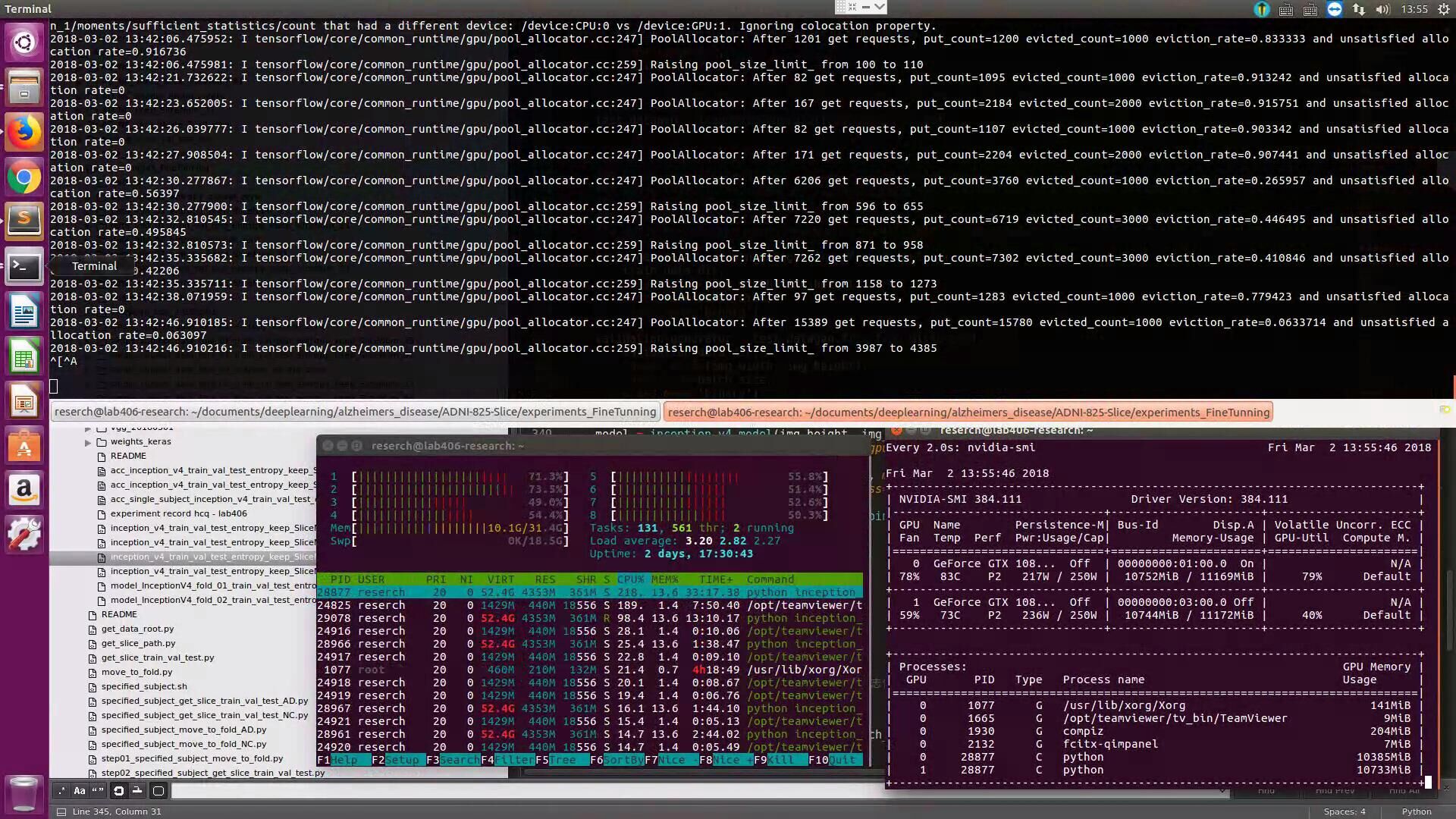
注意:
上述代码使用
- # parallel_model.fit_generator(
- # train_generator,
- # steps_per_epoch=nb_train_samples/batch_size,
- # epochs=epochs,
- # verbose = 2,
- # validation_data=validation_generator,
- # validation_steps=nb_validation_samples/batch_size,
- # callbacks = callbacks_list)
会报错:
TypeError: can't pickle NotImplementedType objects去掉 callbacks 即可,如下所示:
- parallel_model.fit_generator(
- train_generator,
- steps_per_epoch=nb_train_samples/batch_size,
- epochs=epochs,
- verbose = 2,
- validation_data=validation_generator,
- validation_steps=nb_validation_samples/batch_size)
声明:本文内容由网友自发贡献,不代表【wpsshop博客】立场,版权归原作者所有,本站不承担相应法律责任。如您发现有侵权的内容,请联系我们。转载请注明出处:https://www.wpsshop.cn/article/detail/53768?site
推荐阅读
相关标签

