
热门标签
热门文章
- 1linux面试题_使用什么命令没有实现将file文件的内容输出到file.copy
- 2nc的另一种用法——不用它来骂人_nc中showbatchbilltable
- 3C++——Eigen库的学习(6)_c++ eigen 零矩阵
- 4vue3+eslint7.32.0 自动修复规范代码 开发工具 webstorm_eslint: 7.32.0 /opt/test/node_modules/eslint-plugi
- 5堡垒机软件有哪些_十大开源堡垒机软件
- 6交换两个数的值的三种指针方法——指针的引用和指向指针的指针_指针如何交换
- 7iOS开发之UITableView+FDTemplateLayoutCell.h崩溃问题以及mjrefresh无法下拉刷新或刷新偏移问题_cell must be registered to table view for identifi
- 8HCIA-Datacom题库(自己整理)——ACL多选_路由器a的g0-0杠一接口配置信息如下下列说法正确的有
- 9FISCO BCOS的PBFT共识算法流程详解_pbft共识过程
- 10Windows server16怎么将bat格式放入启动项中_winserver2016 bat文件放到开机自启动
当前位置: article > 正文
Jdk8 新特性 函数、Lambda表达式和Stream流总结_jdk8lambda 表达式和 strem 溜
作者:思考机器3 | 2024-02-01 09:59:41
赞
踩
jdk8lambda 表达式和 strem 溜
一、 jdk8 接口的新特性
jdk8 提供了很多实用的新特性,针对接口推出了接口默认方法,接口静态方法以及函数式接口,同时为了简化代码编写,推出了lambda表达式,为了增强对数据的操作,还定义了Stream操作等。
多继承和默认方法:
interface A{}

interface B{}

public interface Inte1 extends A,B {

    String add();

    default int test(int a,int b){
        return a*b;
    }
}
- 1
- 2
- 3
- 4
- 5
- 6
- 7
- 8
- 9
- 10
- 11
- 12
二、 Lambda表达式和函数
1. 将匿名函数换成箭头
public class Test1 {
    public static void main(String[] args) throws InterruptedException {
        new Thread(Test1::test).start();
        new Thread(()->test()).start();
        Thread.sleep(5000);
    }
    private static void test(){
        System.out.println("哈哈哈哈");
    }
}
- 1
- 2
- 3
- 4
- 5
- 6
- 7
- 8
- 9
- 10
如果创建线程只执行一个方法的话,可以直接使用new Thread(Test1::test).start();其中test为静态方法,执行多行逻辑的话,可以()->{}形式。
2. 常用函数
-
Function输入输出类型函数:Function<String, String> f = (s) -> { System.out.println(s); return s+": abc"; }; String s = f.apply("s");- 1
- 2
- 3
- 4
- 5
-
Consumer消费类型函数,通常只有输入没有输出Consumer<String> c = s -> { System.out.println(s); }; c.accept("s");- 1
- 2
- 3
- 4
-
Supplier提供类型函数,通常只有输出,没有输入。Supplier<String> s = ()->{ return "s"; }; String r = s.get();- 1
- 2
- 3
- 4
-
BiFunction可以指定两个输入类型BiFunction<String, String, String> f = (s1, s2) -> { System.out.println(s1 + " " + s2); return s1 + ": " + s2; }; String s = f.apply("s1", "s2");- 1
- 2
- 3
- 4
- 5
-
BinaryOperator继承自BiFunction,三个参数类型都是一致:BinaryOperator<String> f = (s1, s2) -> { System.out.println(s1 + " " + s2); return s1 + ": " + s2; }; String s = f.apply("s1", "s2");- 1
- 2
- 3
- 4
- 5
-
UnaryOperator继承自Function,两个输入输出类型一致:UnaryOperator<String> u = (s) -> { System.out.println(s); return s+": abc"; }; String s = u.apply("s");- 1
- 2
- 3
- 4
- 5
-
固定类型接口
IntUnaryOperator 、DoubleUnaryOperator、LongUnaryOperatorIntUnaryOperator i = (s) -> { return s; }; int a = i.applyAsInt(1); DoubleUnaryOperator d = (s) -> { return s; }; double b = d.applyAsDouble(1d); LongUnaryOperator l = (s) -> { return s; }; long c = l.applyAsLong(1L);- 1
- 2
- 3
- 4
- 5
- 6
- 7
- 8
- 9
- 10
- 11
- 12
- 13
- 14
-
Predicate断言型函数Predicate<String> p = (s) -> { System.out.println(s); return Objects.equals(s, "s"); }; boolean b = p.test("s");- 1
- 2
- 3
- 4
- 5
3. 函数式创建对象
-
无参构造函数创建对象
Supplier<Dog> supplier = Dog::new; System.out.println(supplier.get().test4()); Function<Integer,String> function3 = ((Supplier<Dog>)(Dog::new)).get()::test2; System.out.println(function3.apply(6));- 1
- 2
- 3
- 4
-
有参构造函数
Function<String,Dog> function4 = Dog::new; Dog apply1 = function4.apply("44");- 1
- 2
三、 Stream流
1. 创建流
-
List创建流
List<String> list = new ArrayList<>(); list.stream(); list.parallelStream();- 1
- 2
- 3
-
通过Arrays创建流
int[] i = new int[]{1,2}; Arrays.stream(i);- 1
- 2
-
指定类型流
IntStream.of(i); IntStream.rangeClosed(1,10);- 1
- 2
-
随机流
new Random().ints().limit(10); Stream.generate(()-> "");- 1
- 2
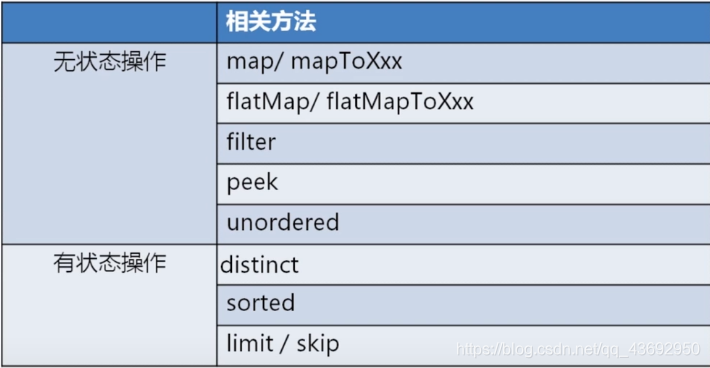
2. 流的中间操作
-
map 中间操作
String str = "my name is hellword"; Stream.of(str.split(" ")).map(s -> s.length()).forEach(System.out :: println); Stream.of(str.split(" ")).map(s -> s.length()).forEachOrdered(System.out :: println);- 1
- 2
- 3
List<Dog> list = new ArrayList<>(); list.add(new Dog("aa", "0")); list.add(new Dog("bb", "1")); list.add(new Dog("cc", "0")); list.add(new Dog("dd", "1")); list.forEach(System.out::println); list.stream().map(dog -> { dog.age = "0".equals(dog.age) ? "是" : "否"; return dog; }).forEach(System.out::println);- 1
- 2
- 3
- 4
- 5
- 6
- 7
- 8
- 9
- 10
- 11
- 12
-
flatMap A里面存的所有B 的集合
Stream.of(str.split(" ")).flatMap(s -> s.chars().boxed()).forEachOrdered(s->{ System.out.println((char)s.intValue()); }); Stream.of(str.split(" ")).flatMap(s -> s.chars().boxed()).forEach(s->{ System.out.println((char)s.intValue()); });- 1
- 2
- 3
- 4
- 5
- 6
List<List<String>> lists = new ArrayList<>(); List<String> list1 = new ArrayList<>(); list1.add("aa"); list1.add("bb"); list1.add("cc"); List<String> list2 = new ArrayList<>(); list2.add("aa"); list2.add("bb"); list2.add("cc"); lists.add(list1); lists.add(list2); lists.stream().flatMap(l->l.stream()).forEach(System.out::println);- 1
- 2
- 3
- 4
- 5
- 6
- 7
- 8
- 9
- 10
- 11
- 12
- 13
- 14
-
filter 过滤
list.stream().map(dog -> { dog.age = "0".equals(dog.age) ? "是" : "否"; return dog; }).filter(dog -> "是".equals(dog.age)).forEach(System.out::println); list.stream().map(dog -> { dog.age = "0".equals(dog.age) ? "是" : "否"; return dog; }).filter(dog -> { if ("是".equals(dog.age)){ return true; } return false; }).forEach(System.out::println);- 1
- 2
- 3
- 4
- 5
- 6
- 7
- 8
- 9
- 10
- 11
- 12
- 13
- 14
-
peek 处理中间内容
Stream.of(str.split(" ")).peek(System.out::println).map(s -> s.length()).forEachOrdered(System.out :: println);- 1
-
Random
过滤条件大于100小于1000的10个数据。new Random().ints().filter(i-> i>100&&i<1000).limit(10).forEach(System.out::println);- 1
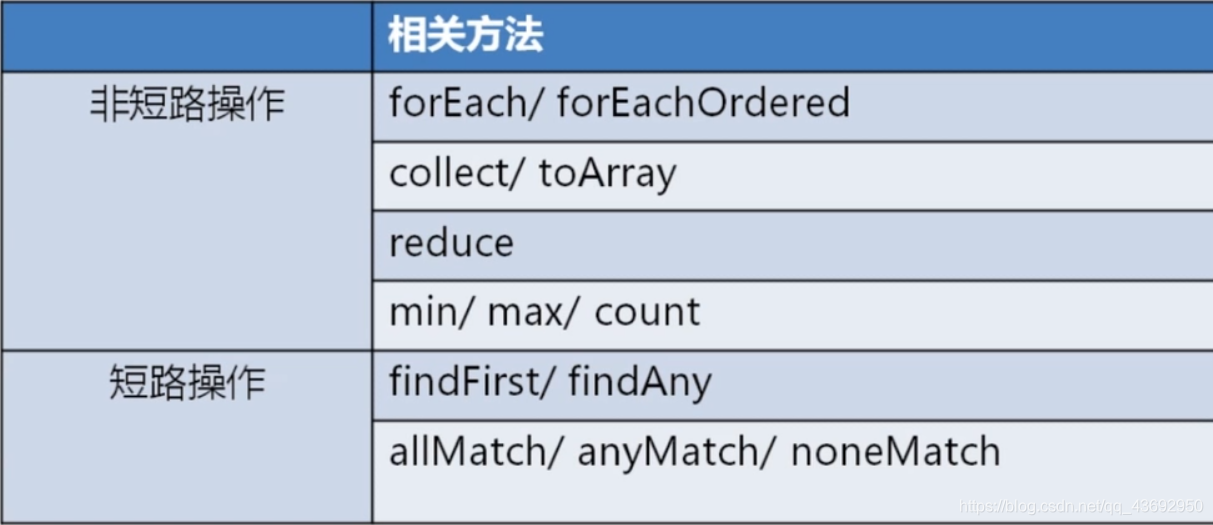
3. 流的终止操作
-
并行流下的forEach 和 forEachOrdered
String str = "my is hello word"; //并行流 Stream.of(str.split(" ")).parallel().forEach(System.out::println); Stream.of(str.split(" ")).parallel().forEachOrdered(System.out::println);- 1
- 2
- 3
- 4
-
collect 收集器
收集到List
List<String> list = Stream.of(str.split(" ")).parallel().collect(Collectors.toList()); System.out.println(list); //收集到TreeSet TreeSet treeSet = Stream.of(str.split(" ")).parallel().collect(Collectors.toCollection(TreeSet::new)); System.out.println(treeSet.toString());- 1
- 2
- 3
- 4
- 5
拼接
String s = Stream.of(str.split(" ")).parallel().collect(Collectors.joining("|")); System.out.println(s);- 1
- 2
计算平均
int i = Stream.of(str.split(" ")).map(s -> s.length()).parallel().collect(Collectors.averagingInt(Integer::shortValue)).intValue(); System.out.println(i); double d = Stream.of(str.split(" ")).map(s -> (double)s.length()).parallel().collect(Collectors.averagingDouble(Double::doubleValue)); System.out.println(d); double d2 = Stream.of(str.split(" ")).map(s -> (double)s.length()).parallel().collect(Collectors.averagingDouble(s->s.doubleValue())); System.out.println(d2);- 1
- 2
- 3
- 4
- 5
- 6
- 7
- 8
统计汇总
IntSummaryStatistics summaryStatistics = Stream.of(str.split(" ")).map(s -> s.length()).parallel().collect(Collectors.summarizingInt(Integer::intValue)); System.out.println(summaryStatistics.toString());- 1
- 2

会得到 数量、总和、最小值、最大值、平均数。分块
Map<Boolean,List<String>> map = Stream.of(str.split(" ")).collect(Collectors.partitioningBy(s->s.length() == 2)); System.out.println(map.toString());- 1
- 2
分组
Map<Integer,List<String>> map = Stream.of(str.split(" ")).collect(Collectors.groupingBy(s-> s.length())); System.out.println(map.toString()); //分组,第二个参数可对原先的List再操作 Map<Integer,String> map = Stream.of(str.split(" ")).collect(Collectors.groupingBy(s-> s.length(),Collectors.joining(","))); System.out.println(map.toString()); Map<Integer,Long> map1 = Stream.of(str.split(" ")).collect(Collectors.groupingBy(s->s.length(),Collectors.counting())); System.out.println(map1.toString());- 1
- 2
- 3
- 4
- 5
- 6
- 7
- 8
- 9
分组后,提取第一个数据
Map<String, Rule> ruleMap = list.stream(). .collect(Collectors.groupingBy(User::getName, Collectors.collectingAndThen(Collectors.toList(), value -> value.get(0))));- 1
- 2
- 3
-
reduce 收集(拼接)
String s = Stream.of(str.split(" ")).parallel().reduce((s1,s2)->s1+","+s2).get(); System.out.println(s);- 1
- 2
带初始化的reduce
String str1 = Stream.of(str.split(" ")).parallel().reduce("",(s1, s2) -> s1+"|"+s2); System.out.println(str1); Integer integer = Stream.of(str.split(" ")).map(s -> s.length()).reduce(0,(s1, s2) -> s1+s2); System.out.println(integer); String str1 = Stream.of(str.split(" ")).parallel().reduce((s1, s2) -> s1+","+s2).orElse(""); System.out.println(str1);- 1
- 2
- 3
- 4
- 5
- 6
- 7
- 8
4 . 指定类型流的计算
int[] i = {1,9,6,4,3,5};

//计算平均数
double d = IntStream.of(i).average().getAsDouble();
System.out.println(d);

//计算最小值
int m = IntStream.of(i).min().getAsInt();
System.out.println(m);

//并行计算最小值
int m1 = IntStream.of(i).parallel().min().getAsInt();
System.out.println(m1);

//计算平均值
double d1 = DoubleStream.of(0.1,0.1).average().getAsDouble();
System.out.println(d1);

//含有中间操作的计算
double d2 = IntStream.of(i).parallel().map((x)-> x*2).average().getAsDouble();
System.out.println(d2);
- 1
- 2
- 3
- 4
- 5
- 6
- 7
- 8
- 9
- 10
- 11
- 12
- 13
- 14
- 15
- 16
- 17
- 18
- 19
- 20
- 21
声明:本文内容由网友自发贡献,不代表【wpsshop博客】立场,版权归原作者所有,本站不承担相应法律责任。如您发现有侵权的内容,请联系我们。转载请注明出处:https://www.wpsshop.cn/article/detail/53087
推荐阅读
相关标签

