
热门标签
热门文章
- 1Django之权限_django class 权限
- 2配置(Linux、JDK、Tomcat、nginx)阿里云ecs服务器_云服务器 nginx tomcat 配置
- 3百卓Smart管理平台 uploadfile.php 文件上传漏洞(CVE-2024-0939)
- 4(原)torch的训练过程
- 5【Java程序设计】【C00260】基于Springboot的企业客户信息反馈平台(有论文)
- 6windows 批处理命令大全
- 7【后端高频面试题--SpringBoot篇】
- 8网络协议之UDP数据包_udp包
- 9Linux top命令详解_linux 获取 top id
- 10python爬虫入门篇_slbrowser/9.0.0.10191 slbchan/33
当前位置: article > 正文
Conditional Gan代码学习_vaegan中的normal_init函数
作者:程序质量控制师 | 2024-01-17 14:23:54
赞
踩
vaegan中的normal_init函数
自己修改了github的代码,选取了比较核心的代码,简化了相关操作
基于MNIST数据集
- # 库的引用
- import torch
- import torch.nn as nn
- import torch.nn.functional as F
- import numpy
- from torchvision import datasets
- from torch.utils.data import DataLoader
- from torchvision import transforms
- from torch.autograd import Variable
- from torchvision.utils import save_image
-
-
- # 用到的参数及设置
- batch_size = 128
- lr = 0.0002
- train_epoch = 50
- transform = transforms.Compose([transforms.ToTensor(), transforms.Normalize([0.5], [0.5])])
- # device = torch.device('cuda:0' if torch.cuda.is_available() else 'cpu')
-
-
-
- # 准备数据
- data = datasets.MNIST(root='./data/mnist', train=True, transform=transform, download=True)
- data_loader = DataLoader(data, batch_size=batch_size, shuffle=True, num_workers=4)
-
- def normal_init(m, mean, std):
- if isinstance(m, nn.Linear):
- m.weight.data.normal_(mean, std)
- m.bias.data.zero_()
-
-
- class Generator(nn.Module):
- def __init__(self):
- super(Generator, self).__init__()
- self.fc1_1 = nn.Linear(100, 256) # 100是噪声的维度
- self.fc1_1_bn = nn.BatchNorm1d(256)
- self.fc1_2 = nn.Linear(10, 256)
- self.fc1_2_bn = nn.BatchNorm1d(256)
- self.fc2 = nn.Linear(512, 512)
- self.fc2_bn = nn.BatchNorm1d(512)
- self.fc3 = nn.Linear(512, 1024)
- self.fc3_bn = nn.BatchNorm1d(1024)
- self.fc4 = nn.Linear(1024, 784)
-
-
- # 循环时字典遍历的是key
- def weight_init(self, mean, std):
- for m in self._modules:
- normal_init(self._modules[m], mean, std)
-
-
- def forward(self, input, label):
- batch_size = input.size(0)
- x = F.relu(self.fc1_1_bn(self.fc1_1(input)))
- y = F.relu(self.fc1_2_bn(self.fc1_2(label)))
- x = torch.cat([x, y], 1) # 这样就变为512维了
- x = F.relu(self.fc2_bn(self.fc2(x)))
- x = F.relu(self.fc3_bn(self.fc3(x)))
- x = torch.tanh(self.fc4(x))
- # 可以reshape为图片的维度
- gen_img = x.view(batch_size, 1, 28, 28)
- return gen_img
-
-
- class Discriminator(nn.Module):
- def __init__(self):
- super(Discriminator, self).__init__()
- self.fc1_1 = nn.Linear(784, 1024)
- self.fc1_2 = nn.Linear(10, 1024)
- self.fc2 = nn.Linear(2048, 512)
- self.fc2_bn = nn.BatchNorm1d(512)
- self.fc3 = nn.Linear(512, 256)
- self.fc3_bn = nn.BatchNorm1d(256)
- self.fc4 = nn.Linear(256, 1)
-
- def weight_init(self, mean, std):
- for m in self._modules:
- normal_init(self._modules[m], mean, std)
-
- def forward(self, input, label):
- # Flatten操作,展平为784个像素后再操作
- batch_size = input.shape[0]
- x = input.view(batch_size, -1)
-
- x = F.leaky_relu(self.fc1_1(x), 0.2)
- y = F.leaky_relu(self.fc1_2(label), 0.2)
- x = torch.cat([x, y], 1) # 按列进行连接,变为2048维
- x = F.leaky_relu(self.fc2_bn(self.fc2(x)), 0.2)
- x = F.leaky_relu(self.fc3_bn(self.fc3(x)), 0.2)
- x = torch.sigmoid(self.fc4(x))
-
- return x
-
-
- # network,结构可以参照图片
- G = Generator().cuda()
- D = Discriminator().cuda()
- G.weight_init(mean=0, std=0.02)
- D.weight_init(mean=0, std=0.02)
- criterion = nn.BCELoss()
- G_optimizer = torch.optim.Adam(G.parameters(), lr=lr, betas=(0.5, 0.999))
- D_optimizer = torch.optim.Adam(D.parameters(), lr=lr, betas=(0.5, 0.999))
-
-
- def train(epoch):
-
- # 随着训练进行, 让lr变小
-
- if (epoch+1) == 30:
- G_optimizer.param_groups[0]['lr'] /= 10
- D_optimizer.param_groups[0]['lr'] /= 10
- print("learning rate change!")
-
-
- if (epoch+1) == 40:
- G_optimizer.param_groups[0]['lr'] /= 10
- D_optimizer.param_groups[0]['lr'] /= 10
- print("learning rate change!")
-
-
- for ind, (images, labels) in enumerate(data_loader):
-
- # 随机噪声z,100维
- z = Variable(torch.Tensor(numpy.random.normal(0, 1, (images.size(0), 100))))
-
- # train discriminator D
-
- mini_batch = images.size(0)
- D.zero_grad()
-
- #这是对应的二分类真与假的标签值
- y_real_ = torch.ones(mini_batch)
- y_fake_ = torch.zeros(mini_batch)
-
- # 这两句是生成label的one-hot向量,因为bceloss用的是one-hot
- y_label_ = torch.zeros(mini_batch, 10)
- y_label_.scatter_(1, labels.view(mini_batch, 1), 1)
- # (128,10)
-
- images, y_label_, y_real_, y_fake_ = Variable(images.cuda()), Variable(y_label_.cuda()), Variable(\
- y_real_.cuda()), Variable(y_fake_.cuda())
-
-
- D_result = D(images, y_label_).squeeze() # 这是告诉判别器标签和图片的配对情况
- # 这个地方suqeeze就是128, 不是就是(128,1), 不能BCEloss
-
- D_real_loss = criterion(D_result, y_real_) # Discriminator的一个loss
-
- y_ = (torch.rand(mini_batch, 1) * 10).type(torch.LongTensor)
- y_label_ = torch.zeros(mini_batch, 10)
- y_label_.scatter_(1, y_.view(mini_batch, 1), 1)
- z, y_label_ = Variable(z.cuda()), Variable(y_label_.cuda())
-
- G_result = G(z, y_label_)
- gen_imgs = G(z, y_label_)
-
- D_result = D(G_result, y_label_).squeeze()
- D_fake_loss = criterion(D_result, y_fake_) # Discriminator的假图片loss
-
- D_train_loss = D_real_loss + D_fake_loss
-
- D_train_loss.backward()
- D_optimizer.step()
-
- # train generator G
- G.zero_grad()
-
- # 杂乱的生成的标签
- z_ = torch.rand((mini_batch, 100))
- y_ = (torch.rand(mini_batch, 1) * 10).type(torch.LongTensor)
- y_label_ = torch.zeros(mini_batch, 10)
- y_label_.scatter_(1, y_.view(mini_batch, 1), 1)
-
- z_, y_label_ = Variable(z_.cuda()), Variable(y_label_.cuda())
-
- G_result = G(z_, y_label_)
- D_result = D(G_result, y_label_).squeeze()
- G_train_loss = criterion(D_result, y_real_)
- G_train_loss.backward()
- G_optimizer.step()
-
-
- if ind % 50 == 0:
- print('G_loss:', G_train_loss.data.item(), 'D_loss:', D_train_loss.data.item())
- save_image(gen_imgs.data[:25], 'images{}.png'.format(epoch), nrow=5, normalize=True)
-
-
- if __name__ == '__main__':
- for epoch in range(train_epoch):
- train(epoch)

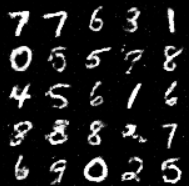
结果如图,效果还是不错的
声明:本文内容由网友自发贡献,不代表【wpsshop博客】立场,版权归原作者所有,本站不承担相应法律责任。如您发现有侵权的内容,请联系我们。转载请注明出处:https://www.wpsshop.cn/article/detail/41012?site
推荐阅读
相关标签

