
热门标签
当前位置: article > 正文
【Java数据结构】链表(Linked List)-双向链表_java双向链表数据结构
作者:程序自动化专家 | 2024-02-02 12:45:31
赞
踩
java双向链表数据结构
双向链表(Linked List)是一种常用的数据结构,它允许在所有节点中快速添加或删除元素,并且可以有效地实现反向遍历。本篇文章将介绍双向链表的基础知识,并提供使用Java语言实现该数据结构的示例代码。
一、双向链表的基础知识
一个双向链表由多个节点组成,每个节点包含两个指针,分别指向前驱节点和后继节点。首节点的前驱节点为null,尾节点的后继节点为null。
下面是一个示意图:
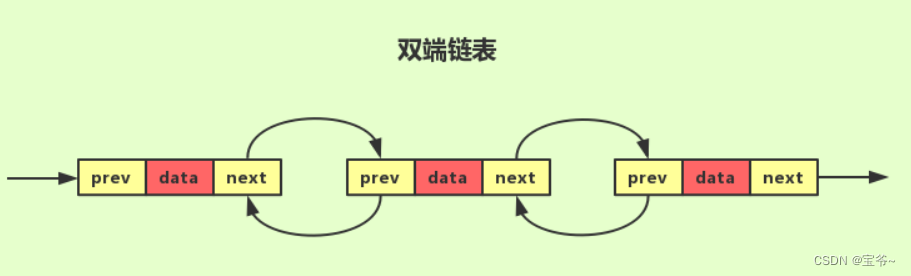
null <- A <-> B <-> C <-> D -> null
上述图中,A为首节点,D为尾节点。每个节点都有一个值域(value),这个值域可以存储任意类型的数据。在双向链表中,我们通常只需要保存首节点的引用,即可轻松访问整个链表。
二、双向链表的操作
- 添加节点
为了在链表中添加新节点,我们需要指定插入节点的位置。假设我们要在节点B之后插入一个新节点E,则需要进行以下操作:
- 创建一个新节点
E,并将其值域设置为目标元素。 - 将新节点
E的前驱指针指向节点B,将新节点E的后继指针指向节点C。 - 将节点
B的后继指针指向新节点E,将节点C的前驱指针指向新节点E。
下面是上述操作的示意图:
null <- A <-> B <-> E <-> C <-> D -> null- 删除节点
要从双向链表中删除节点,我们需要知道目标节点的位置。假设我们要删除节点C,则需要进行以下操作:
- 将节点
C的前驱节点(即节点B)的后继指针指向节点D。 - 将节点
D的前驱指针指向节点B。
下面是上述操作的示意图:
null <- A <-> B <-> E <-> D -> null- 遍历节点
由于双向链表中每个节点都有一个指向后继节点和前驱节点的引用,因此可以非常容易地实现正向和反向遍历。
下面是一个遍历链表并打印所有元素值的示例代码:
- public class DoublyLinkedList<T> {
- private Node<T> head;
- private Node<T> tail;
-
- private static class Node<T> {
- private T data;
- private Node<T> prev;
- private Node<T> next;
-
- public Node(T data) {
- this.data = data;
- this.prev = null;
- this.next = null;
- }
- }
-
- public void addFirst(T data) {
- Node<T> newNode = new Node<>(data);
- if (head == null) {
- head = newNode;
- tail = newNode;
- } else {
- head.prev = newNode;
- newNode.next = head;
- head = newNode;
- }
- }
-
- public void addLast(T data) {
- Node<T> newNode = new Node<>(data);
- if (tail == null) {
- head = newNode;
- tail = newNode;
- } else {
- tail.next = newNode;
- newNode.prev = tail;
- tail = newNode;
- }
- }
-
- public void removeFirst() {
- if (head == null) {
- throw new NoSuchElementException();
- } else if (head == tail) {
- head = null;
- tail = null;
- } else {
- head.next.prev = null;
- head = head.next;
- }
- }
-
- public void removeLast() {
- if (tail == null) {
- throw new NoSuchElementException();
- } else if (head == tail) {
- head = null;
- tail = null;
- } else {
- tail.prev.next = null;
- tail = tail.prev;
- }
- }
-
- /**
- *为了实现反向遍历,我们只需要替换current.next为current.prev,同时从尾节点开始遍历即可。
- */
- public void traverse() {
- Node<T> current = head;
- while (current != null) {
- System.out.print(current.data + " ");
- current = current.next;
- }
- System.out.println();
- }
- }

上述实现定义了一个 DoublyLinkedList 类,其中包含一个嵌套的 Node 类,用于表示双向链表中的节点。通过 addFirst 和 addLast 方法可以在链表的头部和尾部添加元素,通过 removeFirst 和 removeLast 方法可以删除链表中的第一个和最后一个元素。traverse方法用于遍历链表并打印所有元素值
声明:本文内容由网友自发贡献,不代表【wpsshop博客】立场,版权归原作者所有,本站不承担相应法律责任。如您发现有侵权的内容,请联系我们。转载请注明出处:https://www.wpsshop.cn/article/detail/55355
推荐阅读


相关标签

