
热门标签
热门文章
- 1云计算openstack私有云部分答案(自用)_【题目 5】数据库安装与调优[0.5 分] 在 controller 节点上使用 iaas-inst
- 2神经网络与深度学习——TensorFlow实践(十四)_池化层也称特征映射层,是一种上采样运算
- 3【vue3】 axios封装使用(js/ts)_ts import { getcfgmap } from "@/request/api.ts";
- 4UCON模型
- 5如何在本地设置www.xxx.com,使其允许访问
- 6反向传播及梯度检测_反向传播 cs_grad初始为0 后面所有梯度均为0了
- 7ts-node 的使用_yarn 安装 ts-node
- 8mac地址对应的厂商_苹果公司 mac地址段
- 9NeuDs 数据结构月考2_在二叉树的顺序存储结构中(根的下标为1),下标为130的结点一定处于左子树中
- 10vue路由的跳转方式_vue路由跳转
当前位置: article > 正文
matlab遗传算法工具箱的使用_maxstallgenerations
作者:pnstu | 2024-02-01 10:15:28
赞
踩
maxstallgenerations
前言:
1.官方文档里面有很多的实例和参数的说明
2.图形化操作之后可以自动生成代码
3.注意在程序里面要关掉打开的文件 fclose
内容提要
启用:

遗传算法:
在ga.m的文档中其实有很多例子
1.
 A = [1 1; -1 2; 2 1];  b = [2; 2; 3];  lb = zeros(2,1);
%    % Use mutation function which can handle constraints
    options = optimoptions('ga','MutationFcn',@mutationadaptfeasible);
    [x,fval,exitflag] = ga(@lincontest6,2,A,b,[],[],lb,[],[],options);
- 1
- 2
- 3
- 4
- 5
- 6
- 7
2.
  fun = @(x) (x(1) - 0.2)^2 + (x(2) - 1.7)^2 + (x(3) -5.1)^2;
 x = ga(fun,3,[],[],[],[],[],[],[],[2 3])
- 1
- 2
- 3
- 4
3.匿名函数
 x = ga(@(x) 3*sin(x(1))+exp(x(2)),2)
- 1
- 2
- 3
 4.官方文档
 function [x,fval,exitFlag,output,population,scores] = ga(fun,nvars,Aineq,bineq,Aeq,beq,lb,ub,nonlcon,intcon,options)
 function [解,适应度值,退出标志,输出,种群大小,得分]=ga(函数,解的维数,不等式的系数A,不等式的系数b,等式的系数A,等式的系数b)

%GA    Constrained optimization using genetic algorithm.
%   GA attempts to solve problems of the following forms:
%       min F(X)  subject to:  A*X  <= B, Aeq*X  = Beq (linear constraints)
%        X                     C(X) <= 0, Ceq(X) = 0 (nonlinear constraints)
%                              LB <= X <= UB
%                              X(i) integer, where i is in the index
%                              vector INTCON (integer constraints)
%
%   Note: If INTCON is not empty, then no equality constraints are allowed.
%   That is:-
%   * Aeq and Beq must be empty
%   * Ceq returned from NONLCON must be empty
%
%   X = GA(FITNESSFCN,NVARS) finds a local unconstrained minimum X to the
%   FITNESSFCN using GA. NVARS is the dimension (number of design
%   variables) of the FITNESSFCN. FITNESSFCN accepts a vector X of size
%   1-by-NVARS, and returns a scalar evaluated at X.
%
%   X = GA(FITNESSFCN,NVARS,A,b) finds a local minimum X to the function
%   FITNESSFCN, subject to the linear inequalities A*X <= B. Linear
%   constraints are not satisfied when the PopulationType option is set to
%   'bitString' or 'custom'. See the documentation for details.
%
%   X = GA(FITNESSFCN,NVARS,A,b,Aeq,beq) finds a local minimum X to the
%   function FITNESSFCN, subject to the linear equalities Aeq*X = beq as
%   well as A*X <= B. (Set A=[] and B=[] if no inequalities exist.) Linear
%   constraints are not satisfied when the PopulationType option is set to
%   'bitString' or 'custom'. See the documentation for details.
%
%   X = GA(FITNESSFCN,NVARS,A,b,Aeq,beq,lb,ub) defines a set of lower and
%   upper bounds on the design variables, X, so that a solution is found in
%   the range lb <= X <= ub. Use empty matrices for lb and ub if no bounds
%   exist. Set lb(i) = -Inf if X(i) is unbounded below;  set ub(i) = Inf if
%   X(i) is unbounded above. Linear constraints are not satisfied when the
%   PopulationType option is set to 'bitString' or 'custom'. See the
%   documentation for details.
%
%   X = GA(FITNESSFCN,NVARS,A,b,Aeq,beq,lb,ub,NONLCON) subjects the
%   minimization to the constraints defined in NONLCON. The function
%   NONLCON accepts X and returns the vectors C and Ceq, representing the
%   nonlinear inequalities and equalities respectively. GA minimizes
%   FITNESSFCN such that C(X)<=0 and Ceq(X)=0. (Set lb=[] and/or ub=[] if
%   no bounds exist.) Nonlinear constraints are not satisfied when the
%   PopulationType option is set to 'bitString' or 'custom'. See the
%   documentation for details.
%
%   X = GA(FITNESSFCN,NVARS,A,b,Aeq,beq,lb,ub,NONLCON,options) minimizes
%   with the default optimization parameters replaced by values in OPTIONS.
%   OPTIONS can be created with the OPTIMOPTIONS function. See OPTIMOPTIONS
%   for details. For a list of options accepted by GA refer to the
%   documentation.
%
%   X = GA(FITNESSFCN,NVARS,A,b,[],[],lb,ub,NONLCON,INTCON) requires that
%   the variables listed in INTCON take integer values. Note that GA does
%   not solve problems with integer and equality constraints. Pass empty
%   matrices for the Aeq and beq inputs if INTCON is not empty.
%
%   X = GA(FITNESSFCN,NVARS,A,b,[],[],lb,ub,NONLCON,INTCON,options)
%   minimizes with integer constraints and the default optimization
%   parameters replaced by values in OPTIONS. OPTIONS can be created with
%   the OPTIMOPTIONS function. See OPTIMOPTIONS for details.
%
%   X = GA(PROBLEM) finds the minimum for PROBLEM. PROBLEM is a structure
%   that has the following fields:
%       fitnessfcn: <Fitness function>
%            nvars: <Number of design variables>
%            Aineq: <A matrix for inequality constraints>
%            bineq: <b vector for inequality constraints>
%              Aeq: <Aeq matrix for equality constraints>
%              beq: <beq vector for equality constraints>
%               lb: <Lower bound on X>
%               ub: <Upper bound on X>
%          nonlcon: <Nonlinear constraint function>
%           intcon: <Index vector for integer variables>
%          options: <Options created with optimoptions('ga',...)>
%         rngstate: <State of the random number generator>
%
%   [X,FVAL] = GA(FITNESSFCN, ...) returns FVAL, the value of the fitness
%   function FITNESSFCN at the solution X.
%
%   [X,FVAL,EXITFLAG] = GA(FITNESSFCN, ...) returns EXITFLAG which
%   describes the exit condition of GA. Possible values of EXITFLAG and the
%   corresponding exit conditions are
%
%     1 Average change in value of the fitness function over
%        options.MaxStallGenerations generations less than
%        options.FunctionTolerance and constraint violation less than
%        options.ConstraintTolerance.
%     3 The value of the fitness function did not change in
%        options.MaxStallGenerations generations and constraint violation
%        less than options.ConstraintTolerance.
%     4 Magnitude of step smaller than machine precision and constraint
%        violation less than options.ConstraintTolerance. This exit
%        condition applies only to nonlinear constraints.
%     5 Fitness limit reached and constraint violation less than
%        options.ConstraintTolerance.
%     0 Maximum number of generations exceeded.
%    -1 Optimization terminated by the output or plot function.
%    -2 No feasible point found.
%    -4 Stall time limit exceeded.
%    -5 Time limit exceeded.
%
%   [X,FVAL,EXITFLAG,OUTPUT] = GA(FITNESSFCN, ...) returns a
%   structure OUTPUT with the following information:
%             rngstate: <State of the random number generator before GA started>
%          generations: <Total generations, excluding HybridFcn iterations>
%            funccount: <Total function evaluations>
%        maxconstraint: <Maximum constraint violation>, if any
%              message: <GA termination message>
%
%   [X,FVAL,EXITFLAG,OUTPUT,POPULATION] = GA(FITNESSFCN, ...) returns the
%   final POPULATION at termination.
%
%   [X,FVAL,EXITFLAG,OUTPUT,POPULATION,SCORES] = GA(FITNESSFCN, ...) returns
%   the SCORES of the final POPULATION.
%
%
%   Example:
%     Unconstrained minimization of 'rastriginsfcn' fitness function of
%     numberOfVariables = 2
%      x = ga(@rastriginsfcn,2)
%
%     Display plotting functions while GA minimizes
%      options = optimoptions('ga','PlotFcn',...
%        {@gaplotbestf,@gaplotbestindiv,@gaplotexpectation,@gaplotstopping});
%      [x,fval,exitflag,output] = ga(@rastriginsfcn,2,[],[],[],[],[],[],[],options)
%
%   An example with inequality constraints and lower bounds
%    A = [1 1; -1 2; 2 1];  b = [2; 2; 3];  lb = zeros(2,1);
%    % Use mutation function which can handle constraints
%    options = optimoptions('ga','MutationFcn',@mutationadaptfeasible);
%    [x,fval,exitflag] = ga(@lincontest6,2,A,b,[],[],lb,[],[],options);
%
%     FITNESSFCN can also be an anonymous function:
%        x = ga(@(x) 3*sin(x(1))+exp(x(2)),2)
%
%   If FITNESSFCN or NONLCON are parameterized, you can use anonymous
%   functions to capture the problem-dependent parameters. Suppose you want
%   to minimize the fitness given in the function myfit, subject to the
%   nonlinear constraint myconstr, where these two functions are
%   parameterized by their second argument a1 and a2, respectively. Here
%   myfit and myconstr are MATLAB file functions such as
%
%        function f = myfit(x,a1)
%        f = exp(x(1))*(4*x(1)^2 + 2*x(2)^2 + 4*x(1)*x(2) + 2*x(2) + a1);
%
%   and
%
%        function [c,ceq] = myconstr(x,a2)
%        c = [1.5 + x(1)*x(2) - x(1) - x(2);
%              -x(1)*x(2) - a2];
%        % No nonlinear equality constraints:
%         ceq = [];
%
%   To optimize for specific values of a1 and a2, first assign the values
%   to these two parameters. Then create two one-argument anonymous
%   functions that capture the values of a1 and a2, and call myfit and
%   myconstr with two arguments. Finally, pass these anonymous functions to
%   GA:
%
%     a1 = 1; a2 = 10; % define parameters first
%     % Mutation function for constrained minimization
%     options = optimoptions('ga','MutationFcn',@mutationadaptfeasible);
%     x = ga(@(x)myfit(x,a1),2,[],[],[],[],[],[],@(x)myconstr(x,a2),options)
%
%   Example: Solving a mixed-integer optimization problem
%   An example of optimizing a function where a subset of the variables are
%   required to be integers:
%
%   % Define the objective and call GA. Here variables x(2) and x(3) will
%   % be integer.
%   fun = @(x) (x(1) - 0.2)^2 + (x(2) - 1.7)^2 + (x(3) -5.1)^2;
%   x = ga(fun,3,[],[],[],[],[],[],[],[2 3])
%
%   See also OPTIMOPTIONS, FITNESSFUNCTION, GAOUTPUTFCNTEMPLATE, PATTERNSEARCH, @.

%   Copyright 2003-2015 The MathWorks, Inc.

% If the first arg is not a gaoptimset, then it's a fitness function followed by a genome
% length. Here we make a gaoptimset from the args.

- 1
- 2
- 3
- 4
- 5
- 6
- 7
- 8
- 9
- 10
- 11
- 12
- 13
- 14
- 15
- 16
- 17
- 18
- 19
- 20
- 21
- 22
- 23
- 24
- 25
- 26
- 27
- 28
- 29
- 30
- 31
- 32
- 33
- 34
- 35
- 36
- 37
- 38
- 39
- 40
- 41
- 42
- 43
- 44
- 45
- 46
- 47
- 48
- 49
- 50
- 51
- 52
- 53
- 54
- 55
- 56
- 57
- 58
- 59
- 60
- 61
- 62
- 63
- 64
- 65
- 66
- 67
- 68
- 69
- 70
- 71
- 72
- 73
- 74
- 75
- 76
- 77
- 78
- 79
- 80
- 81
- 82
- 83
- 84
- 85
- 86
- 87
- 88
- 89
- 90
- 91
- 92
- 93
- 94
- 95
- 96
- 97
- 98
- 99
- 100
- 101
- 102
- 103
- 104
- 105
- 106
- 107
- 108
- 109
- 110
- 111
- 112
- 113
- 114
- 115
- 116
- 117
- 118
- 119
- 120
- 121
- 122
- 123
- 124
- 125
- 126
- 127
- 128
- 129
- 130
- 131
- 132
- 133
- 134
- 135
- 136
- 137
- 138
- 139
- 140
- 141
- 142
- 143
- 144
- 145
- 146
- 147
- 148
- 149
- 150
- 151
- 152
- 153
- 154
- 155
- 156
- 157
- 158
- 159
- 160
- 161
- 162
- 163
- 164
- 165
- 166
- 167
- 168
- 169
- 170
- 171
- 172
- 173
- 174
- 175
- 176
- 177
- 178
- 179
- 180
- 181
- 182
- 183
- 184
- 185
遗传算法的调用方式和参数的说明
可以这样查看默认参数的值
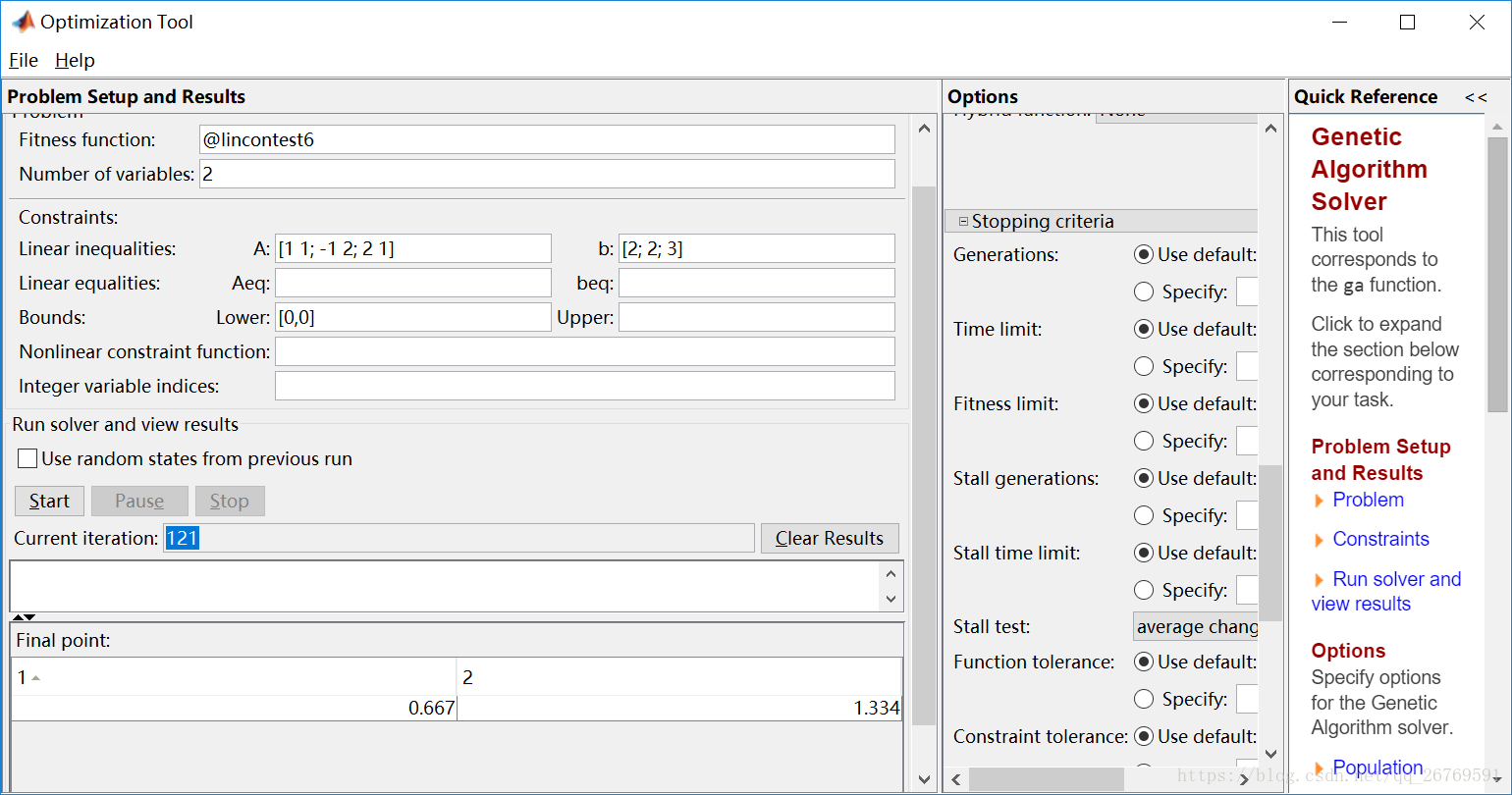
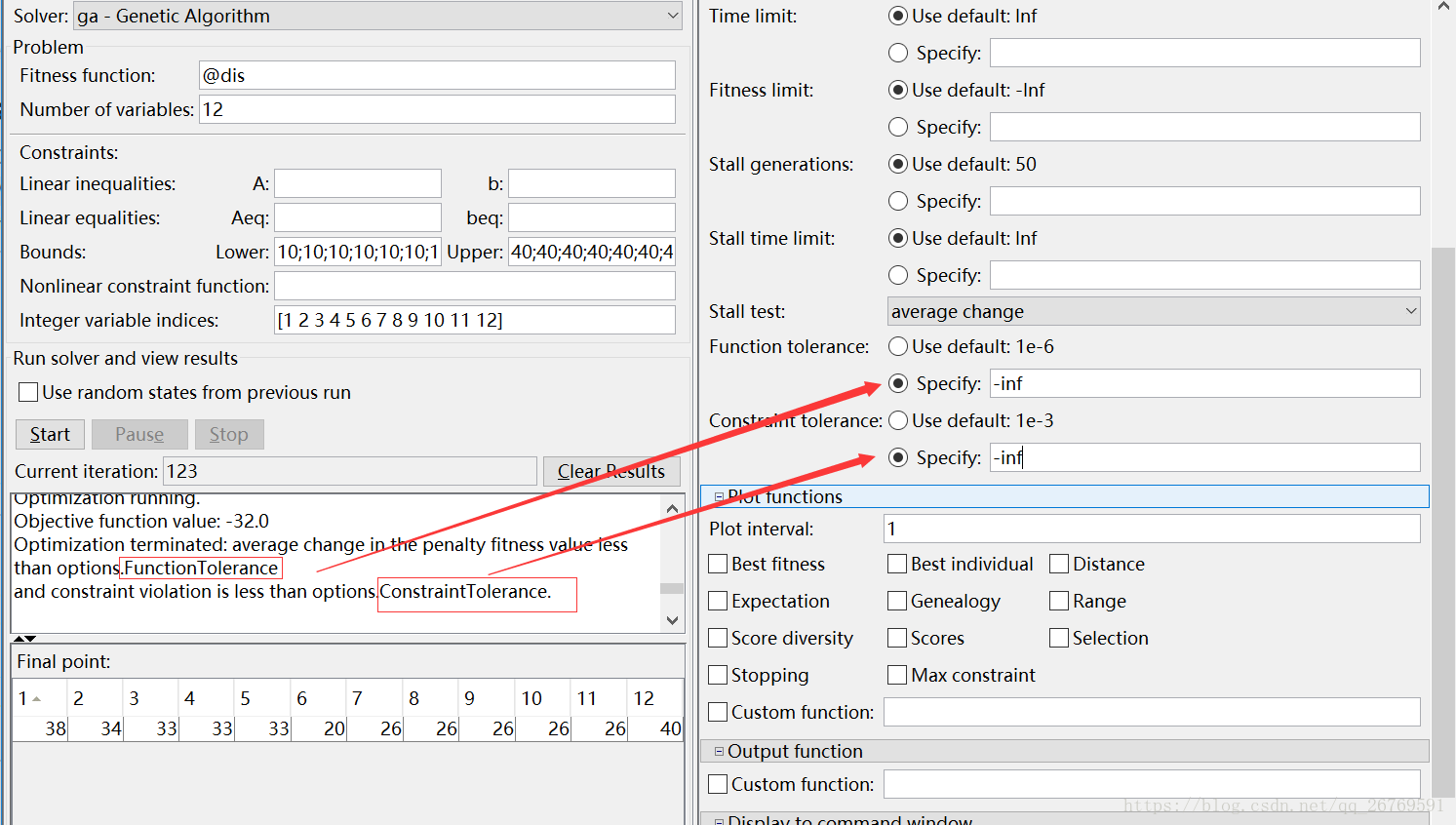
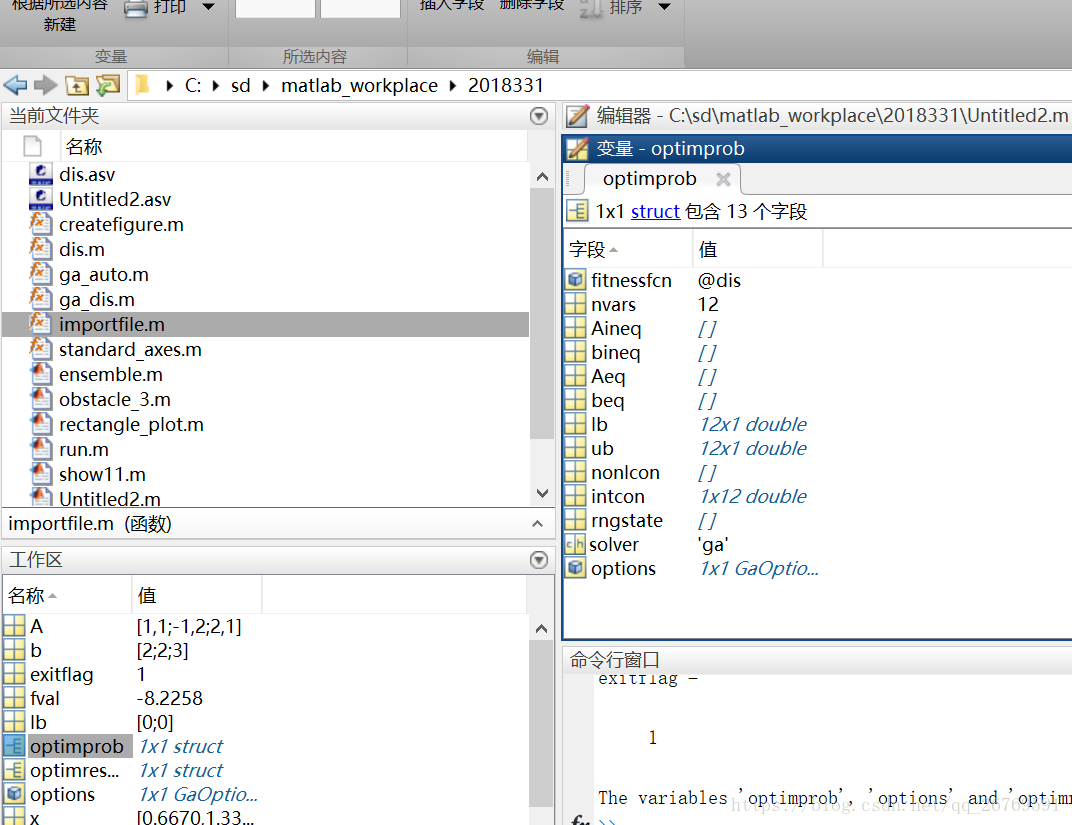
A = [1 1; -1 2; 2 1];
b = [2; 2; 3];  lb = zeros(2,1);
[x,fval,exitflag] = ga(@lincontest6,2,A,b,[],[],lb)
注意顺序决定传值
- 1
- 2
- 3
- 4
遗传算法简单的几个测试用例
遗传算法测试用例
1.分段函数测试
%分段函数测试 ok
function y=ga_f_test(x)
y=0;
if x>1
    y=y+x;
else
    y=y+2*y;
end
end


2.关于解的测试,我觉得解应该只能是一维的

2.
A = [1 1; -1 2; 2 1];
b = [2; 2; 3];
lb = zeros(2,1);
[x,fval,exitflag] = ga(@lincontest6,2,A,b,[],[],lb)
%lb表示x的下界,up表示上界
 Optimization terminated:
 average change in the fitness value less than
 options.TolFun.
 x =     0.7794   1.2205
 fval =-8.03916    exitflag =
- 1
- 2
- 3
- 4
- 5
- 6
- 7
- 8
- 9
- 10
- 11
- 12
- 13
- 14
- 15
- 16
- 17
- 18
- 19
- 20
- 21
- 22
- 23
- 24
- 25
- 26
谈谈我使用遗传算法过程中的一些坑
1.遗传算法只能生成一维的向量做为解 所以参数栏只会让你输入一个个数
2.那些参数的意义 可以见上面的
3.遗传算法适合各各样的问题,不论你的函数里面是分段的还是提前退出的,可以使用return 但是要注意的是退出的时候最好是个一个较大的随机值,而不是一个固定的值,否则最后会认为解基本上没有变化,然后就终止掉了
        if x(i)==x(j)  %一旦发现重复的值 给他一个很大的值然后马上退出
          distance=randi(1000)*100000 ;
- 1
- 2
4.对于这种离散的点,其实可以先给点编号,然后随机生成1-6之间的数,再根据序号进行读值,这样可提高效率,保证有解
5.如何控制不生成重复的解目前还只能通过自己的程序进行控制
%控制一下不能有重复的值
for i=1:Number_of_trash
    for j=i+1:Number_of_trash
        if x(i)==x(j)  %一旦发现重复的值 给他一个很大的值然后马上退出
          distance=randi(1000)*100000 ;
         return ;
        end
    end

end
- 1
- 2
- 3
- 4
- 5
- 6
- 7
- 8
- 9
- 10
- 11
- 12
最后贴上自己的完整的代码
dis2
function distance=dis2(x)
%准备数据
%x=[1 2 3 4 5 6];
input = importfile('input.txt');
Num_of_obstacle=input{3:3,{'VarName1'}};
trash=zeros(1,3);
Number_of_trash=input{3+Num_of_obstacle+1:3+Num_of_obstacle+1,{'VarName1'}};
for i=1:Number_of_trash
    trash_temp=input{3+Num_of_obstacle+1+i:3+Num_of_obstacle+1+i,{'VarName1','VarName2','VarName3'}};
    trash(:,:,i)= trash_temp;
    w(i)=trash_temp(1,3);
end
%把垃圾读进来
robot=input{2:2,{'VarName1','VarName2','VarName3','VarName4'}};
garbage=input{3+Num_of_obstacle+Number_of_trash+2:3+Num_of_obstacle+Number_of_trash+2,{'VarName1','VarName2'}};
w_temp=0;
weight=5;
distance=0;


%控制一下不能有重复的值
for i=1:Number_of_trash
    for j=i+1:Number_of_trash
        if x(i)==x(j)  %一旦发现重复的值 给他一个很大的值然后马上退出
          distance=randi(1000)*100000 ;
         return ;
        end
    end

end


for i=1:Number_of_trash
   %每到达一个点 首先计算距离和权重
   w_temp=w_temp+ trash(1,3,x(i));
   %若没有超重
    if w_temp<weight
        if i==1
           distance=abs(trash(1,1,x(i))-robot(1,1))+abs(trash(1,2,x(i))-robot(1,2))+distance;
        else if i==Number_of_trash
           distance=abs(trash(1,1,x(i))-garbage(1,1))+abs(trash(1,2,x(i))-garbage(1,2))+distance;
            else if i<Number_of_trash&&i>1
                  distance=distance+abs(trash(1,1,x(i))-trash(1,2,x(i-1)))+abs(trash(1,1,x(i))-trash(1,1,x(i-1)));
                end  %i<Number_of_trash&&i>1
            end  %i==Number_of_trash
        end  %i==1
    else  %若是超重
       %先把之前的放下,只计算当前一个的重量
       w_temp=0;
       w_temp=w_temp+ trash(1,3,x(i));
       %这里默认第一个永远都不是超重的 所以就不会陷入死循环
       %距离=到达的距离+扔垃圾的距离
       if i>1
       distance=abs(trash(1,1,x(i-1))-garbage(1,1))+abs(trash(1,2,x(i))-garbage(1,2))+abs(trash(1,1,x(i))-garbage(1,1))+abs(trash(1,2,x(i))-garbage(1,2))+distance;
       else   %第一个垃圾就大于 weight 直接退出  一般情况下这是不可能存在的
        distance=inf;
        return
       end
       end

end
- 1
- 2
- 3
- 4
- 5
- 6
- 7
- 8
- 9
- 10
- 11
- 12
- 13
- 14
- 15
- 16
- 17
- 18
- 19
- 20
- 21
- 22
- 23
- 24
- 25
- 26
- 27
- 28
- 29
- 30
- 31
- 32
- 33
- 34
- 35
- 36
- 37
- 38
- 39
- 40
- 41
- 42
- 43
- 44
- 45
- 46
- 47
- 48
- 49
- 50
- 51
- 52
- 53
- 54
- 55
- 56
- 57
- 58
- 59
- 60
- 61
- 62
- 63
- 64
- 65
- 66
ga_dis2
function [x,fval,exitflag,output,population,score] = ga_dis2()
%% This is an auto generated MATLAB file from Optimization Tool.
nvars=6;
lb=[1 1 1 1 1 1];
ub=[6 6 6 6 6 6];
intcon=[1 2 3 4 5 6];
FunctionTolerance_Data=1e-6;
ConstraintTolerance_Data=1e-3;
%% Start with the default options
options = optimoptions('ga');
%% Modify options setting
options = optimoptions(options,'FunctionTolerance', FunctionTolerance_Data);
options = optimoptions(options,'ConstraintTolerance', ConstraintTolerance_Data);
options = optimoptions(options,'Display', 'off');
[x,fval,exitflag,output,population,score] = ...
ga(@dis2,nvars,[],[],[],[],lb,ub,[],intcon,options);
- 1
- 2
- 3
- 4
- 5
- 6
- 7
- 8
- 9
- 10
- 11
- 12
- 13
- 14
- 15
- 16
- 17
声明:本文内容由网友自发贡献,不代表【wpsshop博客】立场,版权归原作者所有,本站不承担相应法律责任。如您发现有侵权的内容,请联系我们。转载请注明出处:https://www.wpsshop.cn/article/detail/53177
推荐阅读
相关标签

