- 1JavaScript学习(基础)_课程 javascript基础
- 2Ubuntu22.04.01Desktop桌面版安装记录221109_hwclock: use the --verbose option to see the detai
- 3python怎样给对象赋值_python 对象/变量&赋值的几点思考
- 4如何升级到 Docker Compose v2_docker-compose 版本过低,请升级至v2+!
- 5python 数字人视频生成_python的数字人面部表情视频
- 6The authentication type 10 is not supported_the authentication type 10 is not supported. check
- 7分布式消息通知----Kafka集群部署_kafka分布式部署
- 8unity配置.asset文件_unity .asset
- 9使用QT实现点餐ui界面_qt点餐系统
- 10pyqt5界面的布局与资源文件的载入_pyqt5布局文件
【Java新特性学习 二】JDK8: 语言新特性之Lambda表达式、函数式接口、接口的默认方法和静态方法_java: -source 1.5 中不支持 lambda 表达式
赞
踩
本篇Blog开始学习和实践Java8中的新特性,主要分为两大部分:语言新特性和库函数新特性,重点落在工作中经常会用到的几个重大特性:
- 语言新特性:Lambda表达式和函数式接口,接口的默认方法和静态方法,方法引用
- 库函数新特性:Optional,Streams,Date/Time API(JSR 310),Base64,并行数组
接下来按照如下几个结构分别介绍和学习以上知识点:基本概念,解决问题,语法范式,实践操作,我发现虽然经常听到函数式编程这样的名词,但是好像从来不知道具体是什么,所以这次一并了解下函数式编程的概念。
函数式编程
什么是函数式编程?函数式编程是一种编程范式,除了函数式编程之外还有 命令式编程,声明式编程 等编程范式
- 命令式编程:命令式编程 是面向计算机硬件的抽象,有变量、赋值语句、表达式、控制语句等,可以理解为 命令式编程就是冯诺伊曼的指令序列。 它的主要思想是关注计算机执行的步骤,即一步一步告诉计算机先做什么再做什么,其实就是代码脚本段
- 声明式编程:声明式编程 是以数据结构的形式来表达程序执行的逻辑。它的主要思想是告诉计算机应该做什么,但不指定具体要怎么做。SQL 语句就是最明显的一种声明式编程的例子,
SELECT * FROM collection WHERE num > 5,其实就是表达式结果。它不需要创建变量用来存储数据,它也不包含循环控制的代码如 for, while - 函数式编程:函数式编程和声明式编程是有所关联的,因为他们思想是一致的:即只关注做什么而不是怎么做。但函数式编程不仅仅局限于声明式编程。
函数式编程的本质就是:函数式编程中的函数不是指计算机中的函数,而是指数学中的函数,即自变量的映射。函数的值取决于函数的参数的值,不依赖于其他状态,比如abs(x)函数计算x的绝对值,只要x不变,无论何时调用、调用次数,最终的值都是一样
函数式编程特点
函数式编程有两个特点:函数是第一等公民,函数是纯函数
- 函数是第一等公民:是指函数跟其它的数据类型一样处于平等地位,可以赋值给其他变量,可以作为参数传入另一个函数,也可以作为别的函数的返回值
// 赋值
var func1 = function func1() {  }
// 函数作为参数
function func2(fn) {
    fn()
}
// 函数作为返回值
function func3() {
    return function() {}
}
- 1
- 2
- 3
- 4
- 5
- 6
- 7
- 8
- 9
- 10
- 函数是纯函数:纯函数是指相同的输入总会得到相同的输出,并且不会产生副作用的函数。纯函数的两个特点:相同的输入必有同输出,函数无副作用
这两个特点的示例如下:
// 是纯函数
function sum(x,y){
    return x + y
}
// 输出不确定,不是纯函数
function random(x){
    return Math.random() * x
}
// 有副作用,不是纯函数
function setFontSize(el,fontsize){
    el.style.fontsize = fontsize ;
}
// 输出不确定、有副作用,不是纯函数
let count = 0;
function addCount(x){
    count+=x;
    return count;
}

- 1
- 2
- 3
- 4
- 5
- 6
- 7
- 8
- 9
- 10
- 11
- 12
- 13
- 14
- 15
- 16
- 17
- 18
函数式编程优劣
综合来理解就是函数式编程,不变、不变、不变,固定的输入产生固定的输出且对外部没有任何影响,那么好处显而易见,所有的操作都是幂等的:
- 更好的管理状态:因为它的宗旨是无状态,或者说更少的状态,能最大化的减少这些未知、优化代码、减少出错情况
- 更简单的复用:固定输入->固定输出,没有其他外部变量影响,并且无副作用。这样代码复用时,完全不需要考虑它的内部实现和外部影响
- 更优雅的组合:往大的说,网页是由各个组件组成的。往小的说,一个函数也可能是由多个小函数组成的。更强的复用性,带来更强大的组合性
- 隐性好处。减少代码量,提高维护性
缺点也就是命令式编程可以发挥作用的:
- 性能差:函数式编程相对于指令式编程,性能绝对是一个短板,因为它往往会对一个方法进行过度包装,从而产生上下文切换的性能开销
- 资源占用:为了实现对象状态的不可变,往往会创建新的对象,因此,它对垃圾回收所产生的压力远远超过其他编程方式
- 递归陷阱:在函数式编程中,为了实现迭代,通常会采用递归操作
大致了解了函数式编程后再来看看Java是如何使用Lambda表达式来应用函数式编程这一理念的。
函数式接口
Lambda的设计者们为了让现有的功能与Lambda表达式良好兼容,考虑了很多方法,于是产生了函数接口这个概念。函数接口指的是只有一个函数的接口,这样的接口可以隐式转换为Lambda表达式。java.lang.Runnable和java.util.concurrent.Callable是函数式接口的最佳例子。在实践中,函数式接口非常脆弱:只要某个开发者在该接口中添加一个函数,则该接口就不再是函数式接口进而导致编译失败。为了克服这种代码层面的脆弱性,并显式说明某个接口是函数式接口,Java 8 提供了一个特殊的注解@FunctionalInterface(Java 库中的所有相关接口都已经带有这个注解了),举个简单的函数式接口的定义:
@FunctionalInterface
public interface Functional {
    void method();
}
- 1
- 2
- 3
- 4
不过有一点需要注意,默认方法和静态方法不会破坏函数式接口的定义,因此如下的代码是合法的。
@FunctionalInterface
public interface FunctionalDefaultMethods {
    void method();

    default void defaultMethod() {
    }
}
- 1
- 2
- 3
- 4
- 5
- 6
- 7
常见的函数式接口如下:
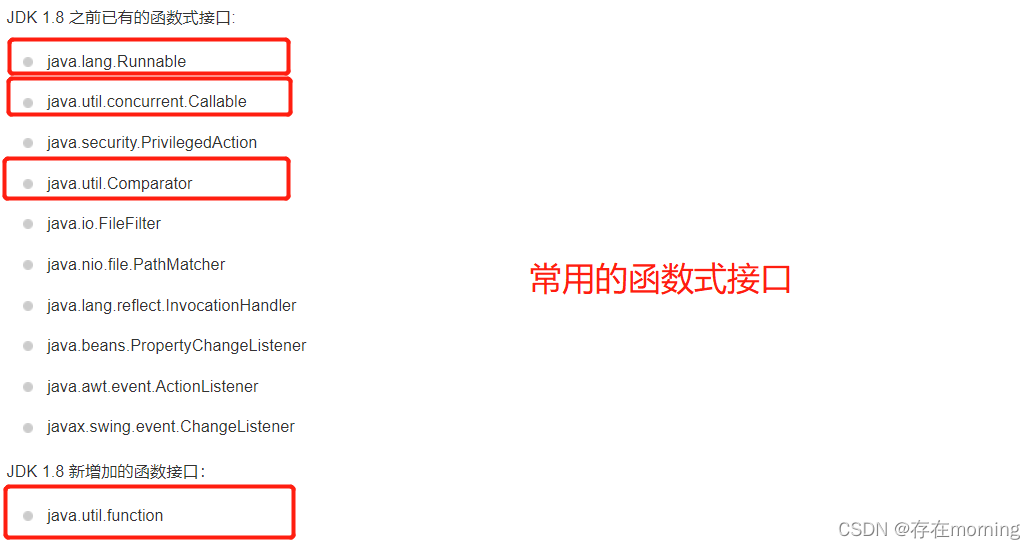
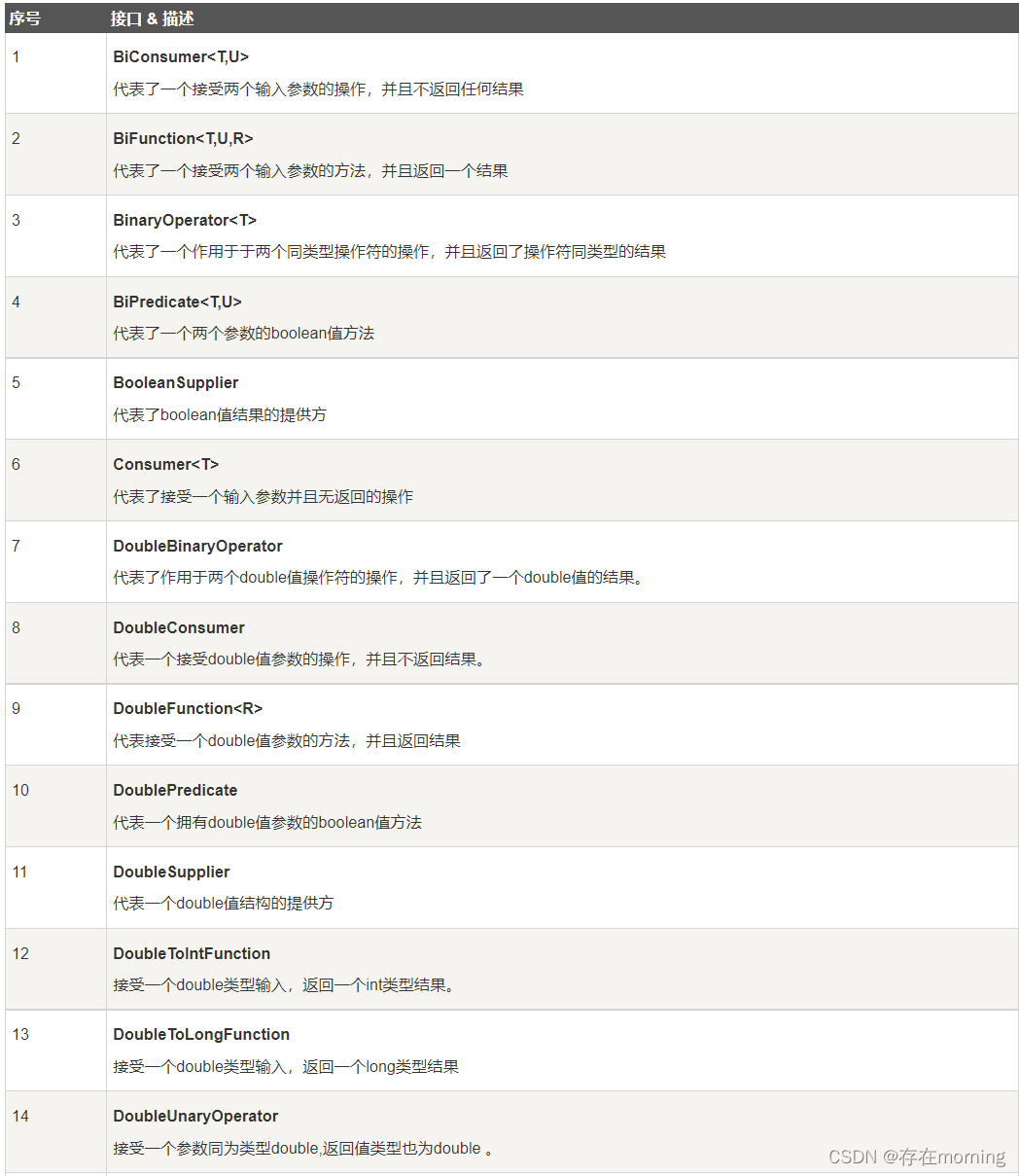
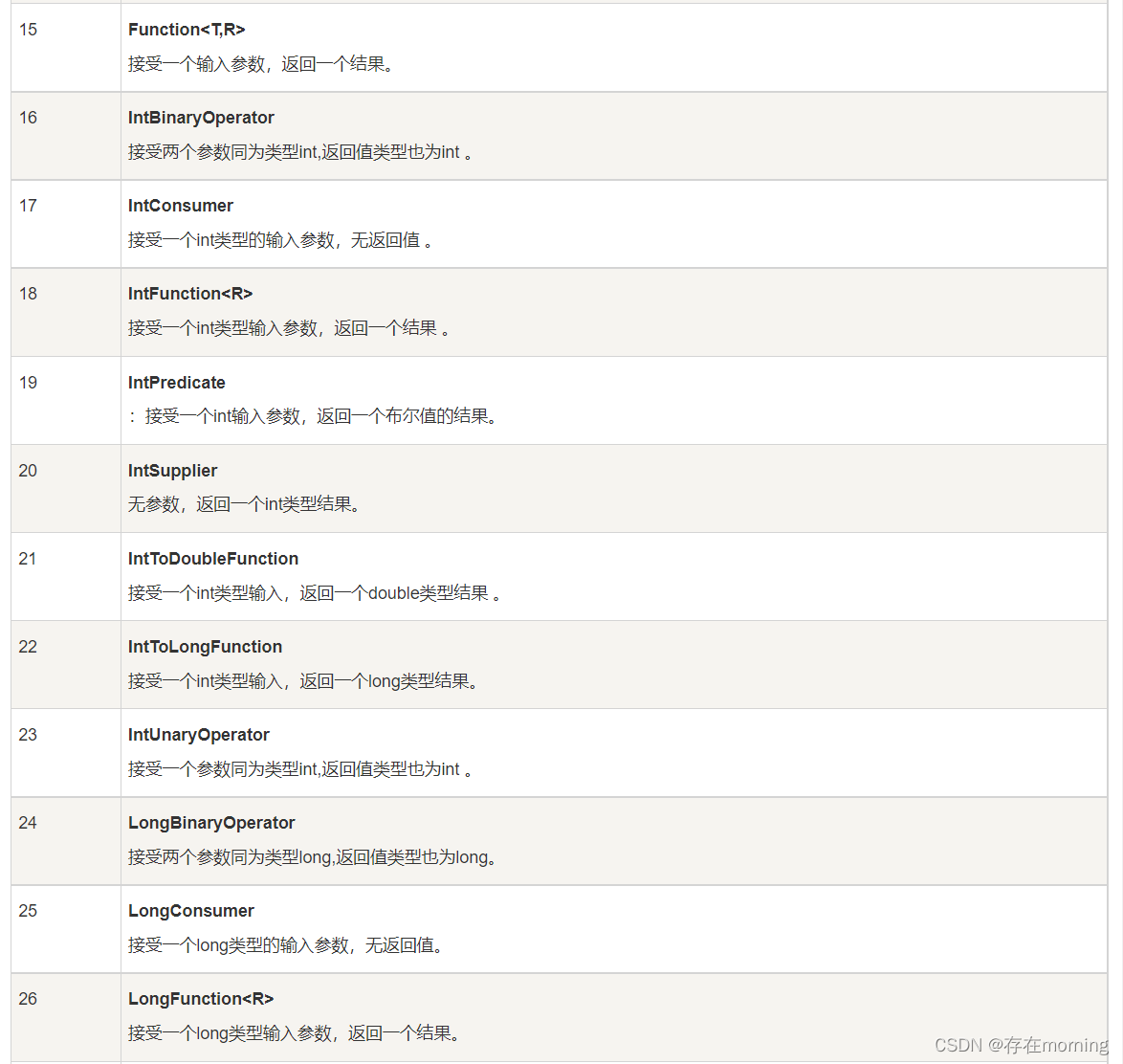
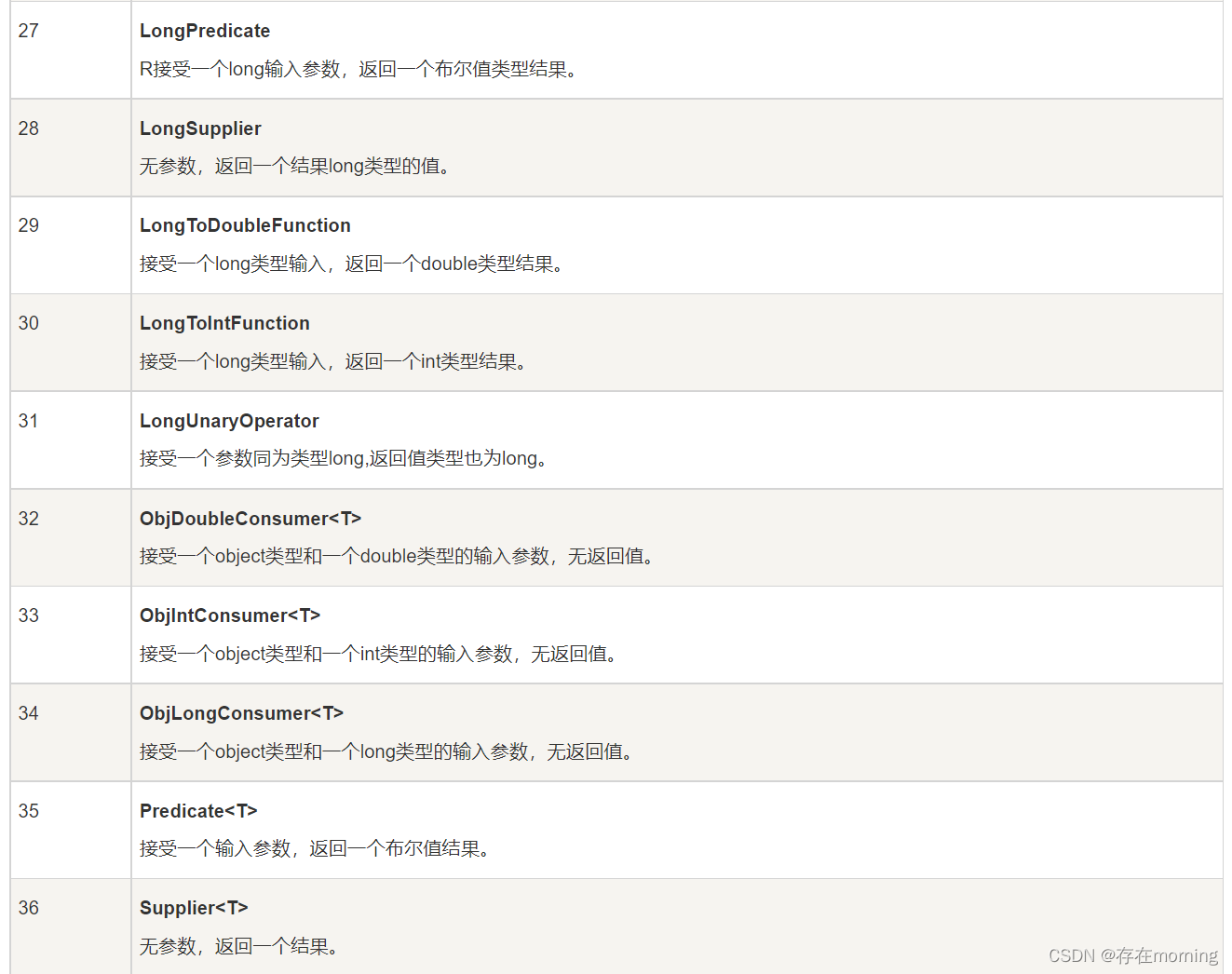
java.util.function 它包含了很多类,用来支持 Java的 函数式编程,该包中的函数式接口有:
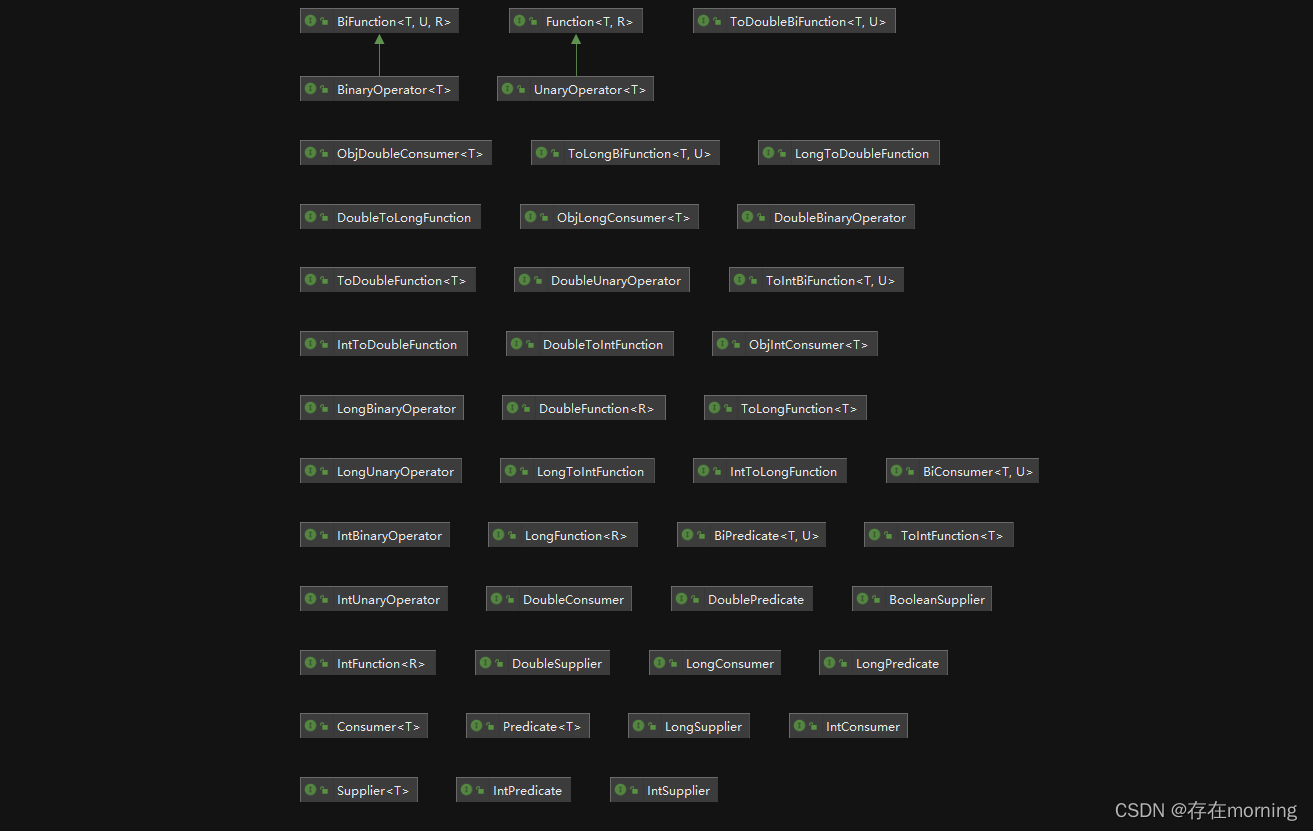
方法释义如下:
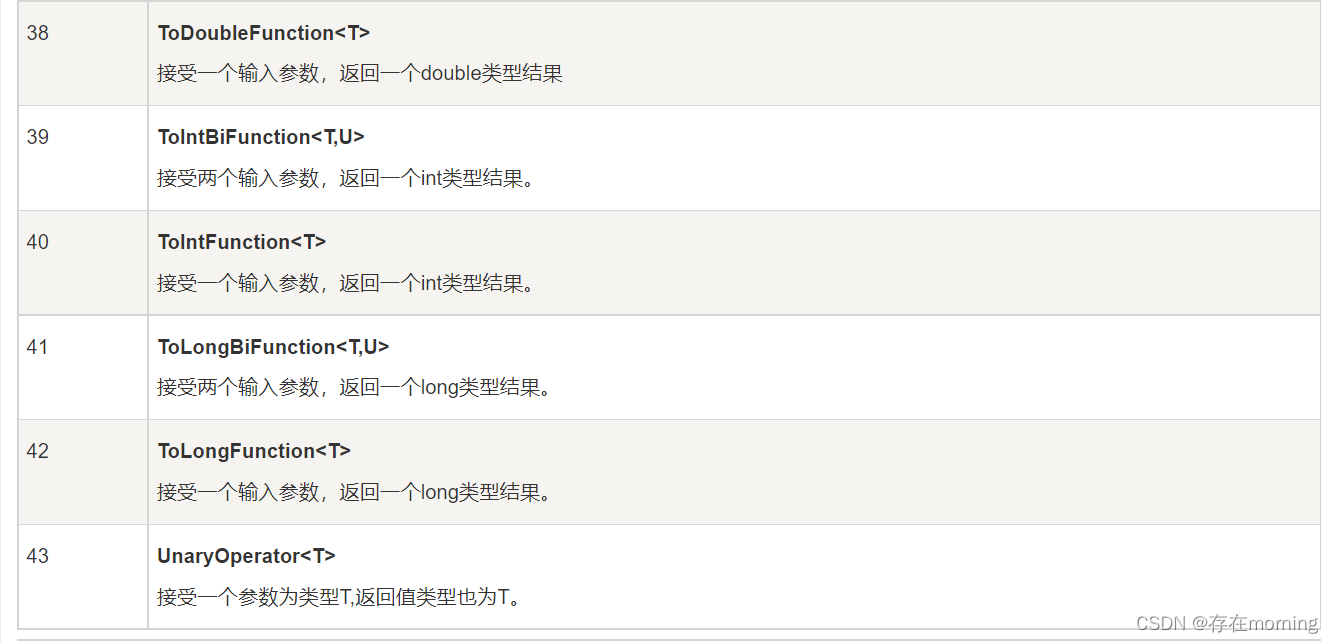
接口的默认方法和静态方法
我们上文说到,函数式接口只能有一个功能函数,但是默认方法和静态方法除外,那么什么是默认方法和静态方法呢?Java 8使用两个新概念扩展了接口的含义:默认方法和静态方法。
接口的默认方法
默认方法使得开发者可以在不破坏二进制兼容性的前提下,往现存接口中添加新的方法**,即不强制那些实现了该接口的类也同时实现这个新加的方法**。
默认方法和抽象方法之间的区别在于抽象方法需要实现,而默认方法不需要。接口提供的默认方法会被接口的实现类继承或者覆写,例子代码如下
private interface Defaulable {
    // Interfaces now allow default methods, the implementer may or
    // may not implement (override) them.
    default String notRequired() {
        return "Default implementation";
    }
}

private static class DefaultableImpl implements Defaulable {
}

private static class OverridableImpl implements Defaulable {
    @Override
    public String notRequired() {
        return "Overridden implementation";
    }
}
- 1
- 2
- 3
- 4
- 5
- 6
- 7
- 8
- 9
- 10
- 11
- 12
- 13
- 14
- 15
- 16
- 17
Defaulable接口使用关键字default定义了一个默认方法notRequired()。DefaultableImpl类实现了这个接口,同时默认继承了这个接口中的默认方法;OverridableImpl类也实现了这个接口,但覆写了该接口的默认方法,并提供了一个不同的实现
接口的静态方法
Java 8也允许在接口中定义静态方法
private interface DefaulableFactory {
    // Interfaces now allow static methods
    static Defaulable create( Supplier< Defaulable > supplier ) {
        return supplier.get();
    }
}
- 1
- 2
- 3
- 4
- 5
- 6
默认方法和静态方法应用
下面的代码片段整合了默认方法和静态方法的使用场景:
public static void main( String[] args ) {
    Defaulable defaulable = DefaulableFactory.create( DefaultableImpl::new );
    System.out.println( defaulable.notRequired() );

    defaulable = DefaulableFactory.create( OverridableImpl::new );
    System.out.println( defaulable.notRequired() );
}
- 1
- 2
- 3
- 4
- 5
- 6
- 7
输出结果如下:
Default implementation
Overridden implementation
- 1
- 2
由于JVM上的默认方法的实现在字节码层面提供了支持,因此效率非常高。默认方法允许在不打破现有继承体系的基础上改进接口。该特性在官方库中的应用是:给java.util.Collection接口添加新方法,如stream()、parallelStream()、forEach()和removeIf()等等
Lambda表达式
Lambda 表达式,也可称为闭包,它是推动 Java 8 发布的最重要新特性,Lambda 允许把函数作为一个方法的参数(函数作为参数传递进方法中),使用 Lambda 表达式可以使代码变的更加简洁紧凑
解决问题
核心解决的问题就是:让程序员使用更少的代码实现同样的功能。虽然看着很先进,其实Lambda表达式的本质只是一个语法糖,由编译器推断并帮你转换包装为常规的代码,因此你可以使用更少的代码来实现同样的功能
语法范式
lambda表达式允许通过表达式来代替功能接口。lambda表达式就和方法一样,它提供了一个正常的参数列表和一个使用这些参数的主体【body可以是一个表达式或一个代码块】
左侧:Lambda表达式的参数列表 -> 右侧:Lambda表达式中要执行的功能
- 1
右侧实现可以是表达式,也可以是代码块
(parameters) -> expression
或
(parameters) ->{ statements; }
- 1
- 2
- 3
对于左侧的参数列表而言:
- 可选参数个数:参数可以没有,也可以只有一个或多个。
- 可选参数类型声明:不需要声明参数类型,编译器可以统一识别参数值
- 可选参数圆括号:一个参数无需定义圆括号,但多个参数需要定义圆括号
对于右侧功能实现来说
- 可选返回主体:如果返回主体是表达式,那么编译器自动返回表达式值,如果主体是单行语句,那么返回类型可以看做void,如果主体是代码块,需要用return关键字指定返回值
- 可选返回关键字:如上所述,如果主体是代码块,需要用return关键字指定返回值
- 可选大括号:如果主体只包含单行语句(表达式),就不需要使用大括号,如果主体是多行代码块,需要使用大括号
对于右侧功能,总结而言:单行语句或表达式,可以省略return关键字和{},几个简单的例子:
// 1. 不需要参数,返回值为 5
() -> 5

// 2. 接收一个参数(数字类型),返回其2倍的值
x -> 2 * x

// 3. 接受2个参数(数字),并返回他们的差值
(x, y) -> x – y

// 4. 接收2个int型整数,返回他们的和
(int x, int y) -> x + y

// 5. 接受一个 string 对象,并在控制台打印,不返回任何值(看起来像是返回void)
(String s) -> System.out.print(s)
- 1
- 2
- 3
- 4
- 5
- 6
- 7
- 8
- 9
- 10
- 11
- 12
- 13
- 14
实践操作
既然一个新的事物出现,一定有其原因,也就是之前一定有痛点,那么新事物才有价值,这里只列举当前我看到的Lambda解决的问题
1 快速处理集合
我们一般在一些集合操作时使用Lambda表达式,没有lambda之前:
 public static void main(String[] args) {
        List<String> list = Arrays.asList("t", "m", "l");
        for (String s : list) {
            System.out.println(s);
        }
    }
- 1
- 2
- 3
- 4
- 5
- 6
有了lambda之后,只需要一行代码,将参数和功能组合成一个入参。
Arrays.asList( "t", "m", "l" ).forEach(e -> System.out.println( e ) );
- 1
为什么这里可以使用lambda呢,因为这里的forEach的入参是一个功能接口:
   default void forEach(Consumer<? super T> action) {
        Objects.requireNonNull(action);
        for (T t : this) {
            action.accept(t);
        }
    }
- 1
- 2
- 3
- 4
- 5
- 6
再进去一步:
package java.util.function;

import java.util.Objects;

/**
 * Represents an operation that accepts a single input argument and returns no
 * result. Unlike most other functional interfaces, {@code Consumer} is expected
 * to operate via side-effects.
 *
 * <p>This is a <a href="package-summary.html">functional interface</a>
 * whose functional method is {@link #accept(Object)}.
 *
 * @param <T> the type of the input to the operation
 *
 * @since 1.8
 */
@FunctionalInterface
public interface Consumer<T> {

    /**
     * Performs this operation on the given argument.
     *
     * @param t the input argument
     */
    void accept(T t);

    /**
     * Returns a composed {@code Consumer} that performs, in sequence, this
     * operation followed by the {@code after} operation. If performing either
     * operation throws an exception, it is relayed to the caller of the
     * composed operation.  If performing this operation throws an exception,
     * the {@code after} operation will not be performed.
     *
     * @param after the operation to perform after this operation
     * @return a composed {@code Consumer} that performs in sequence this
     * operation followed by the {@code after} operation
     * @throws NullPointerException if {@code after} is null
     */
    default Consumer<T> andThen(Consumer<? super T> after) {
        Objects.requireNonNull(after);
        return (T t) -> { accept(t); after.accept(t); };
    }
}
- 1
- 2
- 3
- 4
- 5
- 6
- 7
- 8
- 9
- 10
- 11
- 12
- 13
- 14
- 15
- 16
- 17
- 18
- 19
- 20
- 21
- 22
- 23
- 24
- 25
- 26
- 27
- 28
- 29
- 30
- 31
- 32
- 33
- 34
- 35
- 36
- 37
- 38
- 39
- 40
- 41
- 42
- 43
- 44
如同上面说的理论能力,上面这个代码中的参数e的类型是由编译器推理得出的,e也可以自定义类型:
Arrays.asList( "t", "m", "l" ).forEach( ( String e ) -> System.out.println( e ) );
- 1
如果Lambda表达式需要更复杂的语句块,则可以使用花括号将该语句块括起来,类似于Java中的函数体:
    public static void main(String[] args) {
        Arrays.asList("t", "m", "l").forEach((String e) ->
                {
                    String a = e + "帅";
                    System.out.println(a);
                }
        );
    }
- 1
- 2
- 3
- 4
- 5
- 6
- 7
- 8
2 取代匿名内部类
关于内部类可以看我的这篇Blog【Java SE基础 九】Java内部类,所谓匿名内部类就是:匿名内部类是直接使用 new 来生成一个对象的引用,匿名内部类没有类的名称,很多场景下可以简化我们代码,但是Lambda出现后告诉我们可以更简化:它只聚焦于核心实现:
public class Demo01Inner {
    public static void main(String[] args) {
        //使用匿名内部类的方式实现多线程。
        new Thread(new Runnable() {
            @Override
            public void run() {
                System.out.println(Thread.currentThread().getName() + "执行了");
            }
        }).start();

        //使用Lambda表达式实现多线程
        new Thread(() -> System.out.println(Thread.currentThread().getName() + "执行了")).start();
    }
}
- 1
- 2
- 3
- 4
- 5
- 6
- 7
- 8
- 9
- 10
- 11
- 12
- 13
- 14
同样为什么这里可以使用lambda呢:
  public Thread(Runnable target) {
        init(null, target, "Thread-" + nextThreadNum(), 0);
    }
- 1
- 2
- 3
再进去一步:
package java.lang;

/**
 * The <code>Runnable</code> interface should be implemented by any
 * class whose instances are intended to be executed by a thread. The
 * class must define a method of no arguments called <code>run</code>.
 * <p>
 * This interface is designed to provide a common protocol for objects that
 * wish to execute code while they are active. For example,
 * <code>Runnable</code> is implemented by class <code>Thread</code>.
 * Being active simply means that a thread has been started and has not
 * yet been stopped.
 * <p>
 * In addition, <code>Runnable</code> provides the means for a class to be
 * active while not subclassing <code>Thread</code>. A class that implements
 * <code>Runnable</code> can run without subclassing <code>Thread</code>
 * by instantiating a <code>Thread</code> instance and passing itself in
 * as the target.  In most cases, the <code>Runnable</code> interface should
 * be used if you are only planning to override the <code>run()</code>
 * method and no other <code>Thread</code> methods.
 * This is important because classes should not be subclassed
 * unless the programmer intends on modifying or enhancing the fundamental
 * behavior of the class.
 *
 * @author  Arthur van Hoff
 * @see     java.lang.Thread
 * @see     java.util.concurrent.Callable
 * @since   JDK1.0
 */
@FunctionalInterface
public interface Runnable {
    /**
     * When an object implementing interface <code>Runnable</code> is used
     * to create a thread, starting the thread causes the object's
     * <code>run</code> method to be called in that separately executing
     * thread.
     * <p>
     * The general contract of the method <code>run</code> is that it may
     * take any action whatsoever.
     *
     * @see     java.lang.Thread#run()
     */
    public abstract void run();
}
- 1
- 2
- 3
- 4
- 5
- 6
- 7
- 8
- 9
- 10
- 11
- 12
- 13
- 14
- 15
- 16
- 17
- 18
- 19
- 20
- 21
- 22
- 23
- 24
- 25
- 26
- 27
- 28
- 29
- 30
- 31
- 32
- 33
- 34
- 35
- 36
- 37
- 38
- 39
- 40
- 41
- 42
- 43
- 44
- 45
有了Lambda,不需要再定义接口、不需要new实例、不需要run()的方法声明等,只care核心实现即可。这就是函数式或者声明式编程的魅力,不是万物皆对象的,有些时候实现可以如此简单。
3 匿名方法的使用
只要是接口函数也都可以使用lambda,如果不使用lambda,我们调用参数和比较器来进行排序:
public class Person {

    // ...

    LocalDate birthday;

    public int getAge() {
        // ...
    }

    public LocalDate getBirthday() {
        return birthday;
    }

    public static int compareByAge(Person a, Person b) {
        return a.birthday.compareTo(b.birthday);
    }

    // ...
}
- 1
- 2
- 3
- 4
- 5
- 6
- 7
- 8
- 9
- 10
- 11
- 12
- 13
- 14
- 15
- 16
- 17
- 18
- 19
- 20
假设我们有一个Person数组,并且想对它进行排序,这时候,我们可能会这样写
Person[] rosterAsArray = new Person[]{
                new Person("003", LocalDate.of(2021,9,1)),
                new Person("001", LocalDate.of(2021,2,1)),
                new Person("002", LocalDate.of(2021,3,1)),
                new Person("004", LocalDate.of(2021,12,1))};


class PersonAgeComparator implements Comparator<Person> {
    public int compare(Person a, Person b) {
        return a.getBirthday().compareTo(b.getBirthday());
    }
}

Arrays.sort(rosterAsArray, new PersonAgeComparator());
- 1
- 2
- 3
- 4
- 5
- 6
- 7
- 8
- 9
- 10
- 11
- 12
- 13
- 14
其中sort的方法签名为:
static <T> void sort(T[] a, Comparator<? super T> c)
- 1
Comparator接口是一个功能接口:
 public static <T> void sort(T[] a, Comparator<? super T> c) {
        if (c == null) {
            sort(a);
        } else {
            if (LegacyMergeSort.userRequested)
                legacyMergeSort(a, c);
            else
                TimSort.sort(a, 0, a.length, c, null, 0, 0);
        }
    }
- 1
- 2
- 3
- 4
- 5
- 6
- 7
- 8
- 9
- 10
@FunctionalInterface
public interface Comparator<T> {
    int compare(T o1, T o2);
    boolean equals(Object obj);//equals是Object中的方法,这种对Object类的方法的重新声明会让方法不再是抽象的
    ...
    }
- 1
- 2
- 3
- 4
- 5
- 6
因此可以使用 lambda 表达式,而不是定义然后创建一个实现以下内容的类的新实例ComparatorComparator
Arrays.sort(rosterAsArray,
    (Person a, Person b) -> {
        return a.getBirthday().compareTo(b.getBirthday());
    }
);
- 1
- 2
- 3
- 4
- 5
这种比较两个实例的出生日期的方法我们可以在Person中定义,并且已经有了,所以上述写法还可以再简化:
Arrays.sort(rosterAsArray,
    (a, b) -> Person.compareByAge(a, b)
);
- 1
- 2
- 3
总结一下
总而言之,通过写这篇博客刷新了一些关于函数式编程模式的一些认知,最深刻的感受就是我们可能太OOP了,有时候感觉没有对象就什么也干不成了,做一些逻辑实现时总要定义一些冗余的类,接口,其实有些时候只需要关注最核心的实现可以减少大量的代码编写,忘记实例创建、忘记方法声明、忘记new吧,只关注核心实现!当然这也不是说别OOP了,其实无论是命令式编程还是函数式编程都有其具体的应用场景,Java这样的OOP语言也不会把函数式编程模式完全隔绝出去,这才引入了Lambda。所以一切不以应用场景为前提的优劣比较都是耍流氓