
热门标签
热门文章
- 1AIGC笔记--CVAE模型的搭建
- 2yield 关键字在 Python 中的用途是什么?_fizzy()在python中的作用
- 32024.1.21力扣每日一题——分割数组的最大值
- 4目前全球生成数字人有哪些开源的项目?_数字人开源项目
- 5【愚公系列】2023年12月 HarmonyOS应用开发者高级认证(完美答案)_下列哪些状态装饰器修饰的属性必须在本地进行初始化
- 6Daily-Interview-Question
- 7相似度计算方法(三) 余弦相似度
- 8Android OkHttp3简介和使用详解
- 9uniapp 安卓/ios app获取权限授权,获取权限(相机权限,相册权限 等),App权限判断和提示_uinapp 苹果 获取权限
- 10在 VsCode 上编写和调试 C 语言程序_vscode调试c语言
当前位置: article > 正文
SpringBoot中的异步操作与线程池_destroymethod = "shutdown
作者:算法设计者 | 2024-01-31 23:47:09
赞
踩
destroymethod = "shutdown
线程池类型
Java通过 java.util.concurrent.Executors 的静态方法提供五种线程池
- newCachedThreadPool 创建一个可缓存线程池,如果线程池长度超过处理需要,可灵活回收空闲线程,若无可回收,则新建线程。
- newFixedThreadPool 创建一个定长线程池,可控制线程最大并发数,超出的线程会在队列中等待。
- newScheduledThreadPool 创建一个定长线程池,支持定时及周期性任务执行。
- newSingleThreadExecutor 创建一个单线程化的线程池,它只会用唯一的工作线程来执行任务,保证所有任务按照指定顺序(FIFO, LIFO, 优先级)执行。
- newWorkStealingPool 这是java8新增的线程池类型。创建一个含有足够多线程的线程池,来维持相应的并行级别,它会通过工作窃取的方式,使得多核的CPU不会闲置,总会有活着的线程让CPU去运行。
五种线程池的底层实现
- ThreadPoolExecutor 是CachedThreadPool、FixedThreadPool、SingleThreadExecutor、ScheduledThreadPool 这四种类型线程池的底层实现
- ForkJoinPool (java7已有) 是WorkStealingPool线程池的底层实现
使用线程池的优点
- 重用存在的线程,减少对象创建、消亡的开销,性能佳。
- 可有效控制最大并发线程数,提高系统资源的使用率,同时避免过多资源竞争,避免堵塞。
- 提供定时执行、定期执行、单线程、并发数控制等功能。
如何在SpringBoot中优雅的使用线程池
注册线程池
在config目录下创建 AsyncConfig 配置类,在配置类中定义线程池
- package com.example.async_demo.config;
-
- import org.springframework.context.annotation.Bean;
- import org.springframework.context.annotation.Configuration;
- import org.springframework.context.annotation.Lazy;
- import org.springframework.scheduling.annotation.EnableAsync;
- import org.springframework.scheduling.annotation.EnableScheduling;
- import org.springframework.scheduling.annotation.SchedulingConfigurer;
- import org.springframework.scheduling.concurrent.ThreadPoolTaskExecutor;
- import org.springframework.scheduling.config.ScheduledTaskRegistrar;
- import java.util.concurrent.ExecutorService;
- import java.util.concurrent.Executors;
-
- @Configuration
- @EnableAsync
- @EnableScheduling
- public class AsyncConfig implements SchedulingConfigurer {
- //第一种线程池定义方式,可代替CachedThreadPool、FixedThreadPool、SingleThreadExecutor这三种
- // Spring线程池
- @Lazy //线程池懒加载
- @Bean(name="threadPoolTaskExecutor",destroyMethod="shutdown") //name为线程池名称,destroyMethod="shutdown"在spring bean回收后释放资源
- public ThreadPoolTaskExecutor threadPoolTaskExecutor() {
- //封装的是原生的ThreadPoolExecutor类型线程池
- ThreadPoolTaskExecutor executor = new ThreadPoolTaskExecutor();
- //核心线程数(获取硬件):线程池创建时候初始化的线程数
- int corePoolSize = Runtime.getRuntime().availableProcessors();
- System.out.println(corePoolSize);
- executor.setCorePoolSize(corePoolSize);
- //最大线程数+5:线程池最大的线程数,只有在缓冲队列满了之后才会申请超过核心线程数的线程
- executor.setMaxPoolSize(corePoolSize+5);
- //缓冲队列500:用来缓冲执行任务的队列
- executor.setQueueCapacity(500);
- //允许线程的空闲时间60秒:当超过了核心线程出之外的线程在空闲时间到达之后会被销毁
- executor.setKeepAliveSeconds(60);
- //线程池名的前缀:设置好了之后可以方便我们定位处理任务所在的线程池
- executor.setThreadNamePrefix("MyAsync-");
- executor.initialize();
- return executor;
- }
-
- //第二种线程池定义方式,使用的是WorkStealingPool
- //java8 抢占式线程池
- @Lazy
- @Bean(name="workStealingPool",destroyMethod="shutdown")
- public ExecutorService workStealingPool(){
- ExecutorService executorService = Executors.newWorkStealingPool();
- return executorService;
- }
-
- //第三种线程池定义方式,为周期任务线程池
- //周期任务线程池
- @Lazy
- @Bean(name="scheduledThreadPool",destroyMethod="shutdown")
- public ExecutorService scheduledThreadPool() {
- return Executors.newScheduledThreadPool(3);
- }
-
- @Override
- public void configureTasks(ScheduledTaskRegistrar scheduledTaskRegistrar) {
- scheduledTaskRegistrar.setScheduler(scheduledThreadPool());
- }
- }

我在上述案例代码中定义了三种类型的线程池
- 第一种是ThreadPoolTaskExecutor线程池,他是Spring中的 org.springframework.scheduling.concurrent.ThreadPoolTaskExecutor 线程池,
底层是对 java.util.concurrent.ThreadPoolExecutor 的封装,综合了CachedThreadPool、FixedThreadPool、SingleThreadExecutor这三种线程池的优点; - 第二种是java8新增的 workStealingPool 线程池。第一种和第二种使用时可以在配置类上使用@EnableAsync注解,这样就能优雅的使用@Async注解方法来实现线程run逻辑了;
- 第三种是ScheduledThreadPool线程池,不过在Spring中使用需要配置类实现SchedulingConfigurer接口,重写configureTasks方法。在配置类上使用
@EnableScheduling注解,就可以优雅的使用@Scheduled注解方法来实现周期逻辑了
使用线程池
对第一种和第二种线程池在service中实现线程run的逻辑
- package com.example.async_demo.service;
-
- import org.springframework.scheduling.annotation.Async;
- import org.springframework.scheduling.annotation.AsyncResult;
- import org.springframework.stereotype.Service;
- import java.util.concurrent.CompletableFuture;
- import java.util.concurrent.Future;
-
- @Service
- public class AsyncService {
-
- //使用名为threadPoolTaskExecutor的线程池,返回Future
- @Async("threadPoolTaskExecutor")
- public Future<Double> service1(){
- double result = getRand(3000);
- return AsyncResult.forValue(result);
- }
-
- //使用名为threadPoolTaskExecutor的线程池,返回CompletableFuture
- @Async("threadPoolTaskExecutor")
- public CompletableFuture<Double> service2(){
- double result = getRand(3000);
- return CompletableFuture.completedFuture(result);
- }
-
- //使用名为workStealingPool的线程池,返回CompletableFuture
- @Async("workStealingPool")
- public CompletableFuture<Double> service3(){
- double result = getRand(3000);
- return CompletableFuture.completedFuture(result);
- }
-
- private double getRand(long sleep){
- System.out.println(Thread.currentThread().getId()+"-start");
- try {
- Thread.sleep(sleep);
- } catch (InterruptedException e) {
- e.printStackTrace();
- }
- double result = Math.random();//方法返回的结果
- return result;
- }
- }
测试第一种和第二种线程池
- @SpringBootTest
- class AsyncDemoApplicationTests {
-
- @Autowired
- private AsyncService asyncService;
-
- @Test
- void test1() throws ExecutionException, InterruptedException {
- long start = System.currentTimeMillis();
- Future<Double> result1 = asyncService.service1();
- Future<Double> result2 = asyncService.service1();
- Future<Double> result3 = asyncService.service1();
-
- //让主线程等待子线程结束之后才能继续运行
- while (!(result1.isDone()&&result2.isDone()&&result3.isDone())){
- Thread.sleep(500);
- }
- long end = System.currentTimeMillis();
- System.out.println(end-start+"ms");
- System.out.println(result1.get());
- System.out.println(result2.get());
- System.out.println(result3.get());
- }
-
- @Test
- void test2() throws ExecutionException, InterruptedException {
- long start = System.currentTimeMillis();
- CompletableFuture<Double> result1 = asyncService.service2();
- CompletableFuture<Double> result2 = asyncService.service2();
- CompletableFuture<Double> result3 = asyncService.service2();
-
- //join() 的作用:让主线程等待子线程结束之后才能继续运行
- CompletableFuture.allOf(result1,result2,result3).join();
- long end = System.currentTimeMillis();
- System.out.println(end-start+"ms");
- System.out.println(result1.get());
- System.out.println(result2.get());
- System.out.println(result3.get());
- }
-
- @Test
- void test3() throws ExecutionException, InterruptedException {
- long start = System.currentTimeMillis();
- CompletableFuture<Double> result1 = asyncService.service3();
- CompletableFuture<Double> result2 = asyncService.service3();
- CompletableFuture<Double> result3 = asyncService.service3();
-
- //join() 的作用:让主线程等待子线程结束之后才能继续运行
- CompletableFuture.allOf(result1,result2,result3).join();
- long end = System.currentTimeMillis();
- System.out.println(end-start+"ms");
- System.out.println(result1.get());
- System.out.println(result2.get());
- System.out.println(result3.get());
- }
- }
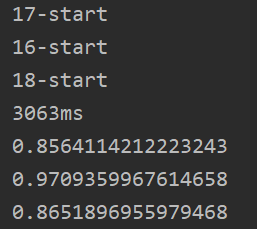
test1测试结果
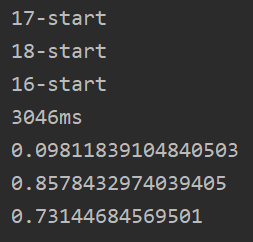
test2测试结果
test3测试结果
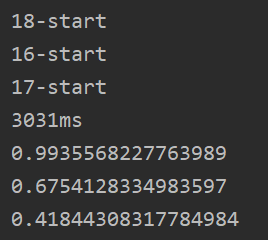
通过测试发现Future返回类型不适合主线等待多个子线程全部完成的操作,
因为需要用到while循环去阻塞主线程,而CompletableFuture可以通过CompletableFuture.allOf(cf1,cf2,cf3).join()
去完成这个操作,所以推荐使用CompletableFuture作为返回类型
注意:@Async注解的方法不能在本类中被调用,只能在其他类中调用,如Controller类
对第三种线程池在service中实现线程的逻辑
- package com.example.async_demo.service;
-
- import org.springframework.scheduling.annotation.Scheduled;
- import org.springframework.stereotype.Service;
-
- @Service
- public class AsyncService {
-
- //cron表达式 每5秒执行一次
- //@Scheduled(cron = "*/5 * * * * ?")
- @Scheduled(cron = "${cron.sec5}") //表达式写在application.yml文件中,则以这种方式取出。
- public void service4(){
- System.out.println("5s-"+Thread.currentThread().getId()+":"+System.currentTimeMillis()/1000);
- }
-
- //cron表达式 每3秒执行一次
- @Scheduled(cron = "${cron.sec3}")
- public void service5(){
- System.out.println("3s-"+Thread.currentThread().getId()+":"+System.currentTimeMillis()/1000);
- }
-
- }
application.yml 文件
- cron:
- sec5: '*/5 * * * * ?'
- sec3: '*/3 * * * * ?'
周期任务测试结果(启动Application类)
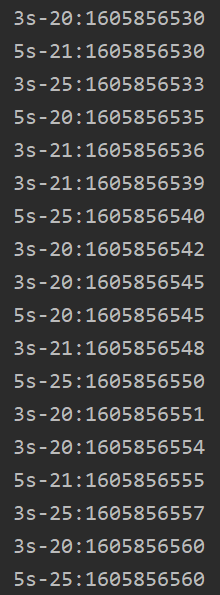
通过测试结果可发现两个周期任务使用了三个线程,
线程id分别是20、21、25。两个周期任务分别以3s和5s执行一次,
但不固定在某个线程中执行,而是哪个线程空闲则使用哪个线程
注意:若不为周期任务配置线程池,只使用@EnableScheduling和@Scheduled注解的话,
则所有周期任务共用一个子线程,若出现下一个周期开始上一个周期任务还没结束的情况,
则线程阻塞,直到前一个任务完成
CRON表达式
- cron表达式是定义任务周期的一种表达式
- 这里不多介绍,可以参考这篇 博客
声明:本文内容由网友自发贡献,不代表【wpsshop博客】立场,版权归原作者所有,本站不承担相应法律责任。如您发现有侵权的内容,请联系我们。转载请注明出处:https://www.wpsshop.cn/article/detail/52489
推荐阅读

相关标签

