
热门标签
热门文章
- 1更新Microsoft.PowerShell遇到 尝试更新源失败: winget_尝试更新源失败: winget
- 2[MySQL] SQL优化之性能分析
- 3powershell一行代码批量修改文件名(附命令详解)_命令控制程序批量处理文件名称代码
- 42022-2024年最全的计算机软件毕业设计选题大全:1000个热门选题推荐✅_毕设 csdn
- 5基于微信山西太原某大学球馆预约预约小程序系统设计与实现 研究背景和意义、国内外现状
- 6ssm+mysql校园信息交流平台的设计与实现-计算机毕业设计源码28259_校园空间数据库管理系统开发
- 7深度学习框架-keras_.keras
- 8linux nohup命令如何使用?_linux中nohup怎么用
- 9FaceChain V2,Human AIGC开源应用平台
- 10Java连接Mysql报错:javax.net.ssl.SSLException: Received fatal alert: internal_error_caused by: javax.net.ssl.sslexception: received fa
当前位置: article > 正文
PyTorch笔记 - Diffusion Model 源码开发 (2)_diffusion model 数据集制作
作者:数据科学灵魂 | 2024-01-30 16:21:08
赞
踩
diffusion model 数据集制作
Diffusion Model的效果如下:
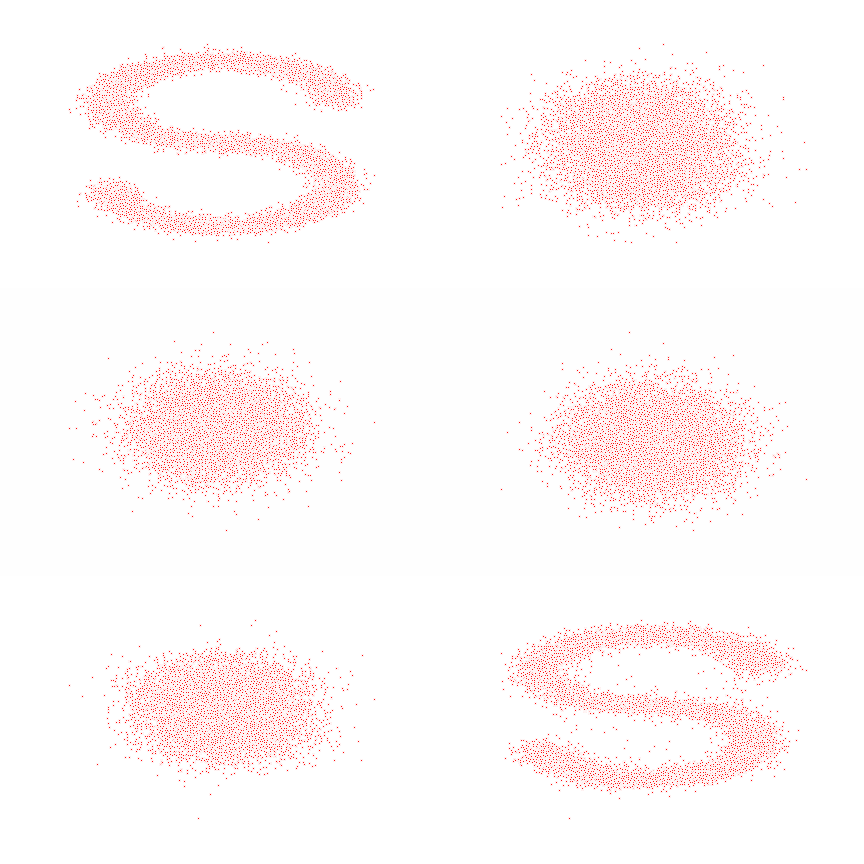
源码如下:
- 选择一个数据集
- 确定超参数的值
- 确定扩散过程任意时刻的采样值
- 演示原始数据分布加噪100步后的效果
- 编写拟合逆扩散过程高斯分布的模型
- 编写训练的误差函数
- 编写逆扩散采样函数(inference过程)
- 开始训练模型,并打印loss及中间的重构效果
- 动画演示扩散过程和逆扩散过程
# 1、选择一个数据集
%matplotlib inline

import matplotlib.pyplot as plt
import numpy as np
from sklearn.datasets import make_s_curve
import torch

s_curve, _ = make_s_curve(10**4, noise=0.1)  # 10000个点
s_curve = s_curve[:, [0,2]]/10.0  # 每个点只取第0维和第2维
print(f'[Info] s_curve[0]: {
     s_curve[0]}')

print(f"[Info] shape of moons: {
     np.shape(s_curve)}")

data = s_curve.T
fig, ax = plt.subplots()
ax.scatter(*data, color="red", edgecolor="white")
ax.axis("off")
dataset = torch.Tensor(s_curve).float()


# 2、确定超参数的值

num_steps = 100

# 制定每一步的beta
betas = torch.linspace(-6, 6, num_steps)
print(f'[Info] betas: {
     betas.shape}, betas[0]: {
     betas[1]}')
betas = torch.sigmoid(betas) * (0.5e-2 - 1e-5) + 1e-5
# 近似:最小值0.00001,最大值0.005
print(f'[Info] betas[0]: {
     betas[0]}, betas[-1]: {
     betas[-1]}')

# 计算alpha
alphas = 1 - betas
alphas_prod = torch.cumprod(alphas, 0)  # prod是product乘法,连乘
alphas_prod_p = torch.cat([torch.tensor([1]).float(), alphas_prod[:-1]], 0)
alphas_bar_sqrt = torch.sqrt(alphas_prod)
one_minus_alphas_bar_log = torch.log(1  - alphas_prod)
one_minus_alphas_bar_sqrt = torch.sqrt(1 - alphas_prod)

assert alphas.shape == alphas_prod.shape == alphas_prod_p.shape == alphas_bar_sqrt.shape \
    == one_minus_alphas_bar_log.shape == one_minus_alphas_bar_sqrt.shape

print("[Info] all the same shape:", betas.shape)


# 测试linspace、cumprod
alist = torch.linspace(1, 4, 4)   # [1, 2, 3, 4]</

- 1
- 2
- 3
- 4
- 5
- 6
- 7
- 8
- 9
- 10
- 11
- 12
- 13
- 14
- 15
- 16
- 17
- 18
- 19
- 20
- 21
- 22
- 23
- 24
- 25
- 26
- 27
- 28
- 29
- 30
- 31
- 32
- 33
- 34
- 35
- 36
- 37
- 38
- 39
- 40
- 41
- 42
- 43
- 44
- 45
- 46
- 47
- 48
- 49
- 50
- 51
- 52
- 53
- 54
推荐阅读
相关标签

