- 1浅谈Volatile三大特性
- 2windows版 docker desktop学习笔记——2 容器仓库管理_docker desktop创建命名空间
- 3STM32f103C8T6的优势是什么?
- 4python对文件操作 r w a 文件复制/修改_r 复制其他文件夹下的文件追加内容
- 5前端登录界面网站设计模板--HTML+CSS
- 6使用Sqoop将Hive数据导出到TiDB
- 7解决浏览器访问Github访问速度慢问题_github加速访问
- 8使用IDA对ipa进行反编译_windows反编译ipa
- 9选择排序 | 冒泡排序 | C语言(详解)
- 10回归预测 | MATLAB实现CNN-GRU-Attention多输入单输出回归预测_机器学习之心 多变量预测回归
LDD学习笔记 -- Linux字符设备驱动
赞
踩
字符驱动程序用于与Linux内核中的设备进行交互;
字符设备指的是像内存区域这样的硬件组件,通常称为伪设备;
用户空间应用程序通常使用open read write等系统调用与这些设备通信;
虚拟文件系统 VFS
把用户空间的系统调用连接到设备驱动的系统调用实现方法上。
内核的虚拟文件系统 virtual file system,在内核空间
设备驱动需要使用内核的API向虚拟文件系统注册
设备号
Major numbers(指示特定的驱动) + Minor numbers(表示指定的设备文件)
设备创建时候在VFS注册设备号,虚拟文件系统,将设备文件的设备号与驱动程序列表进行比较,选择正确的驱动程序,并将用户请求连接到对应驱动程序的文件操作方法。
相关Kernel APIs
| kernel functions and data structures(Creation) | (Deletion) | kernel header file |
|---|---|---|
alloc_chrdev_region() | unregister_chrdev_region() | include/linux/fs.h |
cdev_init() cdev_add() | cdev_del() | include/linux/cdev.h |
device_creat() class_creat() | device_destory() class_destory | include/linux/device.h |
copy_to_user() copy_from_user() | include/linux/uaccess.h | |
VFS structure definitions | include/linux/cdev.h |
动态申请设备号
alloc_chrdev_region() 可以动态申请主设备号,保证唯一性,传输设备号(dev_t [u32])地址和次设备号起始(一般0)和个数。
dev_t device_number;  //32bit
int minor_no = MINOR(device_number);  //后20bit  `kdev_t.h`
int major_no = MAJOR(device_number);  //前12bit

MKDEV(int major, int minor);
- 1
- 2
- 3
- 4
- 5
动态创建设备文件
当收到uevent,udev根据uevent内存储的细节在dev目录下创建设备文件。
class_create :在sysf中创建一个目录/sys/Class/<your_class_name>
device_create:在上面目录下使用设备名创建一个子目录/sys/Class/<your_class_name>/<your_device_name> /dev 这里的dev文件存储设备名主副设备号等
udev:用户空间的应用,动态创建设备文件/sys/Class/<your_class_name>/<your_device_name> /dev --> dev/your_device_name
内核空间和用户空间的数据交换
用户空间的指针不是完全可信的,用户地址空间有时可能无效,虚拟内存管理器可以交换出这些内存位置。
内核级代码不能直接引用用户级内存指针;
使用内核数据复制工具copy_to_user copy_from_user。工具会检查用户空间指针是否有效
系统调用方法
read
用户级进程执行read系统调用从文件中读取。文件可以是普通文件,也可以是一个设备文件(处理具体设备)。
例如前面的伪字符设备,有一块内存数组(设备内存buffer)。当用户程序在该设备文件上发出read系统调用时,应该将数据从设备buffer传到用户buffer。该数据拷贝发生在内核端到用户端。
write
将数据从用户空间复制到内核空间,
用户程序想把一些数据写入设备内存buffer。
lseek
改变f_pos(struct file)变量的位置,将文件位置指针向前/向后移动。
写一个伪字符设备驱动
- 动态申请设备号
- 创建
cdev结构体变量和file_operiations结构体变量 - 使用fops初始化字符设备结构体变量
- 向内核VFS注册设备
- 实现
file operiation的方法 - 初始化
file operiation变量 - 创建设备文件
class_create()device_create() - 驱动清理函数功能实现
#include <linux/module.h>
#include <linux/fs.h>
#include <linux/cdev.h>
#include <linux/device.h>
#include <linux/kdev_t.h>
#include <linux/uaccess.h>
#include <uapi/asm-generic/errno-base.h>

#define DEV_MEM_SIZE    512

/* pseudo device's memory */
char device_buffer[DEV_MEM_SIZE];

/* This hold the device number */
dev_t device_number;

/* Cdev variable */
struct cdev pcd_cdev;

loff_t pcd_llseek(struct file *filp, loff_t offset, int whence)
{
        pr_info("%s\n", __func__);
        loff_t temp;

        switch (whence)
        {
                case SEEK_SET:
                        if ((offset > DEV_MEM_SIZE) || (offset < 0))
                                return -EINVAL;
                        filp->f_pos = offset;
                        break;
                case SEEK_CUR:
                        temp = filp->f_pos + offset;
                        if ((temp > DEV_MEM_SIZE) || (offset < 0))
                                return -EINVAL;
                        filp->f_pos = temp;
                        break;
                case SEEK_END:
                        temp = DEV_MEM_SIZE + offset;
                        if ((temp > DEV_MEM_SIZE) || (offset < 0))
                                return -EINVAL;
                        filp->f_pos = temp;
                        break;

                default:
                        return -EINVAL;

        }

        pr_info("New value of the file position = %lld\n", filp->f_pos);

        return filp->f_pos;
        // return 0;

}

ssize_t pcd_read(struct file *filp, char __user *buff, size_t count, loff_t *f_pos)
{
        pr_info("%s :Read requested for %zu bytes\n", __func__, count);

        if((*f_pos + count) > DEV_MEM_SIZE)
                count = DEV_MEM_SIZE - *f_pos;

        if(copy_to_user(buff, &device_buffer[*f_pos], count)){
                return -EFAULT;
        }

        *f_pos += count;
        pr_info("Number of bytes successful read = %zu\n", count);
        pr_info("Update file position = %lld\n", *f_pos);

        return count;
}
ssize_t pcd_write(struct file *filp, const char __user *buff, size_t count, loff_t *f_pos)
{
        pr_info("%s :Write requested for %zu bytes, current file position = %lld\n", __func__, count, *f_pos);

        if((*f_pos + count) > DEV_MEM_SIZE)
                count = DEV_MEM_SIZE - *f_pos;

        if(!count)
                return -ENOMEM;

        if(copy_from_user(&device_buffer[*f_pos], buff, count)){
                return -EFAULT;
        }

        *f_pos += count;
        pr_info("Number of bytes successful writtens = %zu\n", count);
        pr_info("Update file position = %lld\n", *f_pos);
        return count;
}
int pcd_open(struct inode *inode, struct file *filp)
{
        pr_info("%s\n", __func__);
        return 0;
}
int pcd_release(struct inode *inode, struct file *filp)
{
        pr_info("%s\n", __func__);
        return 0;
}


/* file operations variable */
struct file_operations pcd_fops = {
        .open = pcd_open,
        .write = pcd_write,
        .read = pcd_read,
        .llseek = pcd_llseek,
        .release = pcd_release,
        .owner = THIS_MODULE
};

struct class *class_pcd;
struct device *device_pcd;

static int __init pcd_driver_init(void)
{
        pr_info("pcd_driver_init\n");

        /* 1. Dynamically allocate a device number */
        alloc_chrdev_region(&device_number, 0, 1, "pcd");

        pr_info("Device number <major>:<minor> = %d:%d\n", MAJOR(device_number), MINOR(device_number));

        /* 2. Initialize the cdev structure with fops */
        cdev_init(&pcd_cdev, &pcd_fops);

        /* 3. Register a device(cdev structure) with VFS */
        pcd_cdev.owner = THIS_MODULE;
        cdev_add(&pcd_cdev, device_number, 1);

        /* creat device class under /sys/class / */
        class_pcd = class_create(THIS_MODULE, "pcd_class");

        /* populate the sysfs with device information */
        device_pcd = device_create(class_pcd, NULL, device_number, NULL, "pcd");

        pr_info("Module init was successful\n");

        return 0;
}

/* This is module clean-up entry point */
static void __exit pcd_driver_exit(void)
{
        pr_info("my hello module exit\n");
        device_destroy(class_pcd, device_number);
        class_destroy(class_pcd);
        cdev_del(&pcd_cdev);
        unregister_chrdev_region(device_number, 1);
        pr_info("module unloaded\n");
}

/* registration */
module_init(pcd_driver_init);
module_exit(pcd_driver_exit);

/* This is description information about the module */
MODULE_LICENSE("GPL");
MODULE_AUTHOR("NAME");
MODULE_DESCRIPTION("A pseudo device driver");

- 1
- 2
- 3
- 4
- 5
- 6
- 7
- 8
- 9
- 10
- 11
- 12
- 13
- 14
- 15
- 16
- 17
- 18
- 19
- 20
- 21
- 22
- 23
- 24
- 25
- 26
- 27
- 28
- 29
- 30
- 31
- 32
- 33
- 34
- 35
- 36
- 37
- 38
- 39
- 40
- 41
- 42
- 43
- 44
- 45
- 46
- 47
- 48
- 49
- 50
- 51
- 52
- 53
- 54
- 55
- 56
- 57
- 58
- 59
- 60
- 61
- 62
- 63
- 64
- 65
- 66
- 67
- 68
- 69
- 70
- 71
- 72
- 73
- 74
- 75
- 76
- 77
- 78
- 79
- 80
- 81
- 82
- 83
- 84
- 85
- 86
- 87
- 88
- 89
- 90
- 91
- 92
- 93
- 94
- 95
- 96
- 97
- 98
- 99
- 100
- 101
- 102
- 103
- 104
- 105
- 106
- 107
- 108
- 109
- 110
- 111
- 112
- 113
- 114
- 115
- 116
- 117
- 118
- 119
- 120
- 121
- 122
- 123
- 124
- 125
- 126
- 127
- 128
- 129
- 130
- 131
- 132
- 133
- 134
- 135
- 136
- 137
- 138
- 139
- 140
- 141
- 142
- 143
- 144
- 145
- 146
- 147
- 148
- 149
- 150
- 151
- 152
- 153
- 154
- 155
- 156
- 157
- 158
- 159
- 160
- 161
- 162
- 163
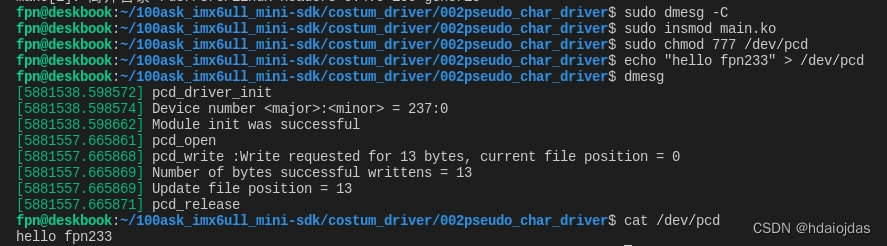
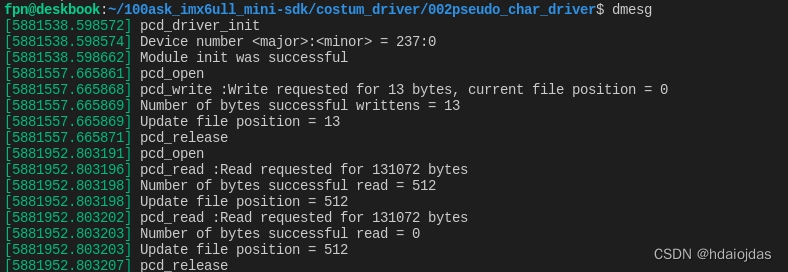
在主机上测试pcd(HOST)
使用echo 命令测试向PCD写数据
使用cat命令测试从PCD读数据
在目标板上测试pcd(TARGET)
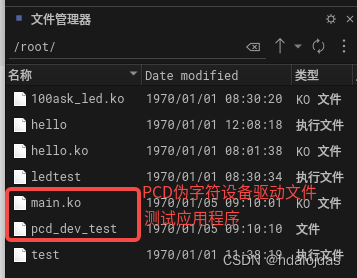
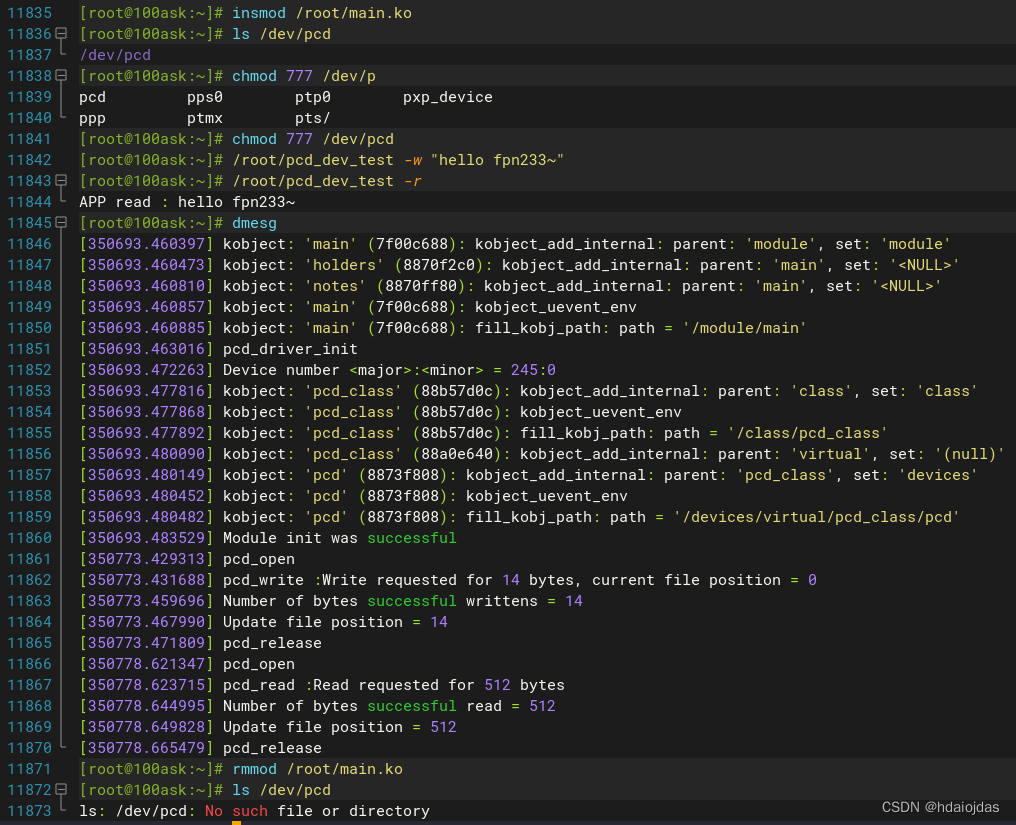
需要在用户空间写一个应用程序(测试应用)来测试字符设备驱动程序。使用对应目标板的编译工具链编译.c文件成目标板上的可执行文件,有没有.exe后缀都可,自己知道就行。
arm-buildroot-linux-gnueabihf-gcc ./pcd_drv_test.c -o pcd_dev_test
将上面设备驱动编译出的目标板的.ko文件和我们的测试应用文件都放到目标板上。
#include <sys/types.h>
#include <sys/stat.h>
#include <fcntl.h>
#include <unistd.h>
#include <stdio.h>
#include <string.h>

/*
 * ./pcd_drv_test -w hello fpn233~
 * ./pcd_drv_test -r
 */
int main(int argc, char **argv)
{
	int fd;
	char buf[512];
	int len;

	/* 1. 判断参数 */
	if (argc < 2)
	{
		printf("Usage: %s -w <string>\n", argv[0]);
		printf("       %s -r\n", argv[0]);
		return -1;
	}

	/* 2. 打开文件 */
	fd = open("/dev/pcd", O_RDWR);
	if (fd == -1)
	{
		printf("can not open file /dev/pcd\n");
		return -1;
	}

	/* 3. 写文件或读文件 */
	if ((0 == strcmp(argv[1], "-w")) && (argc == 3))
	{
		len = strlen(argv[2]) + 1;
		len = len < 512 ? len : 512;
		write(fd, argv[2], len);
	}
	else
	{
		len = read(fd, buf, 512);
		buf[1023] = '\0';
		printf("APP read : %s\n", buf);
	}

	close(fd);

	return 0;
}
- 1
- 2
- 3
- 4
- 5
- 6
- 7
- 8
- 9
- 10
- 11
- 12
- 13
- 14
- 15
- 16
- 17
- 18
- 19
- 20
- 21
- 22
- 23
- 24
- 25
- 26
- 27
- 28
- 29
- 30
- 31
- 32
- 33
- 34
- 35
- 36
- 37
- 38
- 39
- 40
- 41
- 42
- 43
- 44
- 45
- 46
- 47
- 48
- 49
- 50
- 51
- 52
- 53