
- 1python之pygame运动及向量(四)_pygame vector用法
- 2centos6.5腾讯云django环境部署---2、Gunicorn+Django+nginx+mysql部署
- 3星火认知大模型_java对接星火认知大模型
- 4python时间计算-时间戳转换_python 时间戳计算
- 5Python 深度学习实战:图像分类_python图像分类整理
- 6微信小程序校园二手交易小程序的设计与实现(源码+文档)
- 7网易云音乐分析之推荐算法_音乐推荐算法
- 8PHP 解决 mkdir() Permission Denied 的问题_php mkdir permission denied
- 9片上网络(NoC)技术的背景、意义以及发展_片上网络与总线对比
- 10游戏模块分析总结(2)之UI、操作篇
深度学习神经网络中的梯度检查_神经网络检查梯度是否连续
赞
踩
目录
前言
反向传播计算梯度
∂
J
∂
θ
\frac{\partial J}{\partial \theta}
∂θ∂J,
θ
\theta
θ表示模型的参数。
J
J
J是使用正向传播和损失函数来计算的。
计算公式如下:
∂
J
∂
θ
=
lim
ε
→
0
J
(
θ
+
ε
)
−
J
(
θ
−
ε
)
2
ε
(1)
\frac{\partial J}{\partial \theta} = \lim_{\varepsilon \to 0} \frac{J(\theta + \varepsilon) - J(\theta - \varepsilon)}{2 \varepsilon} \tag{1}
∂θ∂J=ε→0lim2εJ(θ+ε)−J(θ−ε)(1)
因为向前传播相对容易实现,所以比较容易获得正确的结果,确定要计算成本
J
J
J 正确。因此,可以通过计算
J
J
J 验证计算
∂
J
∂
θ
\frac{\partial J}{\partial \theta}
∂θ∂J 。
一维梯度检查
一维线性函数
J
(
θ
)
=
θ
x
J(\theta) = \theta x
J(θ)=θx。该模型只包含一个实值参数
θ
\theta
θ,并采取x作为输入。
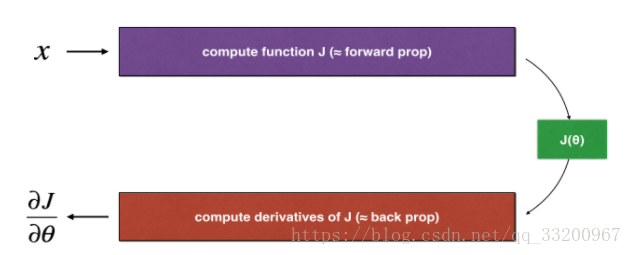
上图显示了关键的计算步骤:首先从开始 x x x,然后评估该功能 J ( x ) J(x) J(x)(“前向传播”)。然后计算导数 ∂ J ∂ θ \frac{\partial J}{\partial \theta} ∂θ∂J(“反向传播”)。下面就用代码来实现。
导入依赖包
首先我们要导入相应的依赖包,其中一些工具类可以在这里下载。
# coding=utf-8
from testCases import *
from gc_utils import sigmoid, relu, dictionary_to_vector, vector_to_dictionary, gradients_to_vector
- 1
- 2
- 3
正向传播
下面是线性前向传播函数代码:
def forward_propagation(x, theta):
    """
    实现线性向前传播(计算J) (J(theta) = theta * x)

    Arguments:
    x -- 一个实值输入
    theta -- 我们的参数,一个实数。

    Returns:
    J -- 函数J的值, 计算使用公式 J(theta) = theta * x
    """
    J = theta * x
    return J
- 1
- 2
- 3
- 4
- 5
- 6
- 7
- 8
- 9
- 10
- 11
- 12
- 13
反向传播
线性反向传播函数,计算公式是 d t h e t a = ∂ J ∂ θ = x dtheta = \frac { \partial J }{ \partial \theta} = x dtheta=∂θ∂J=x:
def backward_propagation(x, theta):
    """
    计算J对的导数

    Arguments:
    x -- 一个实值输入
    theta -- 我们的参数,一个实数。

    Returns:
    dtheta -- 成本的梯度。
    """

    dtheta = x

    return dtheta
- 1
- 2
- 3
- 4
- 5
- 6
- 7
- 8
- 9
- 10
- 11
- 12
- 13
- 14
- 15
开始检查
- 在检查梯度之前首先要求 g r a d a p p r o x gradapprox gradapprox:
- θ + = θ + ε \theta^{+} = \theta + \varepsilon θ+=θ+ε
- θ − = θ − ε \theta^{-} = \theta - \varepsilon θ−=θ−ε
- J + = J ( θ + ) J^{+} = J(\theta^{+}) J+=J(θ+)
- J − = J ( θ − ) J^{-} = J(\theta^{-}) J−=J(θ−)
- g r a d a p p r o x = J + − J − 2 ε gradapprox = \frac{J^{+} - J^{-}}{2 \varepsilon} gradapprox=2εJ+−J−
- 然后使用反向传播计算梯度,并将结果存储在一个变量“grad”中。
- 最后,使用以下公式计算“gradapprox”和“grad”之间的相对差异:
d i f f e r e n c e = ∣ ∣ g r a d − g r a d a p p r o x ∣ ∣ 2 ∣ ∣ g r a d ∣ ∣ 2 + ∣ ∣ g r a d a p p r o x ∣ ∣ 2 (2) difference = \frac {\mid\mid grad - gradapprox \mid\mid_2}{\mid\mid grad \mid\mid_2 + \mid\mid gradapprox \mid\mid_2} \tag{2} difference=∣∣grad∣∣2+∣∣gradapprox∣∣2∣∣grad−gradapprox∣∣2(2)
如果计算得到的结果足够小,就证明是梯度没问题了,以下是梯度检查代码:
def gradient_check(x, theta, epsilon=1e-7):
    """
    实现反向传播

    Arguments:
    x -- 一个实值输入
    theta -- 我们的参数,一个实数
    epsilon -- 用公式对输入进行微小位移计算近似梯度

    Returns:
    difference -- 近似梯度与反向传播梯度之间的差异。
    """

    # 用公式的左边来计算gradapprox(1)
    thetaplus = theta + epsilon  # Step 1
    thetaminus = theta - epsilon  # Step 2
    J_plus = thetaplus * x  # Step 3
    J_minus = thetaminus * x  # Step 4
    gradapprox = (J_plus - J_minus) / (2 * epsilon)  # Step 5

    # :检查gradapprox是否足够接近backward_propagation()的输出
    grad = backward_propagation(x, theta)

    numerator = np.linalg.norm(grad - gradapprox)  # Step 1'
    denominator = np.linalg.norm(grad) + np.linalg.norm(gradapprox)  # Step 2'
    difference = numerator / denominator  # Step 3'

    if difference < 1e-7:
        print ("梯度是正确的!")
    else:
        print ("梯度是错误的!")

    return difference

- 1
- 2
- 3
- 4
- 5
- 6
- 7
- 8
- 9
- 10
- 11
- 12
- 13
- 14
- 15
- 16
- 17
- 18
- 19
- 20
- 21
- 22
- 23
- 24
- 25
- 26
- 27
- 28
- 29
- 30
- 31
- 32
- 33
然后执行这一段代码,看看梯度是否正确:
if __name__ == "__main__":
    x, theta = 2, 4
    difference = gradient_check(x, theta)
    print("difference = " + str(difference))
- 1
- 2
- 3
- 4
当结果满足difference < 1e-7,梯度是正确的。
梯度是正确的!
difference = 2.91933588329e-10
- 1
- 2
多维梯度检查
多维梯度模型的向前和向后传播如下图:
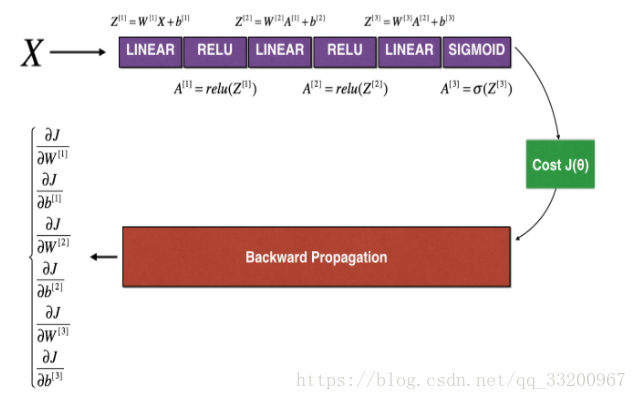
向前传播
多维梯度的向前传播:
def forward_propagation_n(X, Y, parameters):
    """
    实现前面的传播(并计算成本),如图3所示。

    Arguments:
    X -- m例的训练集。
    Y -- m的样本的标签
    parameters -- 包含参数的python字典 "W1", "b1", "W2", "b2", "W3", "b3":
                    W1 -- 权重矩阵的形状(5, 4)
                    b1 -- 偏差的矢量形状(5, 1)
                    W2 -- 权重矩阵的形状(3, 5)
                    b2 -- 偏差的矢量形状(3, 1)
                    W3 -- 权重矩阵的形状(1, 3)
                    b3 -- 偏差的矢量形状(1, 1)

    Returns:
    cost -- 成本函数(一个样本的逻辑成本)
    """

    # 检索参数
    m = X.shape[1]
    W1 = parameters["W1"]
    b1 = parameters["b1"]
    W2 = parameters["W2"]
    b2 = parameters["b2"]
    W3 = parameters["W3"]
    b3 = parameters["b3"]

    # LINEAR -> RELU -> LINEAR -> RELU -> LINEAR -> SIGMOID
    Z1 = np.dot(W1, X) + b1
    A1 = relu(Z1)
    Z2 = np.dot(W2, A1) + b2
    A2 = relu(Z2)
    Z3 = np.dot(W3, A2) + b3
    A3 = sigmoid(Z3)

    # Cost
    logprobs = np.multiply(-np.log(A3), Y) + np.multiply(-np.log(1 - A3), 1 - Y)
    cost = 1. / m * np.sum(logprobs)

    cache = (Z1, A1, W1, b1, Z2, A2, W2, b2, Z3, A3, W3, b3)

    return cost, cache
- 1
- 2
- 3
- 4
- 5
- 6
- 7
- 8
- 9
- 10
- 11
- 12
- 13
- 14
- 15
- 16
- 17
- 18
- 19
- 20
- 21
- 22
- 23
- 24
- 25
- 26
- 27
- 28
- 29
- 30
- 31
- 32
- 33
- 34
- 35
- 36
- 37
- 38
- 39
- 40
- 41
- 42
- 43
反向传播
多维梯度的反向传播:
def backward_propagation_n(X, Y, cache):
    """
    实现反向传播。

    Arguments:
    X -- 输入数据点,形状(输入大小,1)
    Y -- true "label"
    cache -- 缓存输出forward_propagation_n()

    Returns:
    gradients -- 一个字典,它包含了每个参数、激活和预激活变量的成本梯度。
    """

    m = X.shape[1]
    (Z1, A1, W1, b1, Z2, A2, W2, b2, Z3, A3, W3, b3) = cache

    dZ3 = A3 - Y
    dW3 = 1. / m * np.dot(dZ3, A2.T)
    db3 = 1. / m * np.sum(dZ3, axis=1, keepdims=True)

    dA2 = np.dot(W3.T, dZ3)
    dZ2 = np.multiply(dA2, np.int64(A2 > 0))
    dW2 = 1. / m * np.dot(dZ2, A1.T) * 2 # 这有个错误
    db2 = 1. / m * np.sum(dZ2, axis=1, keepdims=True)

    dA1 = np.dot(W2.T, dZ2)
    dZ1 = np.multiply(dA1, np.int64(A1 > 0))
    dW1 = 1. / m * np.dot(dZ1, X.T)
    db1 = 4. / m * np.sum(dZ1, axis=1, keepdims=True) # 这有个错误

    gradients = {"dZ3": dZ3, "dW3": dW3, "db3": db3,
                 "dA2": dA2, "dZ2": dZ2, "dW2": dW2, "db2": db2,
                 "dA1": dA1, "dZ1": dZ1, "dW1": dW1, "db1": db1}

    return gradients
- 1
- 2
- 3
- 4
- 5
- 6
- 7
- 8
- 9
- 10
- 11
- 12
- 13
- 14
- 15
- 16
- 17
- 18
- 19
- 20
- 21
- 22
- 23
- 24
- 25
- 26
- 27
- 28
- 29
- 30
- 31
- 32
- 33
- 34
- 35
开始检查
同样这个还是用回来之前的公式:
∂
J
∂
θ
=
lim
ε
→
0
J
(
θ
+
ε
)
−
J
(
θ
−
ε
)
2
ε
(3)
\frac{\partial J}{\partial \theta} = \lim_{\varepsilon \to 0} \frac{J(\theta + \varepsilon) - J(\theta - \varepsilon)}{2 \varepsilon} \tag{3}
∂θ∂J=ε→0lim2εJ(θ+ε)−J(θ−ε)(3)
但有一些不同的是,
θ
\theta
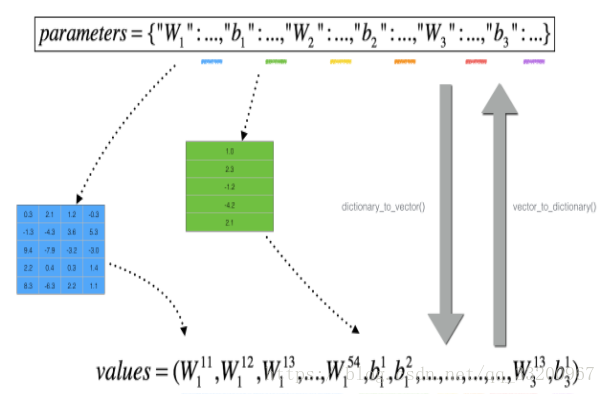
θ 不再是一个标量。这是一个叫做“参数”的字典。
其中函数是“ vector_to_dictionary”,它输出“参数”字典,操如下图:
For each i in num_parameters:
- 计算
J_plus[i]:- Set
θ
+
\theta^{+}
θ+ to
np.copy(parameters_values) - Set θ i + \theta^{+}_i θi+ to θ i + + ε \theta^{+}_i + \varepsilon θi++ε
- 使用
forward_propagation_n(x, y, vector_to_dictionary(θ + \theta^{+} θ+))计算 J i + J^{+}_i Ji+
- Set
θ
+
\theta^{+}
θ+ to
- 计算
J_minus[i]:同样计算 θ − \theta^{-} θ− - 计算 g r a d a p p r o x [ i ] = J i + − J i − 2 ε gradapprox[i] = \frac{J^{+}_i - J^{-}_i}{2 \varepsilon} gradapprox[i]=2εJi+−Ji−
最后使用以下的公式计算结果差异:
d
i
f
f
e
r
e
n
c
e
=
∥
g
r
a
d
−
g
r
a
d
a
p
p
r
o
x
∥
2
∥
g
r
a
d
∥
2
+
∥
g
r
a
d
a
p
p
r
o
x
∥
2
(4)
difference = \frac {\| grad - gradapprox \|_2}{\| grad \|_2 + \| gradapprox \|_2 } \tag{4}
difference=∥grad∥2+∥gradapprox∥2∥grad−gradapprox∥2(4)
def gradient_check_n(parameters, gradients, X, Y, epsilon=1e-7):
    """
    检查backward_propagation_n是否正确地计算了正向传播的成本输出的梯度。

    Arguments:
    parameters --包含参数的python字典 "W1", "b1", "W2", "b2", "W3", "b3":
    grad -- backward_propagation_n的输出包含参数的成本梯度。
    x -- 输入数据点,形状(输入大小,1)
    y -- true "label"
    epsilon -- 用公式对输入进行微小位移计算近似梯度

    Returns:
    difference -- 近似梯度与反向传播梯度之间的差异。
    """

    # Set-up variables
    parameters_values, _ = dictionary_to_vector(parameters)
    grad = gradients_to_vector(gradients)
    num_parameters = parameters_values.shape[0]
    J_plus = np.zeros((num_parameters, 1))
    J_minus = np.zeros((num_parameters, 1))
    gradapprox = np.zeros((num_parameters, 1))

    # Compute gradapprox
    for i in range(num_parameters):
        thetaplus = np.copy(parameters_values)  # Step 1
        thetaplus[i][0] = thetaplus[i][0] + epsilon  # Step 2
        J_plus[i], _ = forward_propagation_n(X, Y, vector_to_dictionary(thetaplus))  # Step 3

        thetaminus = np.copy(parameters_values)  # Step 1
        thetaminus[i][0] = thetaminus[i][0] - epsilon  # Step 2
        J_minus[i], _ = forward_propagation_n(X, Y, vector_to_dictionary(thetaminus))  # Step 3

        # Compute gradapprox[i]
        gradapprox[i] = (J_plus[i] - J_minus[i]) / (2 * epsilon)

    # 通过计算与反向传播梯度比较差异。
    numerator = np.linalg.norm(grad - gradapprox)  # Step 1'
    denominator = np.linalg.norm(grad) + np.linalg.norm(gradapprox)  # Step 2'
    difference = numerator / denominator  # Step 3'

    if difference > 2e-7:
        print (
            "\033[93m" + "反向传播有一个错误! difference = " + str(difference) + "\033[0m")
    else:
        print (
            "\033[92m" + "你的反向传播效果非常好! difference = " + str(difference) + "\033[0m")

    return difference
- 1
- 2
- 3
- 4
- 5
- 6
- 7
- 8
- 9
- 10
- 11
- 12
- 13
- 14
- 15
- 16
- 17
- 18
- 19
- 20
- 21
- 22
- 23
- 24
- 25
- 26
- 27
- 28
- 29
- 30
- 31
- 32
- 33
- 34
- 35
- 36
- 37
- 38
- 39
- 40
- 41
- 42
- 43
- 44
- 45
- 46
- 47
- 48
- 49
最后运行一下这个多维梯度检测:
if __name__ == "__main__":
    X, Y, parameters = gradient_check_n_test_case()
    cost, cache = forward_propagation_n(X, Y, parameters)
    gradients = backward_propagation_n(X, Y, cache)
    difference = gradient_check_n(parameters, gradients, X, Y)
- 1
- 2
- 3
- 4
- 5
以下是输出结果,可以看到已经超过最低的误差了:
反向传播有一个错误! difference = 0.285093156781
- 1
所以我们知道backward_propagation_n的代码有错误!这时我们可以去检查backward_propagation并尝试查找/更正错误,最后我们找到以下的代码出了错误:
dW2 = 1. / m * np.dot(dZ2, A1.T) * 2
db1 = 4. / m * np.sum(dZ1, axis=1, keepdims=True)
- 1
- 2
然后我们修改正确的代码:
dW2 = 1. / m * np.dot(dZ2, A1.T)
db1 = 1. / m * np.sum(dZ1, axis=1, keepdims=True)
- 1
- 2
我们再检查一遍的结果是:
你的反向传播效果非常好! difference = 1.18904178766e-07
- 1
参考资料
- http://deeplearning.ai/
该笔记是学习吴恩达老师的课程写的。初学者入门,如有理解有误的,欢迎批评指正!

