
热门标签
热门文章
- 1史上最全Unity3D游戏开发教程,从入门到精通(含学习路线图)_unity3d从入门到精通
- 2开启物联网的魔法之门 - 深入探索发布/订阅模式
- 3华为ensp模拟器如何使用VMware虚拟机桥接虚拟网卡实现上网(保姆级教程)_ensp云怎么添加虚拟网卡
- 4安全运维:cmd命令大全(108个)
- 5软考高项避坑指南,这些雷区千万别踩_软考高项彻底没用了
- 6Linux 下查看内存使用情况方法总结
- 78-5 HBase 开发:使用Java操作HBase_hbase 开发:使用java操作hbase
- 8【区块链 | IPFS】IPFS节点搭建、文件上传、节点存储空间设置、节点上传文件chunk设置_区块链 ipfs存储
- 9Android mk文件
- 10【ChatGLM】基于 ChatGLM-6B + langchain 实现本地化知识库检索与智能答案生成: 中文 LangChain 项目的实现开源工作_chatglm-6b langchain
当前位置: article > 正文
TensorRT学习笔记--官方示例sampleOnnxMNIST.cpp的理解与运行_params.inputtensornames.push_back
作者:编程变革者 | 2024-02-03 18:26:19
赞
踩
params.inputtensornames.push_back
前言
重点关注官方示例如何导入Onnx模型,相关API的用法;
1--代码
- #include "argsParser.h"
- #include "buffers.h"
- #include "common.h"
- #include "logger.h"
- #include "parserOnnxConfig.h"
-
- #include "NvInfer.h"
- #include <cuda_runtime_api.h>
-
- #include <cstdlib>
- #include <fstream>
- #include <iostream>
- #include <sstream>
-
- using samplesCommon::SampleUniquePtr;
-
- const std::string gSampleName = "TensorRT.sample_onnx_mnist";
-
- class SampleOnnxMNIST
- {
- public:
- SampleOnnxMNIST(const samplesCommon::OnnxSampleParams& params): mParams(params), mEngine(nullptr){}
-
- bool build();
-
- bool infer();
-
- private:
- samplesCommon::OnnxSampleParams mParams;
-
- nvinfer1::Dims mInputDims; // 网络的输入维度
- nvinfer1::Dims mOutputDims; // 网络的输出维度
- int mNumber{0}; // 类别数
-
- std::shared_ptr<nvinfer1::ICudaEngine> mEngine; // 初始化engine
-
- bool constructNetwork(SampleUniquePtr<nvinfer1::IBuilder>& builder,
- SampleUniquePtr<nvinfer1::INetworkDefinition>& network, SampleUniquePtr<nvinfer1::IBuilderConfig>& config,
- SampleUniquePtr<nvonnxparser::IParser>& parser);
-
- // 前处理
- bool processInput(const samplesCommon::BufferManager& buffers);
-
- // 验证结果
- bool verifyOutput(const samplesCommon::BufferManager& buffers);
- };
-
- bool SampleOnnxMNIST::build()
- {
- // 创建 builder
- auto builder = SampleUniquePtr<nvinfer1::IBuilder>(nvinfer1::createInferBuilder(sample::gLogger.getTRTLogger()));
- if (!builder)
- {
- return false;
- }
-
- // 显式 batch
- const auto explicitBatch = 1U << static_cast<uint32_t>(NetworkDefinitionCreationFlag::kEXPLICIT_BATCH);
- // 创建network
- auto network = SampleUniquePtr<nvinfer1::INetworkDefinition>(builder->createNetworkV2(explicitBatch));
- if (!network)
- {
- return false;
- }
- // 创建config
- auto config = SampleUniquePtr<nvinfer1::IBuilderConfig>(builder->createBuilderConfig());
- if (!config)
- {
- return false;
- }
- // 创建parser
- auto parser = SampleUniquePtr<nvonnxparser::IParser>(nvonnxparser::createParser(*network, sample::gLogger.getTRTLogger()));
- if (!parser)
- {
- return false;
- }
-
- // 调用成员函数生成网络
- auto constructed = constructNetwork(builder, network, config, parser);
- if (!constructed)
- {
- return false;
- }
-
- // CUDA stream used for profiling by the builder.
- auto profileStream = samplesCommon::makeCudaStream(); // 创建Cuda stream
- if (!profileStream)
- {
- return false;
- }
- config->setProfileStream(*profileStream);
-
- SampleUniquePtr<IHostMemory> plan{builder->buildSerializedNetwork(*network, *config)}; // 创建推理引擎
- if (!plan)
- {
- return false;
- }
-
- SampleUniquePtr<IRuntime> runtime{createInferRuntime(sample::gLogger.getTRTLogger())}; // 创建Runtime接口
- if (!runtime)
- {
- return false;
- }
-
- mEngine = std::shared_ptr<nvinfer1::ICudaEngine>(
- runtime->deserializeCudaEngine(plan->data(), plan->size()), samplesCommon::InferDeleter());
- if (!mEngine)
- {
- return false;
- }
-
- ASSERT(network->getNbInputs() == 1); // 输入 batch 为1
- mInputDims = network->getInput(0)->getDimensions();
- ASSERT(mInputDims.nbDims == 4); // 输入维度为 4(包含 batch 维度)
-
- ASSERT(network->getNbOutputs() == 1); // 输出 batch 为1
- mOutputDims = network->getOutput(0)->getDimensions();
- ASSERT(mOutputDims.nbDims == 2); // 输出维度为 2
-
- return true;
- }
-
- // constructNetwork 成员函数实现
- bool SampleOnnxMNIST::constructNetwork(SampleUniquePtr<nvinfer1::IBuilder>& builder,
- SampleUniquePtr<nvinfer1::INetworkDefinition>& network, SampleUniquePtr<nvinfer1::IBuilderConfig>& config,
- SampleUniquePtr<nvonnxparser::IParser>& parser)
- {
- auto parsed = parser->parseFromFile(locateFile(mParams.onnxFileName, mParams.dataDirs).c_str(),
- static_cast<int>(sample::gLogger.getReportableSeverity())); // 解析onnx模型
- if (!parsed)
- {
- return false;
- }
-
- config->setMaxWorkspaceSize(16_MiB); // 设置最大工作空间
- if (mParams.fp16) // 设置精度
- {
- config->setFlag(BuilderFlag::kFP16);
- }
- if (mParams.int8)
- {
- config->setFlag(BuilderFlag::kINT8);
- samplesCommon::setAllDynamicRanges(network.get(), 127.0f, 127.0f);
- }
-
- samplesCommon::enableDLA(builder.get(), config.get(), mParams.dlaCore);
-
- return true;
- }
-
- bool SampleOnnxMNIST::infer()
- {
- // 创建内存管理
- samplesCommon::BufferManager buffers(mEngine);
-
- // 创建context
- auto context = SampleUniquePtr<nvinfer1::IExecutionContext>(mEngine->createExecutionContext());
- if (!context)
- {
- return false;
- }
-
- // 从 buffer 中读取数据,并进行前处理
- ASSERT(mParams.inputTensorNames.size() == 1);
- if (!processInput(buffers))
- {
- return false;
- }
-
- // 将数据复制到 GPU 中
- buffers.copyInputToDevice();
-
- bool status = context->executeV2(buffers.getDeviceBindings().data()); // 执行推理
- if (!status)
- {
- return false;
- }
-
- // 将结果复制到 CPU 中
- buffers.copyOutputToHost();
-
- // 验证推理结果
- if (!verifyOutput(buffers))
- {
- return false;
- }
-
- return true;
- }
-
- // 前处理成员函数实现
- bool SampleOnnxMNIST::processInput(const samplesCommon::BufferManager& buffers) // 传入 buffers 的引用
- {
- const int inputH = mInputDims.d[2];
- const int inputW = mInputDims.d[3];
-
- // 随机选择一个数据进行读取
- srand(unsigned(time(nullptr)));
- std::vector<uint8_t> fileData(inputH * inputW);
- mNumber = rand() % 10;
- readPGMFile(locateFile(std::to_string(mNumber) + ".pgm", mParams.dataDirs), fileData.data(), inputH, inputW);
-
- // Print an ascii representation
- sample::gLogInfo << "Input:" << std::endl;
- for (int i = 0; i < inputH * inputW; i++)
- {
- sample::gLogInfo << (" .:-=+*#%@"[fileData[i] / 26]) << (((i + 1) % inputW) ? "" : "\n");
- }
- sample::gLogInfo << std::endl;
-
- // buffers.getHostBuffer() 返回 Name 对应的 buffer 地址
- float* hostDataBuffer = static_cast<float*>(buffers.getHostBuffer(mParams.inputTensorNames[0]));
- for (int i = 0; i < inputH * inputW; i++) // 对这段 buffer 地址的内容进行赋值操作,由于 processInput() 函数传入的是buffer引用,所以能改变buffer的值
- {
- hostDataBuffer[i] = 1.0 - float(fileData[i] / 255.0);
- }
-
- return true;
- }
-
- // 验证推理结果的成员函数实现
- bool SampleOnnxMNIST::verifyOutput(const samplesCommon::BufferManager& buffers)
- {
- const int outputSize = mOutputDims.d[1];
- float* output = static_cast<float*>(buffers.getHostBuffer(mParams.outputTensorNames[0]));
- float val{0.0f};
- int idx{0};
-
- // Calculate Softmax
- float sum{0.0f};
- for (int i = 0; i < outputSize; i++)
- {
- output[i] = exp(output[i]);
- sum += output[i];
- }
-
- sample::gLogInfo << "Output:" << std::endl;
- for (int i = 0; i < outputSize; i++)
- {
- output[i] /= sum;
- val = std::max(val, output[i]);
- if (val == output[i])
- {
- idx = i;
- }
-
- sample::gLogInfo << " Prob " << i << " " << std::fixed << std::setw(5) << std::setprecision(4) << output[i]
- << " "
- << "Class " << i << ": " << std::string(int(std::floor(output[i] * 10 + 0.5f)), '*')
- << std::endl;
- }
- sample::gLogInfo << std::endl;
-
- return idx == mNumber && val > 0.9f;
- }
-
- // 初始化参数
- samplesCommon::OnnxSampleParams initializeSampleParams(const samplesCommon::Args& args)
- {
- samplesCommon::OnnxSampleParams params; // 创建参数对象
- if (args.dataDirs.empty()) //!< Use default directories if user hasn't provided directory paths
- {
- params.dataDirs.push_back("data/mnist/");
- params.dataDirs.push_back("data/samples/mnist/");
- }
- else //!< Use the data directory provided by the user
- {
- params.dataDirs = args.dataDirs;
- }
- // 设置参数对象的默认属性
- params.onnxFileName = "mnist.onnx";
- params.inputTensorNames.push_back("Input3");
- params.outputTensorNames.push_back("Plus214_Output_0");
- params.dlaCore = args.useDLACore;
- params.int8 = args.runInInt8;
- params.fp16 = args.runInFp16;
-
- return params;
- }
-
- // 打印参数信息
- void printHelpInfo()
- {
- std::cout
- << "Usage: ./sample_onnx_mnist [-h or --help] [-d or --datadir=<path to data directory>] [--useDLACore=<int>]"
- << std::endl;
- std::cout << "--help Display help information" << std::endl;
- std::cout << "--datadir Specify path to a data directory, overriding the default. This option can be used "
- "multiple times to add multiple directories. If no data directories are given, the default is to use "
- "(data/samples/mnist/, data/mnist/)"
- << std::endl;
- std::cout << "--useDLACore=N Specify a DLA engine for layers that support DLA. Value can range from 0 to n-1, "
- "where n is the number of DLA engines on the platform."
- << std::endl;
- std::cout << "--int8 Run in Int8 mode." << std::endl;
- std::cout << "--fp16 Run in FP16 mode." << std::endl;
- }
-
- int main(int argc, char** argv)
- {
- samplesCommon::Args args;
- bool argsOK = samplesCommon::parseArgs(args, argc, argv);
- if (!argsOK)
- {
- sample::gLogError << "Invalid arguments" << std::endl;
- printHelpInfo();
- return EXIT_FAILURE;
- }
- if (args.help)
- {
- printHelpInfo();
- return EXIT_SUCCESS;
- }
-
- auto sampleTest = sample::gLogger.defineTest(gSampleName, argc, argv);
-
- sample::gLogger.reportTestStart(sampleTest);
-
- SampleOnnxMNIST sample(initializeSampleParams(args)); // 创建对象
-
- sample::gLogInfo << "Building and running a GPU inference engine for Onnx MNIST" << std::endl;
-
- if (!sample.build())
- {
- return sample::gLogger.reportFail(sampleTest);
- }
- if (!sample.infer())
- {
- return sample::gLogger.reportFail(sampleTest);
- }
-
- return sample::gLogger.reportPass(sampleTest);
- }

2--编译
① CMakeLists.txt:
- cmake_minimum_required(VERSION 3.13)
- project(TensorRT_test)
- set(CMAKE_CXX_STANDARD 11)
-
- set(SAMPLES_COMMON_SOURCES "/home/liujinfu/Downloads/TensorRT-8.2.5.1/samples/common/logger.cpp")
- add_executable(TensorRT_test_OnnxMNIST sampleOnnxMNIST.cpp ${SAMPLES_COMMON_SOURCES})
-
- # add TensorRT8
- include_directories(/home/liujinfu/Downloads/TensorRT-8.2.5.1/include)
- include_directories(/home/liujinfu/Downloads/TensorRT-8.2.5.1/samples/common)
- set(TENSORRT_LIB_PATH "/home/liujinfu/Downloads/TensorRT-8.2.5.1/lib")
- file(GLOB LIBS "${TENSORRT_LIB_PATH}/*.so")
-
- # add CUDA
- find_package(CUDA 11.3 REQUIRED)
- message("CUDA_LIBRARIES:${CUDA_LIBRARIES}")
- message("CUDA_INCLUDE_DIRS:${CUDA_INCLUDE_DIRS}")
- include_directories(${CUDA_INCLUDE_DIRS})
-
- # link
- target_link_libraries(TensorRT_test_OnnxMNIST ${LIBS} ${CUDA_LIBRARIES})
② 编译
- mkdir build && cd build
-
- cmake ..
-
- make
3--运行结果
./TensorRT_test_OnnxMNIST -d /home/liujinfu/Downloads/TensorRT-8.2.5.1/data/mnist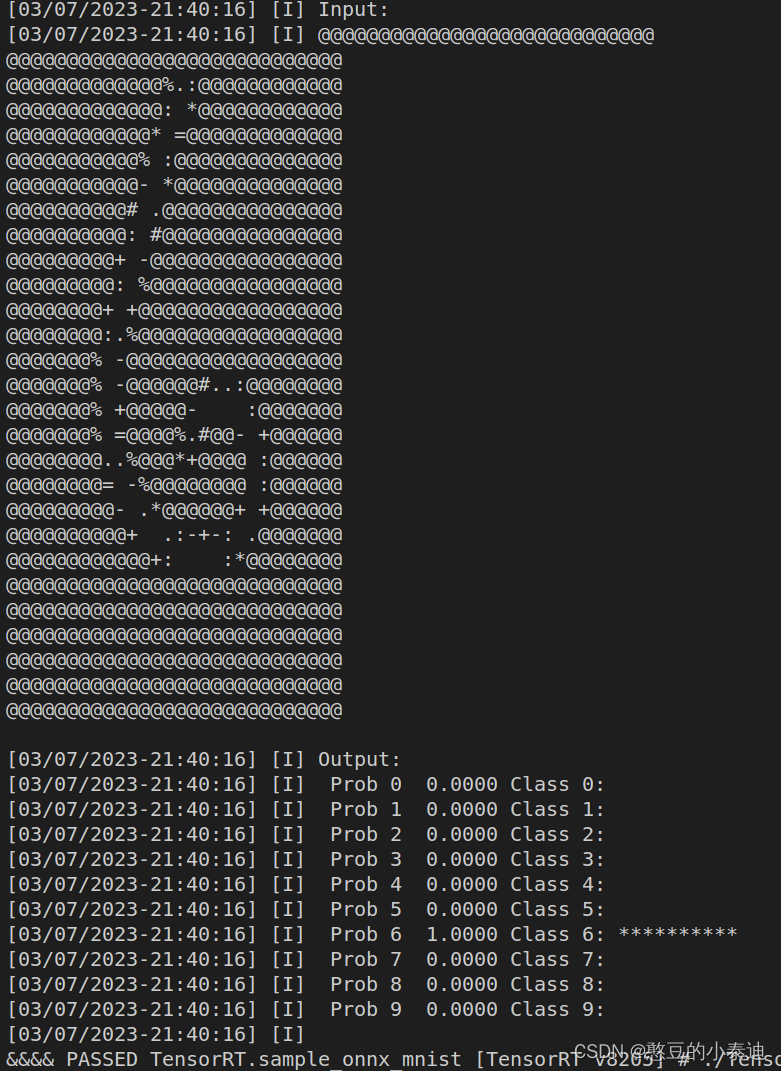
声明:本文内容由网友自发贡献,转载请注明出处:【wpsshop】
推荐阅读
相关标签

