
热门标签
热门文章
- 1SLAM知识点——eigen库学习_c++ cv2eigen
- 2Qt5.12实战之图形编程初识_qt 5.12 实战
- 3Unity之正确设置手机显示布局&&获取手机朝向_如何获取手机朝向
- 4搭建个人网站【华为云服务器、阿里云域名】_华为云域名备案到阿里云
- 52023 ATT&CK v13版本更新指南_attck
- 6python3.10在centos下安装以及配置_centos安装python3.10
- 7Godot 游戏引擎个人评价和2024年规划(无代码)_godot 平台适配
- 8ZYNQ 网络通信的四种实现方案_axi 1g/2.5g ethernet subsystem
- 9vue+element ui动态增加表单项并支持删除_vue动态新增表单
- 10Class 的继承_class 继承
当前位置: article > 正文
D*算法原理与程序详解(Python)
作者:代码维护者 | 2024-02-01 09:50:00
赞
踩
d*算法
提示:前文写了D搜索算法,是一种贪心算法。
一、D*算法是什么?
D*算法也是用于机器人路径规划问题的启发式方法,它是一种局部规划方法,即仅仅已知一部分地形,对地形的未知部分进行假设,并在这些假设下找到当前坐标到目标坐标的最短路径。然后机器人沿着这条路走,当它观察到新的地图信息(如从前未知的障碍)时,将这些信息添加到地图中,并在必要时重新规划从当前坐标到给定目标坐标的新的最短路径。重复这个过程,直到达到目标坐标或无法达到目标坐标。
二、原理以及代码步骤
1.原理分析
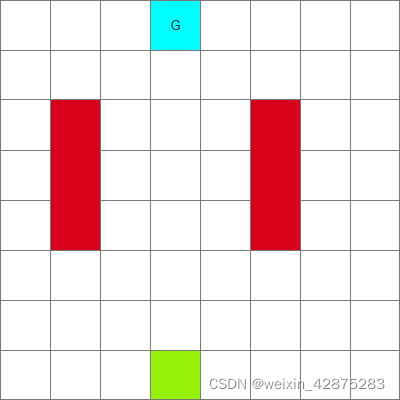
如上图的空间,给定起点(绿色点)、目标点(G蓝色)、障碍(红色),如何进行路径规划?
- 首次搜索
将终点G置于openlist中,采用Dijkstra进行搜索,规定上下左右的代价为10,斜着方向的代价为14。不熟悉Dijkstra算法的朋友看我之前的博文Dijkstra算法在python中的实现。
大概说一下,每个格子包含有三个量(节点名,代价,父节点),从终点A开始,搜索周围的邻节点,给它们分别标号:B,C,D,E,F,代价按照规定的计算(上下左右的代价为10,斜着方向的代价为14),并把终点A放入close list里面(不再遍历)。然后找出代价最小的节点作为新节点,继续搜索,在搜索过程中,如果有节点K已经有代价,但是以新的点为父节点,这个节点K的代价值更小,那么更新其代价值和父节点。
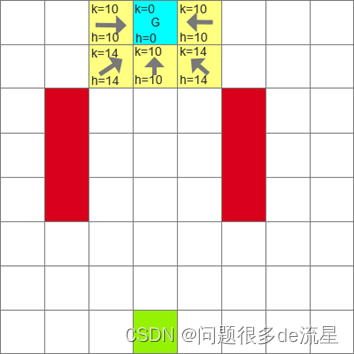
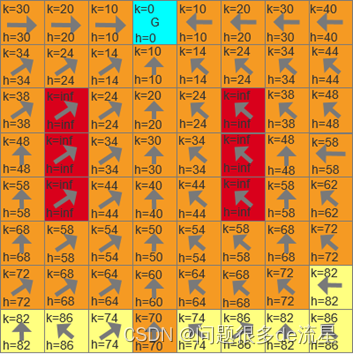
搜索结束条件就是终点从openlist中弹出进入了closelist。
最终,我们搜索到了起点,结束搜索。从起点开始找父节点,一路搜索到终点。 - 遇到障碍
如果机器人在按照原来规划路径行进的时候,路上遇到障碍(不在规划路径上的障碍忽略不计)。例如(3,3)遇到障碍。
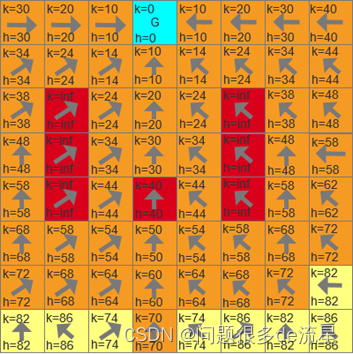
修改这个点的h值为无穷大(inf),并且令障碍的所有子节点的h都为无穷大。
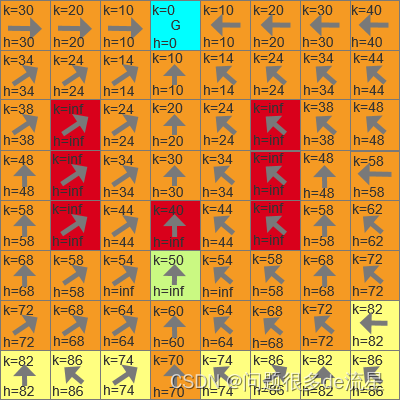
图中浅绿色节点是路径上障碍的子节点X,子节点X的h变为inf,将节点X从closelist中弹出,放入openlist列表。
接下来就是将这个改变进行扩散。
先取出openlist中k值最小的节点,还是浅绿色节点X(k=50,h=inf)
找X的周围邻接点Y,如果能够让X的h值变小,就让Y成为X的父节点,这样X(3,2)的父节点变为(4,3),hx变为58,此时X的子节点如(3,1),而hx+10(x和y的代价)不等于hy(60),说明障碍的影响没有扩散到子节点,所以更改子节点(3,1)的h值为hx+10。
因为(4,3)节点到目标点的路径其实是之前计算过的,所以不必计算。
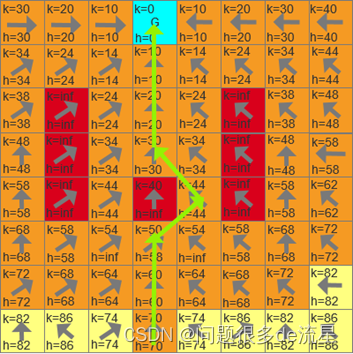
扩散的结束条件就是k_min(openlist中所有节点最小的k值)>=hx(当前点X的h值)。
就能找到一条路径:
2.代码解释
- D算法首次搜索
# coding=utf-8
import matplotlib.pyplot as plt
import numpy as np
import math

map_grid = [[1 for j in range(0, 8)] for i in range(0, 8)]  # 定义列表
map_grid = np.array(map_grid)  # 将列表转化为数组,因为只有数组才有维度的概念,方便切片
map_grid[3:6, 1] = 0  # 障碍物
map_grid[3:6, 5] = 0
map_grid[0, 3] = 5  # 起点
map_grid[7, 3] = 6  # 终点


def draw_effect(map_grid,second_path):
    plt.imshow(map_grid, cmap=plt.cm.hot, interpolation='nearest', vmin=0, vmax=10)  # 绘制热力图
    plt.colorbar()
    plt.xlim(-1, 8)  # x轴的范围
    plt.ylim(-1, 8)
    my_x_ticks = np.arange(0, 8, 1)  # x轴标号的范围
    my_y_ticks = np.arange(0, 8, 1)
    plt.xticks(my_x_ticks)
    plt.yticks(my_y_ticks)
    second_path = np.array(second_path)
    plt.plot(second_path[:, 1:2],second_path[:, 0:1],'-')
    # plt.grid(True)  # 开启栅格  可以不开启
    plt.show()  # 可视化


open_list = [[7, 3, 0, 0, None, None]]  # 将终点置于open列表中列表中分别有x0,y0坐标,h值,父节点X、Y坐标
close_list = []


# draw_effect(map_grid)
# 将邻域放入open_list中
def open_list_append(x0, y0, x1, y1, h0, h1, map_grid, open_list):
    if 0 <= x1 <= 7 and 0 <= y1 <= 7 and map_grid[x1, y1] != 4 and map_grid[x1, y1] != 0:  # 左边没有越界并且没有在closelist里面
        if map_grid[x1, y1] == 3:  # 如果是在open_list中,h要更新
            open_list = np.array(open_list)
            if (h1 + h0) < open_list[np.where((open_list[:, 0] == x1) & (open_list[:, 1] == y1)), 2]:
                h = h1 + h0
                k = h1 + h0
                open_list[np.where((open_list[:, 0] == x1) & (open_list[:, 1] == y1)), 2] = h
                open_list[np.where((open_list[:, 0] == x1) & (open_list[:, 1] == y1)), 3] = k
                open_list[np.where((open_list[:, 0] == x1) & (open_list[:, 1] == y1)), 4] = x0
                open_list[np.where((open_list[:, 0] == x1) & (open_list[:, 1] == y1)), 4] = y0
            open_list = list(open_list.tolist())

        else:  # 是new节点
            h = h1 + h0
            k = h1 + h0
            # open_list = list(open_list)
            open_list.append([x1, y1, h, k, x0, y0])
            map_grid[x1, y1] = 3

    return open_list


# 首次搜索
def first_search(open_list, close_list, map_grid):  # 给出终点坐标,完成首次遍历
    # 采用D算法遍历
    # 选openlist中h最小的,将openlist按照h排序,取第一个,并删除第一个,将它放到close_list里面
    open_list = list(open_list)
    open_list.sort(key=lambda x: x[2])
    # open_list.pop(0)
    insert_list = open_list[0]  # 引入中间列表,用来存储每一次被选中的遍历的点
    x0 = int(insert_list[0])
    y0 = int(insert_list[1])
    open_list.pop(0)
    close_list.append(list(insert_list))
    map_grid[x0, y0] = 4  # 被加入到close_list里面

    # 找insert_list的邻域 ----->寻找顺序:从左边开始逆时针
    h0 = int(insert_list[2])

    x1 = x0
    y1 = y0 - 1
    h1 = 10
    open_list = open_list_append(x0, y0, x1, y1, h0, h1, map_grid, open_list)

    x1 = x0 - 1
    y1 = y0 - 1
    h1 = 14
    open_list = open_list_append(x0, y0, x1, y1, h0, h1, map_grid, open_list)

    x1 = x0 - 1
    y1 = y0
    h1 = 10
    open_list = open_list_append(x0, y0, x1, y1, h0, h1, map_grid, open_list)

    x1 = x0 - 1
    y1 = y0 + 1
    h1 = 14
    open_list = open_list_append(x0, y0, x1, y1, h0, h1, map_grid, open_list)

    x1 = x0
    y1 = y0 + 1
    h1 = 10
    open_list = open_list_append(x0, y0, x1, y1, h0, h1, map_grid, open_list)

    x1 = x0 + 1
    y1 = y0 + 1
    h1 = 14
    open_list = open_list_append(x0, y0, x1, y1, h0, h1, map_grid, open_list)

    x1 = x0 + 1
    y1 = y0
    h1 = 10
    open_list = open_list_append(x0, y0, x1, y1, h0, h1, map_grid, open_list)

    x1 = x0 + 1
    y1 = y0 - 1
    h1 = 14
    open_list = open_list_append(x0, y0, x1, y1, h0, h1, map_grid, open_list)

    return [open_list, close_list, map_grid]


while map_grid[0, 3] != 4 and open_list != []:
    [open_list, close_list, map_grid] = first_search(open_list, close_list, map_grid)

# 首次搜索完成
first_path = []
close_list = np.array(close_list)
xn = 0
yn = 3
while xn != 7 or yn != 3:
    list1 = list(close_list[np.where((close_list[:, 0] == xn) & (close_list[:, 1] == yn))][0])
    xn = int(list1[4])
    yn = int(list1[5])
    first_path.append(list1)

first_path.append([7, 3, 0, 0, None, None])

- 1
- 2
- 3
- 4
- 5
- 6
- 7
- 8
- 9
- 10
- 11
- 12
- 13
- 14
- 15
- 16
- 17
- 18
- 19
- 20
- 21
- 22
- 23
- 24
- 25
- 26
- 27
- 28
- 29
- 30
- 31
- 32
- 33
- 34
- 35
- 36
- 37
- 38
- 39
- 40
- 41
- 42
- 43
- 44
- 45
- 46
- 47
- 48
- 49
- 50
- 51
- 52
- 53
- 54
- 55
- 56
- 57
- 58
- 59
- 60
- 61
- 62
- 63
- 64
- 65
- 66
- 67
- 68
- 69
- 70
- 71
- 72
- 73
- 74
- 75
- 76
- 77
- 78
- 79
- 80
- 81
- 82
- 83
- 84
- 85
- 86
- 87
- 88
- 89
- 90
- 91
- 92
- 93
- 94
- 95
- 96
- 97
- 98
- 99
- 100
- 101
- 102
- 103
- 104
- 105
- 106
- 107
- 108
- 109
- 110
- 111
- 112
- 113
- 114
- 115
- 116
- 117
- 118
- 119
- 120
- 121
- 122
- 123
- 124
- 125
- 126
- 127
- 128
- 129
- 130
- 131
- 132
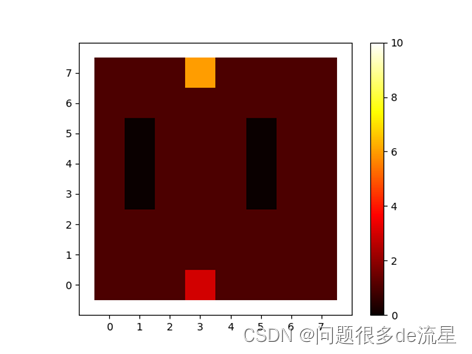
没开始搜索前的地图
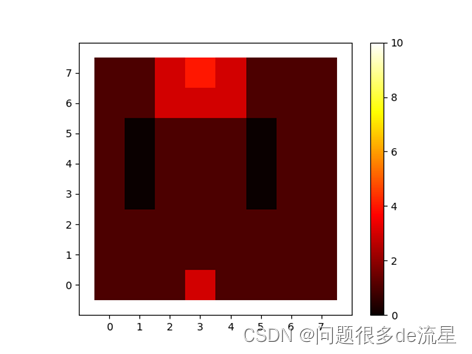
第一步搜索图
- 设置随机障碍,开始第二次搜索
# 通过上面的程序已经找到了一条路径,完成了第一次的搜索,此时每个节点的h和k是相等的。此时开始点在close list里面,最短路径在firstpath中。
# 可以看出,每个节点的父节点都是该节点的八个邻节点中k值最小的哪个。
# 当出现动态变化时,我们可以利用这个图尽快修正我们的路径,而不是重新规划。
# 当我们检测到某点被阻碍了:1、修改这个点的h值,h变为inf,把它放入openlist中。注意此时该节点的k还是小值,是原来哪个h的值,因此它将立即被取出
# 2、把这个修改扩散出去,直到kmin >=h
# 设置一个突然出现的障碍
map_grid[3, 3] = 0

close_list[np.where((close_list[:, 4] == 3) & (close_list[:, 5] == 3)), 2] = math.inf
close_list[np.where((close_list[:, 0] == 3) & (close_list[:, 1] == 3)), 2] = math.inf
insertRow = list(close_list[np.where((close_list[:, 4] == 3) & (close_list[:, 5] == 3))][0])
x = int(insertRow[0])
y = int(insertRow[1])
open_list.append(insertRow)  # ->>>>>>open_list是列表格式
map_grid[x, y] = 3
close_list = list(close_list.tolist())  # ----->>>>>close_list是列表格式
close_list.remove(insertRow)
open_list.sort(key=lambda x: x[3])  # 先排序,选择k最小的节点
k_min = open_list[0][3]  #
hx = open_list[0][2]


# 接下来把这个点扩散出去

def find_neighbor(x0, y0, x1, y1, k_old, hx, h1, close_list):
    close_list = np.array(close_list)
    hy = close_list[np.where((close_list[:, 0] == x1) & (close_list[:, 1] == y1)), 2][0]
    if (hy <= k_old) and (hx > hy + h1):
        close_list[np.where((close_list[:, 0] == x0) & (close_list[:, 1] == y0)), 4] = x1
        close_list[np.where((close_list[:, 0] == x0) & (close_list[:, 1] == y0)), 5] = y1
        close_list[np.where((close_list[:, 0] == x0) & (close_list[:, 1] == y0)), 2] = hy + h1
        hx = hy + h1
    return [hx, list(close_list.tolist())]

def find_neighbor2(x0, y0, x1, y1, k_old, hx, h1, close_list, open_list, map_grid):
    close_list = np.array(close_list)
    hy = close_list[np.where((close_list[:, 0] == x1) & (close_list[:, 1] == y1)), 2][0]
    if (close_list[np.where((close_list[:, 0] == x1) & (close_list[:, 1] == y1)), 4] == x0 and close_list[
        np.where((close_list[:, 0] == x1) & (close_list[:, 1] == y1)), 5] == y0 and (hy != hx + h1)) or (
            (hy > hx + h1) and (
            (close_list[np.where((close_list[:, 0] == x1) & (close_list[:, 1] == y1)), 4] != x0) or (
            close_list[np.where((close_list[:, 0] == x1) & (close_list[:, 1] == y1)), 5] != y0))):
        close_list[np.where((close_list[:, 0] == x1) & (close_list[:, 1] == y1)), 4] = x0
        close_list[np.where((close_list[:, 0] == x1) & (close_list[:, 1] == y1)), 5] = y0
        close_list[np.where((close_list[:, 0] == x1) & (close_list[:, 1] == y1)), 2] = hx + h1
        Y = list(close_list[np.where((close_list[:, 0] == x1) & (close_list[:, 1] == y1))][0])
        # 把Y放入open_list中
        close_list = list(close_list.tolist())
        close_list.remove(Y)
        open_list.append(Y)
        map_grid[x1, y1] = 3
    return [open_list, close_list, map_grid]

def find_neighbor3(x0, y0, x1, y1, k_old, hx, h1, close_list, open_list, map_grid):
    close_list = np.array(close_list)
    hy = close_list[np.where((close_list[:, 0] == x1) & (close_list[:, 1] == y1)), 2][0]
    if (close_list[np.where((close_list[:, 0] == x1) & (close_list[:, 1] == y1)), 4] == x0 and close_list[
        np.where((close_list[:, 0] == x1) & (close_list[:, 1] == y1)), 5] == y0 and (hy != hx + h1)):
        close_list[np.where((close_list[:, 0] == x1) & (close_list[:, 1] == y1)), 4] = x0
        close_list[np.where((close_list[:, 0] == x1) & (close_list[:, 1] == y1)), 5] = y0
        close_list[np.where((close_list[:, 0] == x1) & (close_list[:, 1] == y1)), 2] = hx + h1
        Y = list(close_list[np.where((close_list[:, 0] == x1) & (close_list[:, 1] == y1))][0])
        # 把Y放入open_list中
        close_list = list(close_list.tolist())
        close_list.remove(Y)
        open_list.append(Y)
        map_grid[x1, y1] = 3
    else:
        if ((close_list[np.where((close_list[:, 0] == x1) & (close_list[:, 1] == y1)), 4] != x0 or close_list[
            np.where((close_list[:, 0] == x1) & (close_list[:, 1] == y1)), 5] != y0) and (hy > hx + h1)):
            #print(list(close_list[np.where((close_list[:, 0] == x0) & (close_list[:, 1] == y0))][0]))
            if map_grid[x0,y0]!=3:
                X = list(close_list[np.where((close_list[:, 0] == x0) & (close_list[:, 1] == y0))][0])
                close_list = list(close_list.tolist())
                close_list.remove(X)
                open_list.append(X)
            else:
                open_list = np.array(open_list)
                X = list(open_list[np.where((open_list[:, 0] == x0) & (open_list[:, 1] == y0))][0])
                open_list = list(open_list.tolist())
        #     # 把Y放入open_list中
            map_grid[x0, y0] = 3
        else:
            if ((close_list[np.where((close_list[:, 0] == x1) & (close_list[:, 1] == y1)), 4] != x0 or close_list[
                np.where((close_list[:, 0] == x1) & (close_list[:, 1] == y1)), 5] != y0) and (hx > hy + h1)) and \
                    map_grid[x1, y1] == 4 and hy > k_old:
                if map_grid[x1, y1] != 3:
                    Y = list(close_list[np.where((close_list[:, 0] == x1) & (close_list[:, 1] == y1))][0])
                    close_list = list(close_list.tolist())
                    close_list.remove(Y)
                    open_list.append(Y)
                else:
                    open_list = np.array(open_list)
                    Y = list(open_list[np.where((open_list[:, 0] == x1) & (open_list[:, 1] == y1))][0])
                    open_list = list(open_list.tolist())
                # 把Y放入open_list中
                map_grid[x1, y1] = 3

    return [open_list, close_list, map_grid]

# 扩散程序 process-state:先弹出openlist列表中k最小的节点,并删除这个节点。然后分类处理:
def process_state(open_list, close_list, map_grid):
    # 修改这个点的h值
    open_list.sort(key=lambda x: x[3])  # 先排序,选择k最小的节点
    X = open_list[0]  # X表示k最小的节点
    x0 = int(X[0])
    y0 = int(X[1])
    close_list.append(X)  # 将它放入closelist
    map_grid[x0, y0] = 4
    open_list.remove(X)
    # 从openlist中删除这个节点
    # 分类处理:(该节点处于lower状态,该节点处于lower状态)
    k_old = X[3]
    hx = X[2]
    # print(close_list)

    if k_old < hx:  # k_old是上升状态
        x1 = x0
        y1 = y0 - 1
        h1 = 10
        [hx, close_list] = find_neighbor(x0, y0, x1, y1, k_old, hx, h1, close_list)

        x1 = x0 - 1
        y1 = y0 - 1
        h1 = 14
        [hx, close_list] = find_neighbor(x0, y0, x1, y1, k_old, hx, h1, close_list)

        x1 = x0 - 1
        y1 = y0
        h1 = 10
        [hx, close_list] = find_neighbor(x0, y0, x1, y1, k_old, hx, h1, close_list)

        x1 = x0 - 1
        y1 = y0 + 1
        h1 = 14
        [hx, close_list] = find_neighbor(x0, y0, x1, y1, k_old, hx, h1, close_list)

        x1 = x0
        y1 = y0 + 1
        h1 = 10
        [hx, close_list] = find_neighbor(x0, y0, x1, y1, k_old, hx, h1, close_list)

        x1 = x0 + 1
        y1 = y0 + 1
        h1 = 14
        [hx, close_list] = find_neighbor(x0, y0, x1, y1, k_old, hx, h1, close_list)

        x1 = x0 + 1
        y1 = y0
        h1 = 10
        [hx, close_list] = find_neighbor(x0, y0, x1, y1, k_old, hx, h1, close_list)

        x1 = x0 + 1
        y1 = y0 - 1
        h1 = 14
        [hx, close_list] = find_neighbor(x0, y0, x1, y1, k_old, hx, h1, close_list)
        # 找它的邻节点,看能不能让它的h降低
        #print(hx)

    # if k_old == hx:  # 该节点x处于lower状态
    #     x1 = x0
    #     y1 = y0 - 1
    #     h1 = 10
    #     [open_list, close_list, map_grid] = find_neighbor2(x0, y0, x1, y1, k_old, hx, h1, close_list, open_list,
    #                                                        map_grid)
    #
    #     x1 = x0 - 1
    #     y1 = y0 - 1
    #     h1 = 14
    #     [open_list, close_list, map_grid] = find_neighbor2(x0, y0, x1, y1, k_old, hx, h1, close_list, open_list,
    #                                                        map_grid)
    #
    #     x1 = x0 - 1
    #     y1 = y0
    #     h1 = 10
    #     [open_list, close_list, map_grid] = find_neighbor2(x0, y0, x1, y1, k_old, hx, h1, close_list, open_list,
    #                                                        map_grid)
    #
    #     x1 = x0 - 1
    #     y1 = y0 + 1
    #     h1 = 14
    #     [open_list, close_list, map_grid] = find_neighbor2(x0, y0, x1, y1, k_old, hx, h1, close_list, open_list,
    #                                                        map_grid)
    #
    #     x1 = x0
    #     y1 = y0 + 1
    #     h1 = 10
    #     [open_list, close_list, map_grid] = find_neighbor2(x0, y0, x1, y1, k_old, hx, h1, close_list, open_list,
    #                                                        map_grid)
    #
    #     x1 = x0 + 1
    #     y1 = y0 + 1
    #     h1 = 14
    #     [open_list, close_list, map_grid] = find_neighbor2(x0, y0, x1, y1, k_old, hx, h1, close_list, open_list,
    #                                                        map_grid)
    #
    #     x1 = x0 + 1
    #     y1 = y0
    #     h1 = 10
    #     [open_list, close_list, map_grid] = find_neighbor2(x0, y0, x1, y1, k_old, hx, h1, close_list, open_list,
    #                                                        map_grid)
    #
    #     x1 = x0 + 1
    #     y1 = y0 - 1
    #     h1 = 14
    #     [open_list, close_list, map_grid] = find_neighbor2(x0, y0, x1, y1, k_old, hx, h1, close_list, open_list,
    #                                                        map_grid)
    #
    # else:
    #     x1 = x0
    #     y1 = y0 - 1
    #     h1 = 10
    #     [open_list, close_list, map_grid] = find_neighbor3(x0, y0, x1, y1, k_old, hx, h1, close_list, open_list,
    #                                                        map_grid)
    #
    #     x1 = x0 - 1
    #     y1 = y0 - 1
    #     h1 = 14
    #     [open_list, close_list, map_grid] = find_neighbor3(x0, y0, x1, y1, k_old, hx, h1, close_list, open_list,
    #                                                        map_grid)
    #     #
    #     x1 = x0 - 1
    #     y1 = y0
    #     h1 = 10
    #     [open_list, close_list, map_grid] = find_neighbor3(x0, y0, x1, y1, k_old, hx, h1, close_list, open_list,
    #                                                        map_grid)
    #     #
    #     x1 = x0 - 1
    #     y1 = y0 + 1
    #     h1 = 14
    #     [open_list, close_list, map_grid] = find_neighbor3(x0, y0, x1, y1, k_old, hx, h1, close_list, open_list,
    #                                                        map_grid)
    #     #
    #     x1 = x0
    #     y1 = y0 + 1
    #     h1 = 10
    #     [open_list, close_list, map_grid] = find_neighbor3(x0, y0, x1, y1, k_old, hx, h1, close_list, open_list,
    #                                                        map_grid)
    #     x1 = x0 + 1
    #     y1 = y0 + 1
    #     h1 = 14
    #     [open_list, close_list, map_grid] = find_neighbor3(x0, y0, x1, y1, k_old, hx, h1, close_list, open_list,
    #                                                        map_grid)
    #
    #     x1 = x0 + 1
    #     y1 = y0
    #     h1 = 10
    #     [open_list, close_list, map_grid] = find_neighbor3(x0, y0, x1, y1, k_old, hx, h1, close_list, open_list,
    #                                                        map_grid)
    #     x1 = x0 + 1
    #     y1 = y0 - 1
    #     h1 = 14
    #     [open_list, close_list, map_grid] = find_neighbor3(x0, y0, x1, y1, k_old, hx, h1, close_list, open_list,
    #                                                    map_grid)

    open_list.sort(key=lambda x: x[3])  # 先排序,选择k最小的节点
    k_min = open_list[0][3]  #

    return [open_list, list(close_list), map_grid,k_min,hx]

while k_min<hx:
    [open_list, close_list, map_grid,k_min,hx] = process_state(open_list, close_list, map_grid)


#避障
second_path = []
close_list = np.array(close_list)
xn = 0
yn = 3
while xn != 7 or yn != 3:
    list1 = list(close_list[np.where((close_list[:, 0] == xn) & (close_list[:, 1] == yn))][0])
    xn = int(list1[4])
    yn = int(list1[5])
    second_path.append(list1)

second_path.append([7, 3, 0, 0, None, None])
draw_effect(map_grid,second_path)
print("Find it")
- 1
- 2
- 3
- 4
- 5
- 6
- 7
- 8
- 9
- 10
- 11
- 12
- 13
- 14
- 15
- 16
- 17
- 18
- 19
- 20
- 21
- 22
- 23
- 24
- 25
- 26
- 27
- 28
- 29
- 30
- 31
- 32
- 33
- 34
- 35
- 36
- 37
- 38
- 39
- 40
- 41
- 42
- 43
- 44
- 45
- 46
- 47
- 48
- 49
- 50
- 51
- 52
- 53
- 54
- 55
- 56
- 57
- 58
- 59
- 60
- 61
- 62
- 63
- 64
- 65
- 66
- 67
- 68
- 69
- 70
- 71
- 72
- 73
- 74
- 75
- 76
- 77
- 78
- 79
- 80
- 81
- 82
- 83
- 84
- 85
- 86
- 87
- 88
- 89
- 90
- 91
- 92
- 93
- 94
- 95
- 96
- 97
- 98
- 99
- 100
- 101
- 102
- 103
- 104
- 105
- 106
- 107
- 108
- 109
- 110
- 111
- 112
- 113
- 114
- 115
- 116
- 117
- 118
- 119
- 120
- 121
- 122
- 123
- 124
- 125
- 126
- 127
- 128
- 129
- 130
- 131
- 132
- 133
- 134
- 135
- 136
- 137
- 138
- 139
- 140
- 141
- 142
- 143
- 144
- 145
- 146
- 147
- 148
- 149
- 150
- 151
- 152
- 153
- 154
- 155
- 156
- 157
- 158
- 159
- 160
- 161
- 162
- 163
- 164
- 165
- 166
- 167
- 168
- 169
- 170
- 171
- 172
- 173
- 174
- 175
- 176
- 177
- 178
- 179
- 180
- 181
- 182
- 183
- 184
- 185
- 186
- 187
- 188
- 189
- 190
- 191
- 192
- 193
- 194
- 195
- 196
- 197
- 198
- 199
- 200
- 201
- 202
- 203
- 204
- 205
- 206
- 207
- 208
- 209
- 210
- 211
- 212
- 213
- 214
- 215
- 216
- 217
- 218
- 219
- 220
- 221
- 222
- 223
- 224
- 225
- 226
- 227
- 228
- 229
- 230
- 231
- 232
- 233
- 234
- 235
- 236
- 237
- 238
- 239
- 240
- 241
- 242
- 243
- 244
- 245
- 246
- 247
- 248
- 249
- 250
- 251
- 252
- 253
- 254
- 255
- 256
- 257
- 258
- 259
- 260
- 261
- 262
- 263
- 264
- 265
- 266
- 267
- 268
- 269
- 270
- 271
- 272
- 273
- 274
- 275
- 276
- 277
- 278
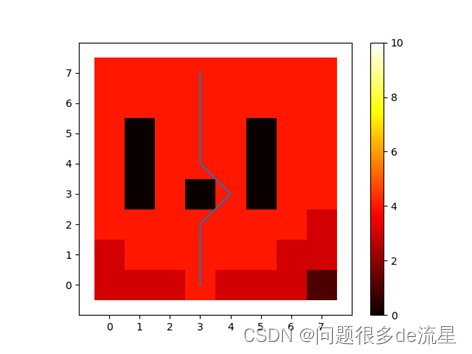
完成第二次搜索图。
总结
D* 算法融合了D算法和A* 算法,可以处理局部动态障碍,运算速度很快。
原本的伪代码是这样的,我根据我地图的实际情况进行了改变。
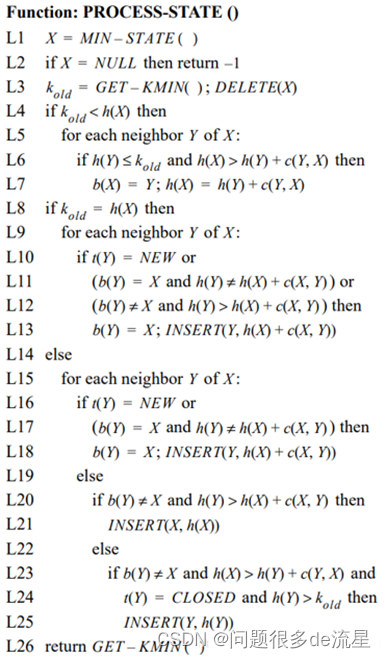
k_old<h(x): 当前h(x)升高说明原来的路径已经不是最优的了,如果在x周围能找到一个点,h.y+c(x,y)更小,那就修改x的父节点,重置其h的值。
k_old=h(x): 它的父节点是X,但是h.y却不等, 设想一下说明这说明h.y被更改了,但是父节点还没有变。
参考原文链接:D*规划算法及python实现
声明:本文内容由网友自发贡献,不代表【wpsshop博客】立场,版权归原作者所有,本站不承担相应法律责任。如您发现有侵权的内容,请联系我们。转载请注明出处:https://www.wpsshop.cn/article/detail/53036?site
推荐阅读


相关标签

