
热门标签
热门文章
- 1uniapp打包安卓app,获取app的权限数据,并弹窗提示设置app权限_uniapp 权限提示框上的内容安卓
- 2muduo库base源码分析二 (原子性操作AtomicIntegerT类封装)_#if !defined(ndebug) && !defined(google_protobuf_n
- 3Python对中国电信消费者特征预测:随机森林、朴素贝叶斯、神经网络、最近邻分类、逻辑回归、支持向量回归(SVR)...
- 4Fontawesome字体使用说明及其常用效果语法
- 5常见凭证获取方法_kiwi获取密码
- 6玩转k8s:yaml介绍
- 7什么是AB实验?能解决什么问题?终于有人讲明白了
- 8selenium之qq邮箱登录-发邮件_selenium登录qq邮箱
- 9Leetcode刷题 - task2 - 字符串与字符串匹配(5 天)_任意给定一个模式字符串pattern,和一个字符串str,返回str中被pattern匹配的部分,
- 102023年十篇具有影响力的人工智能研究论文
当前位置: article > 正文
《统计学习方法:李航》笔记 从原理到实现(基于python)-- 第5章 决策树(代码python实践)
作者:算法设计者 | 2024-02-01 09:29:34
赞
踩
《统计学习方法:李航》笔记 从原理到实现(基于python)-- 第5章 决策树(代码python实践)
《统计学习方法:李航》笔记 从原理到实现(基于python)-- 第5章 决策树
第5章 决策树—python 实践
import numpy as np
import pandas as pd
import matplotlib.pyplot as plt
%matplotlib inline

from sklearn.datasets import load_iris
from sklearn.model_selection import train_test_split
from collections import Counter
import math
from math import log
import pprint
- 1
- 2
- 3
- 4
- 5
- 6
- 7
- 8
- 9
- 10
- 11
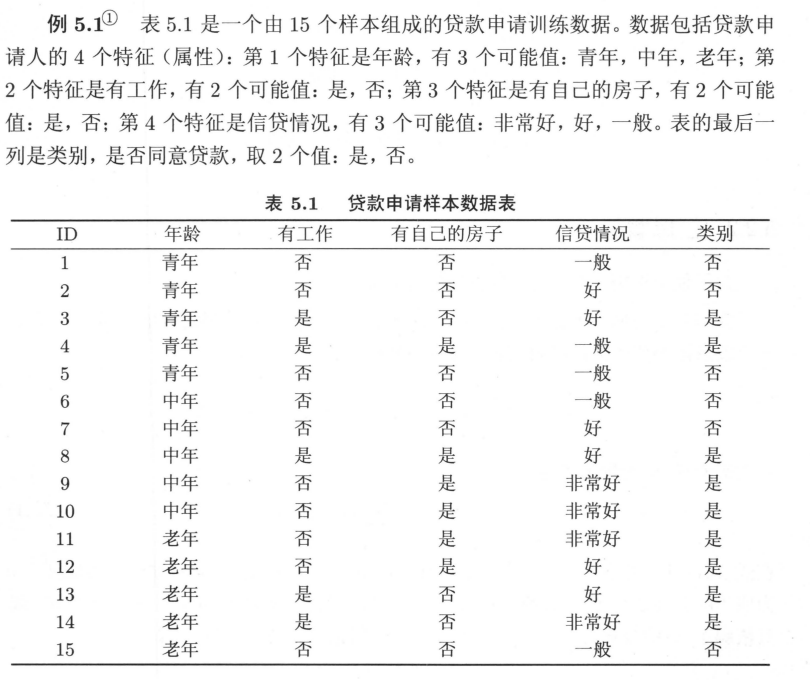
书上题目5.1
def create_data():
    datasets = [['青年', '否', '否', '一般', '否'],
               ['青年', '否', '否', '好', '否'],
               ['青年', '是', '否', '好', '是'],
               ['青年', '是', '是', '一般', '是'],
               ['青年', '否', '否', '一般', '否'],
               ['中年', '否', '否', '一般', '否'],
               ['中年', '否', '否', '好', '否'],
               ['中年', '是', '是', '好', '是'],
               ['中年', '否', '是', '非常好', '是'],
               ['中年', '否', '是', '非常好', '是'],
               ['老年', '否', '是', '非常好', '是'],
               ['老年', '否', '是', '好', '是'],
               ['老年', '是', '否', '好', '是'],
               ['老年', '是', '否', '非常好', '是'],
               ['老年', '否', '否', '一般', '否'],
               ]
    labels = [u'年龄', u'有工作', u'有自己的房子', u'信贷情况', u'类别']
    # 返回数据集和每个维度的名称
    return datasets, labels
- 1
- 2
- 3
- 4
- 5
- 6
- 7
- 8
- 9
- 10
- 11
- 12
- 13
- 14
- 15
- 16
- 17
- 18
- 19
- 20
datasets, labels = create_data()
train_data = pd.DataFrame(datasets, columns=labels)
- 1
- 2
	# 熵
def calc_ent(datasets):
    data_length = len(datasets)
    label_count = {}
    for i in range(data_length):
        label = datasets[i][-1]
        if label not in label_count:
            label_count[label] = 0
        label_count[label] += 1
    ent = -sum([(p / data_length) * log(p / data_length, 2)
                for p in label_count.values()])
    return ent

# 经验条件熵
def cond_ent(datasets, axis=0):
    data_length = len(datasets)
    feature_sets = {}
    for i in range(data_length):
        feature = datasets[i][axis]
        if feature not in feature_sets:
            feature_sets[feature] = []
        feature_sets[feature].append(datasets[i])
    cond_ent = sum(
        [(len(p) / data_length) * calc_ent(p) for p in feature_sets.values()])
    return cond_ent

# 信息增益:熵-经验条件熵
def info_gain(ent, cond_ent):
    return ent - cond_ent

def info_gain_train(datasets):
    count = len(datasets[0]) - 1
    ent = calc_ent(datasets)

    best_feature = []
    for c in range(count):
        c_info_gain = info_gain(ent, cond_ent(datasets, axis=c))
        best_feature.append((c, c_info_gain))
        print('特征({}) - info_gain - {:.3f}'.format(labels[c], c_info_gain))
    # 比较大小
    best_ = max(best_feature, key=lambda x: x[-1])
    return '特征({})的信息增益最大,选择为根节点特征'.format(labels[best_[0]])
- 1
- 2
- 3
- 4
- 5
- 6
- 7
- 8
- 9
- 10
- 11
- 12
- 13
- 14
- 15
- 16
- 17
- 18
- 19
- 20
- 21
- 22
- 23
- 24
- 25
- 26
- 27
- 28
- 29
- 30
- 31
- 32
- 33
- 34
- 35
- 36
- 37
- 38
- 39
- 40
- 41
- 42
info_gain_train(np.array(datasets))
===================================
特征(年龄) - info_gain - 0.083
特征(有工作) - info_gain - 0.324
特征(有自己的房子) - info_gain - 0.420
特征(信贷情况) - info_gain - 0.363
'特征(有自己的房子)的信息增益最大,选择为根节点特征'
- 1
- 2
- 3
- 4
- 5
- 6
- 7
利用ID3算法生成决策树,例5.3
# 定义节点类 二叉树
class Node:
    def __init__(self, root=True, label=None, feature_name=None, feature=None):
        self.root = root
        self.label = label
        self.feature_name = feature_name
        self.feature = feature
        self.tree = {}
        self.result = {
            'label:': self.label,
            'feature': self.feature,
            'tree': self.tree
        }

    def __repr__(self):
        return '{}'.format(self.result)

    def add_node(self, val, node):
        self.tree[val] = node

    def predict(self, features):
        if self.root is True:
            return self.label
        return self.tree[features[self.feature]].predict(features)

class DTree:
    def __init__(self, epsilon=0.1):
        self.epsilon = epsilon
        self._tree = {}

    # 熵
    @staticmethod
    def calc_ent(datasets):
        data_length = len(datasets)
        label_count = {}
        for i in range(data_length):
            label = datasets[i][-1]
            if label not in label_count:
                label_count[label] = 0
            label_count[label] += 1
        ent = -sum([(p / data_length) * log(p / data_length, 2)
                    for p in label_count.values()])
        return ent

    # 经验条件熵
    def cond_ent(self, datasets, axis=0):
        data_length = len(datasets)
        feature_sets = {}
        for i in range(data_length):
            feature = datasets[i][axis]
            if feature not in feature_sets:
                feature_sets[feature] = []
            feature_sets[feature].append(datasets[i])
        cond_ent = sum([(len(p) / data_length) * self.calc_ent(p)
                        for p in feature_sets.values()])
        return cond_ent

    # 信息增益
    @staticmethod
    def info_gain(ent, cond_ent):
        return ent - cond_ent

    def info_gain_train(self, datasets):
        count = len(datasets[0]) - 1
        ent = self.calc_ent(datasets)
        best_feature = []
        for c in range(count):
            c_info_gain = self.info_gain(ent, self.cond_ent(datasets, axis=c))
            best_feature.append((c, c_info_gain))
        # 比较大小
        best_ = max(best_feature, key=lambda x: x[-1])
        return best_

    def train(self, train_data):
        """
        input:数据集D(DataFrame格式),特征集A,阈值eta
        output:决策树T
        """
        _, y_train, features = train_data.iloc[:, :
                                               -1], train_data.iloc[:,
                                                                    -1], train_data.columns[:
                                                                                            -1]
        # 1,若D中实例属于同一类Ck,则T为单节点树,并将类Ck作为结点的类标记,返回T
        if len(y_train.value_counts()) == 1:
            return Node(root=True, label=y_train.iloc[0])

        # 2, 若A为空,则T为单节点树,将D中实例树最大的类Ck作为该节点的类标记,返回T
        if len(features) == 0:
            return Node(
                root=True,
                label=y_train.value_counts().sort_values(
                    ascending=False).index[0])

        # 3,计算最大信息增益 同5.1,Ag为信息增益最大的特征
        max_feature, max_info_gain = self.info_gain_train(np.array(train_data))
        max_feature_name = features[max_feature]

        # 4,Ag的信息增益小于阈值eta,则置T为单节点树,并将D中是实例数最大的类Ck作为该节点的类标记,返回T
        if max_info_gain < self.epsilon:
            return Node(
                root=True,
                label=y_train.value_counts().sort_values(
                    ascending=False).index[0])

        # 5,构建Ag子集
        node_tree = Node(
            root=False, feature_name=max_feature_name, feature=max_feature)

        feature_list = train_data[max_feature_name].value_counts().index
        for f in feature_list:
            sub_train_df = train_data.loc[train_data[max_feature_name] ==
                                          f].drop([max_feature_name], axis=1)

            # 6, 递归生成树
            sub_tree = self.train(sub_train_df)
            node_tree.add_node(f, sub_tree)

        # pprint.pprint(node_tree.tree)
        return node_tree

    def fit(self, train_data):
        self._tree = self.train(train_data)
        return self._tree

    def predict(self, X_test):
        return self._tree.predict(X_test)
- 1
- 2
- 3
- 4
- 5
- 6
- 7
- 8
- 9
- 10
- 11
- 12
- 13
- 14
- 15
- 16
- 17
- 18
- 19
- 20
- 21
- 22
- 23
- 24
- 25
- 26
- 27
- 28
- 29
- 30
- 31
- 32
- 33
- 34
- 35
- 36
- 37
- 38
- 39
- 40
- 41
- 42
- 43
- 44
- 45
- 46
- 47
- 48
- 49
- 50
- 51
- 52
- 53
- 54
- 55
- 56
- 57
- 58
- 59
- 60
- 61
- 62
- 63
- 64
- 65
- 66
- 67
- 68
- 69
- 70
- 71
- 72
- 73
- 74
- 75
- 76
- 77
- 78
- 79
- 80
- 81
- 82
- 83
- 84
- 85
- 86
- 87
- 88
- 89
- 90
- 91
- 92
- 93
- 94
- 95
- 96
- 97
- 98
- 99
- 100
- 101
- 102
- 103
- 104
- 105
- 106
- 107
- 108
- 109
- 110
- 111
- 112
- 113
- 114
- 115
- 116
- 117
- 118
- 119
- 120
- 121
- 122
- 123
- 124
- 125
- 126
datasets, labels = create_data()
data_df = pd.DataFrame(datasets, columns=labels)
dt = DTree()
tree = dt.fit(data_df)
- 1
- 2
- 3
- 4
tree
=============================
{'label:': None, 'feature': 2, 'tree': {'否': {'label:': None, 'feature': 1, 'tree': {'否': {'label:': '否', 'feature': None, 'tree': {}}, '是': {'label:': '是', 'feature': None, 'tree': {}}}}, '是': {'label:': '是', 'feature': None, 'tree': {}}}}
- 1
- 2
- 3
dt.predict(['老年', '否', '否', '一般'])
================================
'否'
- 1
- 2
- 3
scikit-learn实例
# data
def create_data():
    iris = load_iris()
    df = pd.DataFrame(iris.data, columns=iris.feature_names)
    df['label'] = iris.target
    df.columns = [
        'sepal length', 'sepal width', 'petal length', 'petal width', 'label'
    ]
    data = np.array(df.iloc[:100, [0, 1, -1]])
    # print(data)
    return data[:, :2], data[:, -1]

X, y = create_data()
X_train, X_test, y_train, y_test = train_test_split(X, y, test_size=0.3)
- 1
- 2
- 3
- 4
- 5
- 6
- 7
- 8
- 9
- 10
- 11
- 12
- 13
- 14
from sklearn.tree import DecisionTreeClassifier
from sklearn.tree import export_graphviz
import graphviz
- 1
- 2
- 3
clf = DecisionTreeClassifier()
clf.fit(X_train, y_train,)
===================================
DecisionTreeClassifier(class_weight=None, criterion='gini', max_depth=None,
            max_features=None, max_leaf_nodes=None,
            min_impurity_decrease=0.0, min_impurity_split=None,
            min_samples_leaf=1, min_samples_split=2,
            min_weight_fraction_leaf=0.0, presort=False, random_state=None,
            splitter='best')
- 1
- 2
- 3
- 4
- 5
- 6
- 7
- 8
- 9
clf.score(X_test, y_test)
==============================
0.9666666666666667
- 1
- 2
- 3
tree_pic = export_graphviz(clf, out_file="mytree.pdf")
with open('mytree.pdf') as f:
    dot_graph = f.read()

==============================
graphviz.Source(dot_graph)
<graphviz.files.Source at 0x1f159bc2780>
- 1
- 2
- 3
- 4
- 5
- 6
- 7
声明:本文内容由网友自发贡献,不代表【wpsshop博客】立场,版权归原作者所有,本站不承担相应法律责任。如您发现有侵权的内容,请联系我们。转载请注明出处:https://www.wpsshop.cn/article/detail/52928
推荐阅读

相关标签

