
- 1SublimeText调试JS操作方法_sublime text 调试 javascript
- 2AtCoder 注册、如何参加Atcoder的比赛_atcoder注册
- 3C++ 蓝桥杯之 龟兔赛跑预测_c++龟兔赛跑预测
- 4数据结构和算法之排序总结_排序算法的技术要点和设计要求
- 52022年蓝桥杯Python程序设计B组思路和代码分享
- 6uniapp h5发行_uniapp 发布h5
- 7【Godot】学习状态机和行为树的 Godot 网址_godot教程网站
- 8讯飞星火认知大模型 Nodejs SDK & Web使用_讯飞 spark nodejs 部署
- 9华为OD机试真题- 最小的调整次数【2023Q1】【JAVA、Python、C++】_最小调整次数华为od
- 10Python 之 Pandas DataFrame 数据类型的简介、创建的列操作_python pandas dataframe
Codeforces Round 785 C. Palindrome Basis
赞
踩
C. Palindrome Basis
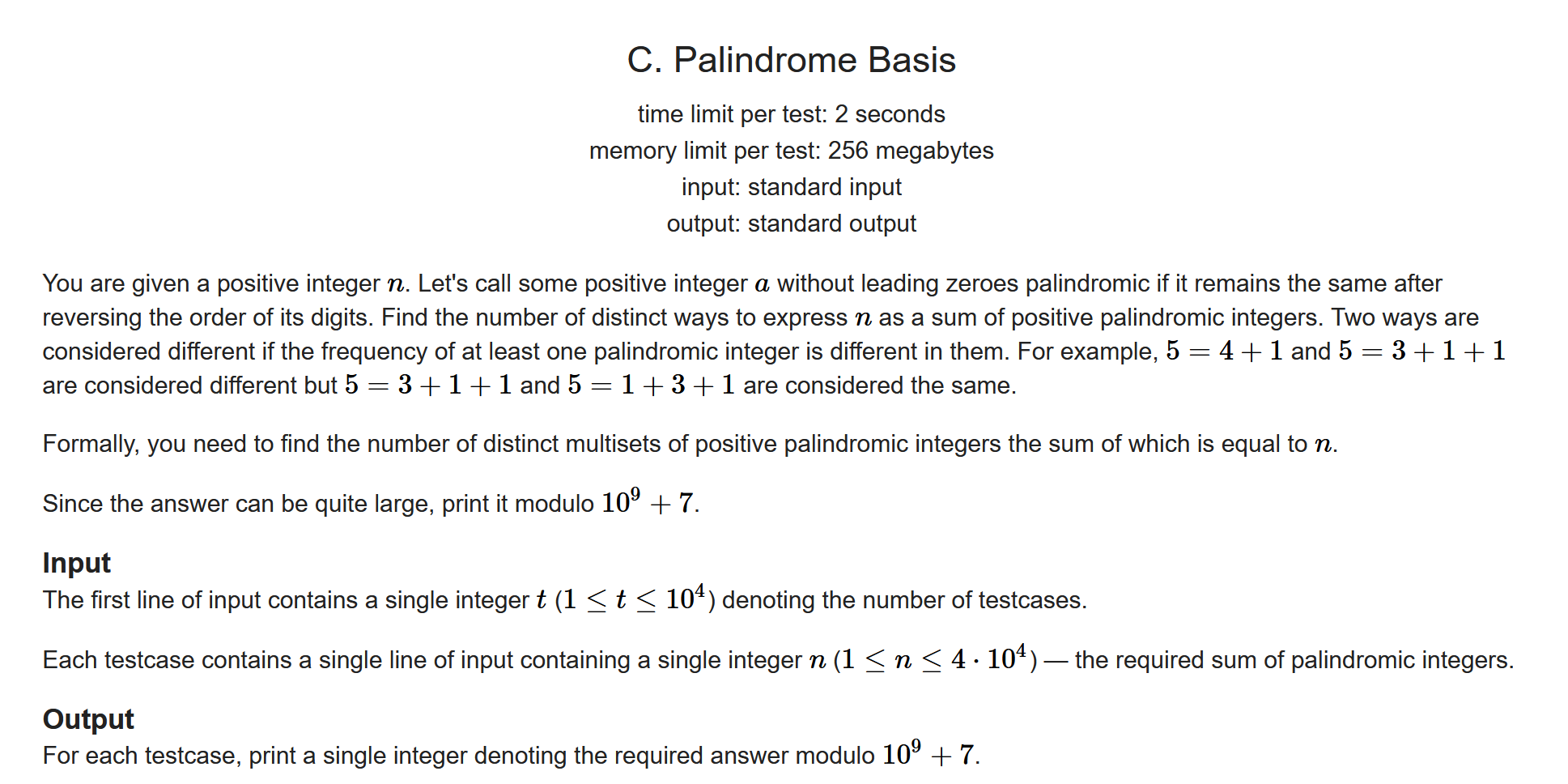
题意
定义一个正整数 a a a 是回文的(没有前导 0 0 0)当且仅当: a a a 的十进制表示形式回文
给定一个正整数 n n n ,求出将 n n n 拆分成若干个回文数之和的方案数
思路
这是一个经典模型,与爬楼梯问题不同的是:这道题一个物品的选择先后顺序无关
在
n
≤
4
⋅
1
0
4
n \leq 4 \cdot 10^4
n≤4⋅104 时,求出回文数字共有
498
498
498 个,考虑
D
P
DP
DP:
用
d
p
[
i
]
[
j
]
dp[i][j]
dp[i][j] 表示只使用前
j
j
j 个回文数字来构成
i
i
i 的方案数,那么转移为:
d p [ i ] [ j ] = d p [ i ] [ j − 1 ] + d p [ i − P [ j ] [ j ] , P [ j ] ≤ i dp[i][j] = dp[i][j-1] + dp[i - P[j][j],P[j] \leq i dp[i][j]=dp[i][j−1]+dp[i−P[j][j],P[j]≤i
意思就是:不用第 j j j 个回文数字 加上 使用 P [ j ] P[j] P[j] 的方案数。
初始化: ∀ j ∈ [ 1 , 498 ] , d p [ 0 ] [ j ] = 1 \forall j \in [1,498],dp[0][j] = 1 ∀j∈[1,498],dp[0][j]=1
#include<bits/stdc++.h>
#define fore(i,l,r)	for(int i=(int)(l);i<(int)(r);++i)
#define fi first
#define se second
#define endl '\n'
#define ull unsigned long long
#define ALL(v) v.begin(), v.end()
#define Debug(x, ed) std::cerr << #x << " = " << x << ed;

const int INF=0x3f3f3f3f;
const long long INFLL=1e18;

typedef long long ll;

template<class T>
constexpr T power(T a, ll b){
    T res = 1;
    while(b){
        if(b&1) res = res * a;
        a = a * a;
        b >>= 1;
    }
    return res;
}

constexpr ll mul(ll a,ll b,ll mod){ //快速乘,避免两个long long相乘取模溢出
    ll res = a * b - ll(1.L * a * b / mod) * mod;
    res %= mod;
    if(res < 0) res += mod; //误差
    return res;
}

template<ll P>
struct MLL{
    ll x;
    constexpr MLL() = default;
    constexpr MLL(ll x) : x(norm(x % getMod())) {}

    static ll Mod;
    constexpr static ll getMod(){
       if(P > 0) return P;
       return Mod;
    }

    constexpr static void setMod(int _Mod){
       Mod = _Mod;
    }
    constexpr ll norm(ll x) const{
       if(x < 0){
           x += getMod();
       }
       if(x >= getMod()){
           x -= getMod();
       }
       return x;
    }
    constexpr ll val() const{
       return x;
    }
    explicit constexpr operator ll() const{
       return x; //将结构体显示转换为ll类型: ll res = static_cast<ll>(OBJ)
    }
    constexpr MLL operator -() const{ //负号,等价于加上Mod
       MLL res;
       res.x = norm(getMod() - x);
       return res;
    }
    constexpr MLL inv() const{
       assert(x != 0);
       return power(*this, getMod() - 2); //用费马小定理求逆
    }
    constexpr MLL& operator *= (MLL rhs) & { //& 表示“this”指针不能指向一个临时对象或const对象
       x = mul(x, rhs.x, getMod()); //该函数只能被一个左值调用
       return *this;
    }
    constexpr MLL& operator += (MLL rhs) & {
       x = norm(x + rhs.x);
       return *this;
    }
    constexpr MLL& operator -= (MLL rhs) & {
       x = norm(x - rhs.x);
       return *this;
    }
    constexpr MLL& operator /= (MLL rhs) & {
       return *this *= rhs.inv();
    }
    friend constexpr MLL operator * (MLL lhs, MLL rhs){
       MLL res = lhs;
       res *= rhs;
       return res;
    }
    friend constexpr MLL operator + (MLL lhs, MLL rhs){
       MLL res = lhs;
       res += rhs;
       return res;
    }
    friend constexpr MLL operator - (MLL lhs, MLL rhs){
       MLL res = lhs;
       res -= rhs;
       return res;
    }
    friend constexpr MLL operator / (MLL lhs, MLL rhs){
       MLL res = lhs;
       res /= rhs;
       return res;
    }
    friend constexpr std::istream& operator >> (std::istream& is, MLL& a){
       ll v;
       is >> v;
       a = MLL(v);
       return is;
    }
    friend constexpr std::ostream& operator << (std::ostream& os, MLL& a){
       return os << a.val();
    }
    friend constexpr bool operator == (MLL lhs, MLL rhs){
       return lhs.val() == rhs.val();
    }
    friend constexpr bool operator != (MLL lhs, MLL rhs){
       return lhs.val() != rhs.val();
    }
};

const ll mod = 1e9 + 7;
using Z = MLL<mod>;

bool f(int x){
    if(x < 10) return true;
    std::string s = std::to_string(x);
    int len = s.size();
    fore(i, 0, len / 2)
        if(s[i] != s[len - 1 - i])
            return false;
    return true;
}

int main(){
    std::ios::sync_with_stdio(false);
    std::cin.tie(nullptr);
    std::cout.tie(nullptr);
    std::vector<int> PN;
    PN.push_back(0);
    fore(i, 1, 40001)
        if(f(i))
            PN.push_back(i);
    std::vector<std::vector<Z>> dp(40005, std::vector<Z>(505, 0));
    fore(j, 1, 500) dp[0][j] = 1;
    fore(i, 1, 40001)
        fore(j, 1, 500)
            if(PN[j] <= i) dp[i][j] = dp[i][j - 1] + dp[i - PN[j]][j];
            else dp[i][j] = dp[i][j - 1];
    int t;
    std::cin >> t;
    while(t--){
        int n;
        std::cin >> n;
        std::cout << dp[n][498] << endl;
    }
    return 0;
}

- 1
- 2
- 3
- 4
- 5
- 6
- 7
- 8
- 9
- 10
- 11
- 12
- 13
- 14
- 15
- 16
- 17
- 18
- 19
- 20
- 21
- 22
- 23
- 24
- 25
- 26
- 27
- 28
- 29
- 30
- 31
- 32
- 33
- 34
- 35
- 36
- 37
- 38
- 39
- 40
- 41
- 42
- 43
- 44
- 45
- 46
- 47
- 48
- 49
- 50
- 51
- 52
- 53
- 54
- 55
- 56
- 57
- 58
- 59
- 60
- 61
- 62
- 63
- 64
- 65
- 66
- 67
- 68
- 69
- 70
- 71
- 72
- 73
- 74
- 75
- 76
- 77
- 78
- 79
- 80
- 81
- 82
- 83
- 84
- 85
- 86
- 87
- 88
- 89
- 90
- 91
- 92
- 93
- 94
- 95
- 96
- 97
- 98
- 99
- 100
- 101
- 102
- 103
- 104
- 105
- 106
- 107
- 108
- 109
- 110
- 111
- 112
- 113
- 114
- 115
- 116
- 117
- 118
- 119
- 120
- 121
- 122
- 123
- 124
- 125
- 126
- 127
- 128
- 129
- 130
- 131
- 132
- 133
- 134
- 135
- 136
- 137
- 138
- 139
- 140
- 141
- 142
- 143
- 144
- 145
- 146
- 147
- 148
- 149
- 150
- 151
- 152
- 153
- 154
- 155
- 156
- 157
- 158
- 159
- 160

