- 1特征值和特征向量_置换矩阵的特征向量
- 24.docker之基本三要素(镜像,容器,仓库)_容器镜像 要素
- 3云服务器环境搭建(详细教程)——安装JDK环境、TomCat服务器、MySQL数据库_云服务器搭建
- 4回归预测 | MATLAB实现TCN-LSTM时间卷积长短期记忆神经网络多输入单输出回归预测
- 5Oracle数据库常用操作指令_orcl数据库命令
- 6Python基于DES算法的企业用户安全系统的研究与实现
- 7竞码编程-蓝桥杯模拟赛2(大学生组&青少年组)_一些数字可以颠倒过来看例如0,1,8车牌,请问这个城市
- 8Java开发工程师项目经验以及个人介绍实例
- 9对话弹窗的头部样式_el-dialog自定义头部
- 10[pyqt5]如何给工具栏图标添加资源文件_pyqt5.15 designer添加file
c++11线程池的实现原理及回调函数的使用_c++ 回调函数 多线程
赞
踩
关于线程池
简单来说就是有一堆已经创建好的线程(最大数目一定),初始时他们都处于空闲状态。当有新的任务进来,从线程池中取出一个空闲的线程处理任务然后当任务处理完成之后,该线程被重新放回到线程池中,供其他的任务使用。当线程池中的线程都在处理任务时,就没有空闲线程供使用,此时,若有新的任务产生,只能等待线程池中有线程结束任务空闲才能执行。
线程池优点
线程本来就是可重用的资源,不需要每次使用时都进行初始化。因此可以采用有限的线程个数处理无限的任务。既可以提高速度和效率,又降低线程频繁创建的开销。比如要异步干的活,就没必要等待。丢到线程池里处理,结果在回调中处理。频繁执行的异步任务,若每次都创建线程势必造成不小的开销。像java中频繁执行的异步任务,就new Therad{}.start(),然后就不管了不是个好的办法,频繁调用可能会触发GC,带来严重的性能问题,类似这种就该使用线程池。
还比如把计算任务都放在主线程进行,那么势必会阻塞主线程的处理流程,无法做到实时处理。使用多线程技术是大家自然而然想到的方案。在上述的场景中必然会频繁的创建和销毁线程,这样的开销相信是不能接受的,此时线程池技术便是很好的选择。
另外在一些高并发的网络应用中,线程池也是常用的技术。陈硕大神推荐的C++多线程服务端编程模式为:one loop per thread + thread pool,通常会有单独的线程负责接受来自客户端的请求,对请求稍作解析后将数据处理的任务提交到专门的计算线程池。
实现原理及思路
大致原理是创建一个类,管理一个任务队列,一个线程队列。然后每次取一个任务分配给一个线程去做,循环往复。任务队列负责存放主线程需要处理的任务,工作线程队列其实是一个死循环,负责从任务队列中取出和运行任务,可以看成是一个生产者和多个消费者的模型。
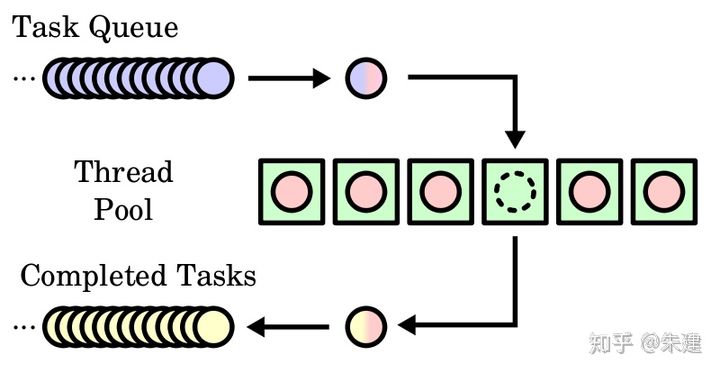
c++11虽然加入了线程库thread,然而 c++ 对于多线程的支持还是比较低级,稍微高级一点的用法都需要自己去实现,还有备受期待的网络库,至今标准库里还没有支持,常用asio替代。感谢网上大神的奉献,这里贴上源码并完善下使用方法,主要是增加了使用示例及回调函数的使用。
使用举例
- #include <iostream>
- #include <chrono>
- #include <thread>
- #include <future>
- #include "threadpool.h"
- using namespace std;
- using namespace std::chrono;
-
- //仿函数示例
- struct gfun {
- int operator()(int n) {
- printf("%d hello, gfun ! %d\n" ,n, std::this_thread::get_id() );
- return 42;
- }
- };
-
- class A {
- public:
- static std::string Bfun(int n, std::string str, char c) {
- std::cout << n << " hello, Bfun ! "<< str.c_str() <<" " << (int)c <<" " << std::this_thread::get_id() << std::endl;
- return str;
- }
- };
-
-
- int main() {
-
- cout << "hello,this is a test using threadpool" <<endl;
-
- me::ThreadPool pool(4);
- std::vector< std::future<int> > results;
-
- //lambada表达式 匿名函数线程中执行
- pool.commit([] {
- std::cout << "this is running in pool therad " << std::endl;
- std::this_thread::sleep_for(std::chrono::seconds(1));
- });
-
- //仿函数放到线程池中执行
- std::future<int> fg = pool.commit(gfun{},0);
-
- std::future<std::string> gh = pool.commit(A::Bfun, 999,"mult args", 123);
- //回调函数示例,模拟耗时操作,结果回调输出
- auto fetchDataFromDB = [](std::string recvdData,std::function<int(std::string &)> cback) {
- // Make sure that function takes 5 seconds to complete
- std::this_thread::sleep_for(seconds(5));
- //Do stuff like creating DB Connection and fetching Data
- if(cback != nullptr){
- std::string out = "this is from callback ";
- cback(out);
- }
- return "DB_" + recvdData;
- };
-
- //模拟,回调
- fetchDataFromDB("aaa",[&](std::string &result){
- std::cout << "callback result:" << result << std::endl;
- return 0;
- } );
-
- //把fetchDataFromDB这一IO耗时任务放到线程里异步执行
- //
- std::future<std::string> resultFromDB = std::async(std::launch::async, fetchDataFromDB, "Data0",
- [&](std::string &result){
- std::cout << "callback result from thread:" << result << std::endl;
- return 0;
- });
-
-
- //把fetchDataFromDB这一IO耗时操作放到pool中的效果
- pool.commit(fetchDataFromDB,"Data1",[&](std::string &result){
- std::cout << "callback result from pool thread:" << result << std::endl;
- return 0;
- });
-
-
- for(int i = 0; i < 8; ++i) {
- results.emplace_back(
- pool.commit([i] {
- std::cout << "hello " << i << std::endl;
- std::this_thread::sleep_for(std::chrono::seconds(1));
- std::cout << "world " << i << std::endl;
- return i*i;
- })
- );
- }
-
- for(auto && result: results){
- std::cout << result.get() << ' ';
- }
- std::cout << std::endl;
- }
以下是具体实现过程:
- #pragma once
- #ifndef THREAD_POOL_H
- #define THREAD_POOL_H
-
- #include <vector>
- #include <queue>
- #include <atomic>
- #include <future>
- //#include <condition_variable>
- //#include <thread>
- #include <functional>
- #include <stdexcept>
-
- namespace me
- {
- using namespace std;
- //线程池最大容量,应尽量设小一点
- #define THREADPOOL_MAX_NUM 16
- //#define THREADPOOL_AUTO_GROW
-
- //线程池,可以提交变参函数或拉姆达表达式的匿名函数执行,可以获取执行返回值
- //不直接支持类成员函数, 支持类静态成员函数或全局函数,Opteron()函数等
- class ThreadPool
- {
- using Task = function<void()>; //定义类型
- vector<thread> _pool; //线程池
- queue<Task> _tasks; //任务队列
- mutex _lock; //同步
- condition_variable _task_cv; //条件阻塞
- atomic<bool> _run{ true }; //线程池是否执行
- atomic<int> _idlThrNum{ 0 }; //空闲线程数量
-
- public:
- inline ThreadPool(unsigned short size = 4) { addThread(size); }
- inline ~ThreadPool()
- {
- _run=false;
- _task_cv.notify_all(); // 唤醒所有线程执行
- for (thread& thread : _pool) {
- //thread.detach(); // 让线程“自生自灭”
- if(thread.joinable())
- thread.join(); // 等待任务结束, 前提:线程一定会执行完
- }
- }
-
- public:
- // 提交一个任务
- // 调用.get()获取返回值会等待任务执行完,获取返回值
- // 有两种方法可以实现调用类成员,
- // 一种是使用 bind: .commit(std::bind(&Dog::sayHello, &dog));
- // 一种是用 mem_fn: .commit(std::mem_fn(&Dog::sayHello), this)
- template<class F, class... Args>
- auto commit(F&& f, Args&&... args) ->future<decltype(f(args...))>
- {
- if (!_run) // stoped ??
- throw runtime_error("commit on ThreadPool is stopped.");
-
- using RetType = decltype(f(args...)); // typename std::result_of<F(Args...)>::type, 函数 f 的返回值类型
- auto task = make_shared<packaged_task<RetType()>>(
- bind(forward<F>(f), forward<Args>(args)...)
- ); // 把函数入口及参数,打包(绑定)
- future<RetType> future = task->get_future();
- { // 添加任务到队列
- lock_guard<mutex> lock{ _lock };//对当前块的语句加锁 lock_guard 是 mutex 的 stack 封装类,构造的时候 lock(),析构的时候 unlock()
- _tasks.emplace([task](){ // push(Task{...}) 放到队列后面
- (*task)();
- });
- }
- #ifdef THREADPOOL_AUTO_GROW
- if (_idlThrNum < 1 && _pool.size() < THREADPOOL_MAX_NUM)
- addThread(1);
- #endif // !THREADPOOL_AUTO_GROW
- _task_cv.notify_one(); // 唤醒一个线程执行
-
- return future;
- }
-
- //空闲线程数量
- int idlCount() { return _idlThrNum; }
- //线程数量
- int thrCount() { return _pool.size(); }
- #ifndef THREADPOOL_AUTO_GROW
- private:
- #endif // !THREADPOOL_AUTO_GROW
- //添加指定数量的线程
- void addThread(unsigned short size)
- {
- for (; _pool.size() < THREADPOOL_MAX_NUM && size > 0; --size)
- { //增加线程数量,但不超过 预定义数量 THREADPOOL_MAX_NUM
- _pool.emplace_back( [this]{ //工作线程函数
- while (_run)
- {
- Task task; // 获取一个待执行的 task
- {
- // unique_lock 相比 lock_guard 的好处是:可以随时 unlock() 和 lock()
- unique_lock<mutex> lock{ _lock };
- _task_cv.wait(lock, [this]{
- return !_run || !_tasks.empty();
- }); // wait 直到有 task
- if (!_run && _tasks.empty())
- return;
- task = move(_tasks.front()); // 按先进先出从队列取一个 task
- _tasks.pop();
- }
- _idlThrNum--;
- task();//执行任务
- _idlThrNum++;
- }
- });
- _idlThrNum++;
- }
- }
- };
-
- }
-
- #endif //https://github.com/lzpong/
另一种实现
- // A simple thread pool class.
- // Usage examples:
- //
- // {
- // ThreadPool pool(16); // 16 worker threads.
- // for (int i = 0; i < 100; ++i) {
- // pool.Schedule([i]() {
- // DoSlowExpensiveOperation(i);
- // });
- // }
- //
- // // `pool` goes out of scope here - the code will block in the ~ThreadPool
- // // destructor until all work is complete.
- // }
- //
- // // TODO(cbraley): Add examples with std::future.
-
- #include <cassert>
- #include <condition_variable>
- #include <functional>
- #include <future>
- #include <mutex>
- #include <queue>
- #include <thread>
- #include <vector>
-
- // This file contains macros that we use to workaround some features that aren't
- // available in C++11.
-
- // We want to use std::invoke if C++17 is available, and fallback to "hand
- // crafted" code if std::invoke isn't available.
- //#if __cplusplus >= 201703L
- //#define INVOKE_MACRO(CALLABLE, ARGS_TYPE, ARGS) std::invoke(CALLABLE, std::forward<ARGS_TYPE>(ARGS)...)
- //#elif __cplusplus >= 201103L
- // Update this with http://www.open-std.org/jtc1/sc22/wg21/docs/papers/2014/n4169.html.
- #define INVOKE_MACRO(CALLABLE, ARGS_TYPE, ARGS) CALLABLE(std::forward<ARGS_TYPE>(ARGS)...)
- //#else
- //#error ("C++ version is too old! C++98 is not supported.")
- //#endif
-
- namespace cb
- {
-
- namespace impl
- {
-
- // This helper class simply returns a std::function that executes:
- // ReturnT x = func();
- // promise->set_value(x);
- // However, this is tricky in the case where T == void. The code above won't
- // compile if ReturnT == void, and neither will
- // promise->set_value(func());
- // To workaround this, we use a template specialization for the case where
- // ReturnT is void. If the "regular void" proposal is accepted, this could be
- // simpler:
- // http://www.open-std.org/jtc1/sc22/wg21/docs/papers/2016/p0146r1.html.
-
- // The non-specialized `FuncWrapper` implementation handles callables that
- // return a non-void value.
- template <typename ReturnT>
- struct FuncWrapper
- {
- template <typename FuncT, typename... ArgsT>
- std::function<void()> GetWrapped(FuncT&& func, std::shared_ptr<std::promise<ReturnT>> promise, ArgsT&&... args)
- {
- // TODO(cbraley): Capturing by value is inefficient. It would be more
- // efficient to move-capture everything, but we can't do this until C++14
- // generalized lambda capture is available. Can we use std::bind instead to
- // make this more efficient and still use C++11?
- return [promise, func, args...]() mutable { promise->set_value(INVOKE_MACRO(func, ArgsT, args)); };
- }
- };
-
- template <typename FuncT, typename... ArgsT>
- void InvokeVoidRet(FuncT&& func, std::shared_ptr<std::promise<void>> promise, ArgsT&&... args)
- {
- INVOKE_MACRO(func, ArgsT, args);
- promise->set_value();
- }
-
- // This `FuncWrapper` specialization handles callables that return void.
- template <>
- struct FuncWrapper<void>
- {
- template <typename FuncT, typename... ArgsT>
- std::function<void()> GetWrapped(FuncT&& func, std::shared_ptr<std::promise<void>> promise, ArgsT&&... args)
- {
- return [promise, func, args...]() mutable {
- INVOKE_MACRO(func, ArgsT, args);
- promise->set_value();
- };
- }
- };
-
- } // namespace impl
-
- class ThreadPool
- {
- public:
- // Create a thread pool with `num_workers` dedicated worker threads.
- explicit ThreadPool(int num_workers) : num_workers_(num_workers)
- {
- assert(num_workers_ > 0);
- // TODO(cbraley): Handle thread construction exceptions.
- workers_.reserve(num_workers);
- for (int i = 0; i < num_workers; ++i)
- {
- workers_.emplace_back(&ThreadPool::ThreadLoop, this);
- }
- }
-
- // Default construction is disallowed.
- ThreadPool() = delete;
-
- // Get the number of logical cores on the CPU. This is implemented using
- // std::thread::hardware_concurrency().
- // https://en.cppreference.com/w/cpp/thread/thread/hardware_concurrency
- static unsigned int GetNumLogicalCores()
- {
- // TODO(cbraley): Apparently this is broken in some older stdlib
- // implementations?
- const unsigned int dflt = std::thread::hardware_concurrency();
- if (dflt == 0)
- {
- // TODO(cbraley): Return some error code instead.
- return 16;
- }
- else
- {
- return dflt;
- }
- }
-
- // The `ThreadPool` destructor blocks until all outstanding work is complete.
- ~ThreadPool()
- {
- // TODO(cbraley): The current thread could help out to drain the work_ queue
- // faster - for example, if there is work that hasn't yet been scheduled this
- // thread could "pitch in" to help finish faster.
-
- {
- std::lock_guard<std::mutex> scoped_lock(mu_);
- exit_ = true;
- }
- condvar_.notify_all(); // Tell *all* workers we are ready.
-
- for (std::thread& thread : workers_)
- {
- thread.join();
- }
- }
-
- // No copying, assigning, or std::move-ing.
- ThreadPool& operator=(const ThreadPool&) = delete;
- ThreadPool(const ThreadPool&) = delete;
- ThreadPool(ThreadPool&&) = delete;
- ThreadPool& operator=(ThreadPool&&) = delete;
-
- // Add the function `func` to the thread pool. `func` will be executed at some
- // point in the future on an arbitrary thread.
- void Schedule(std::function<void(void)> func)
- {
- ScheduleAndGetFuture(std::move(func)); // We ignore the returned std::future.
- }
-
- // Add `func` to the thread pool, and return a std::future that can be used to
- // access the function's return value.
- //
- // *** Usage example ***
- // Don't be alarmed by this function's tricky looking signature - this is
- // very easy to use. Here's an example:
- //
- // int ComputeSum(std::vector<int>& values) {
- // int sum = 0;
- // for (const int& v : values) {
- // sum += v;
- // }
- // return sum;
- // }
- //
- // ThreadPool pool = ...;
- // std::vector<int> numbers = ...;
- //
- // std::future<int> sum_future = ScheduleAndGetFuture(
- // []() {
- // return ComputeSum(numbers);
- // });
- //
- // // Do other work...
- //
- // std::cout << "The sum is " << sum_future.get() << std::endl;
- //
- // *** Details ***
- // Given a callable `func` that returns a value of type `RetT`, this
- // function returns a std::future<RetT> that can be used to access
- // `func`'s results.
- template <typename FuncT, typename... ArgsT>
- auto ScheduleAndGetFuture(FuncT&& func, ArgsT&&... args) -> std::future<decltype(INVOKE_MACRO(func, ArgsT, args))>
- {
- using ReturnT = decltype(INVOKE_MACRO(func, ArgsT, args));
-
- // We are only allocating this std::promise in a shared_ptr because
- // std::promise is non-copyable.
- std::shared_ptr<std::promise<ReturnT>> promise = std::make_shared<std::promise<ReturnT>>();
- std::future<ReturnT> ret_future = promise->get_future();
-
- impl::FuncWrapper<ReturnT> func_wrapper;
- std::function<void()> wrapped_func =
- func_wrapper.GetWrapped(std::forward<FuncT>(func), std::move(promise), std::forward<ArgsT>(args)...);
-
- // Acquire the lock, and then push the WorkItem onto the queue.
- {
- std::lock_guard<std::mutex> scoped_lock(mu_);
- WorkItem work;
- work.func = std::move(wrapped_func);
- work_.emplace(std::move(work));
- }
- condvar_.notify_one(); // Tell one worker we are ready.
- return ret_future;
- }
-
- // Wait for all outstanding work to be completed.
- void Wait()
- {
- std::unique_lock<std::mutex> lock(mu_);
- if (!work_.empty())
- {
- work_done_condvar_.wait(lock, [this] { return work_.empty(); });
- }
- }
-
- // Return the number of outstanding functions to be executed.
- int OutstandingWorkSize() const
- {
- std::lock_guard<std::mutex> scoped_lock(mu_);
- return work_.size();
- }
-
- // Return the number of threads in the pool.
- int NumWorkers() const { return num_workers_; }
-
- void SetWorkDoneCallback(std::function<void(int)> func) { work_done_callback_ = std::move(func); }
-
- private:
- void ThreadLoop()
- {
- // Wait until the ThreadPool sends us work.
- while (true)
- {
- WorkItem work_item;
-
- int prev_work_size = -1;
- {
- std::unique_lock<std::mutex> lock(mu_);
- condvar_.wait(lock, [this] { return exit_ || (!work_.empty()); });
- // ...after the wait(), we hold the lock.
-
- // If all the work is done and exit_ is true, break out of the loop.
- if (exit_ && work_.empty())
- {
- break;
- }
-
- // Pop the work off of the queue - we are careful to execute the
- // work_item.func callback only after we have released the lock.
- prev_work_size = work_.size();
- work_item = std::move(work_.front());
- work_.pop();
- }
-
- // We are careful to do the work without the lock held!
- // TODO(cbraley): Handle exceptions properly.
- work_item.func(); // Do work.
-
- if (work_done_callback_)
- {
- work_done_callback_(prev_work_size - 1);
- }
-
- // Notify a condvar is all work is done.
- {
- std::unique_lock<std::mutex> lock(mu_);
- if (work_.empty() && prev_work_size == 1)
- {
- work_done_condvar_.notify_all();
- }
- }
- }
- }
-
- // Number of worker threads - fixed at construction time.
- int num_workers_;
-
- // The destructor sets `exit_` to true and then notifies all workers. `exit_`
- // causes each thread to break out of their work loop.
- bool exit_ = false;
-
- mutable std::mutex mu_;
-
- // Work queue. Guarded by `mu_`.
- struct WorkItem
- {
- std::function<void(void)> func;
- };
- std::queue<WorkItem> work_;
-
- // Condition variable used to notify worker threads that new work is
- // available.
- std::condition_variable condvar_;
-
- // Worker threads.
- std::vector<std::thread> workers_;
-
- // Condition variable used to notify that all work is complete - the work
- // queue has "run dry".
- std::condition_variable work_done_condvar_;
-
- // Whenever a work item is complete, we call this callback. If this is empty,
- // nothing is done.
- std::function<void(int)> work_done_callback_;
- };
-
- } // namespace cb
- #include <iostream>
- #include <vector>
- #include <queue>
- #include <thread>
- #include <mutex>
- #include <condition_variable>
- #include <functional>
-
- class ThreadPool {
- public:
- ThreadPool(size_t numThreads) : stop(false) {
- for (size_t i = 0; i < numThreads; ++i) {
- workers.emplace_back(
- [this] {
- for (;;) {
- std::function<void()> task;
- {
- std::unique_lock<std::mutex> lock(this->queueMutex);
- this->condition.wait(lock, [this] { return this->stop || !this->tasks.empty(); });
- if (this->stop && this->tasks.empty())
- return;
- task = std::move(this->tasks.front());
- this->tasks.pop();
- }
- task();
- }
- }
- );
- }
- }
-
- template <class F>
- void enqueue(F&& f) {
- {
- std::unique_lock<std::mutex> lock(queueMutex);
- tasks.emplace(std::forward<F>(f));
- }
- condition.notify_one();
- }
-
- ~ThreadPool() {
- {
- std::unique_lock<std::mutex> lock(queueMutex);
- stop = true;
- }
- condition.notify_all();
- for (std::thread &worker : workers)
- worker.join();
- }
-
- private:
- std::vector<std::thread> workers;
- std::queue<std::function<void()>> tasks;
- std::mutex queueMutex;
- std::condition_variable condition;
- bool stop;
- };
-
- int main() {
- // 创建一个包含4个线程的线程池
- ThreadPool pool(4);
-
- // 将任务加入线程池
- for (int i = 0; i < 8; ++i) {
- pool.enqueue([i] {
- std::cout << "Task " << i << " is running\n";
- std::this_thread::sleep_for(std::chrono::seconds(1));
- std::cout << "Task " << i << " is done\n";
- });
- }
-
- // 主线程等待所有任务完成
- std::this_thread::sleep_for(std::chrono::seconds(5));
-
- return 0;
- }
引用:
基于C++11的线程池(threadpool),简洁且可以带任意多的参数 - _Ong - 博客园
C++实现线程池_折线式成长的博客-CSDN博客_c++ 线程池