
热门标签
热门文章
- 1字节跳动岗位薪酬体系曝光,看完才知道:自己差这么多..._字节3-1月薪
- 2【综述】深度学习之图像分类网络实战蓝皮书_分类网络综述
- 3阿里云架构——云计算/存储案例_阿里云运用云计算的案例
- 4idea Springboot 图书管理系统VS开发mysql数据库web结构java编程计算机网页源码maven项目_idea+spring boot 图书信息管理系统
- 5在医学图像分析方向上深度学习论文清单_医学深度学习 期刊
- 6java在线编译_年薪45万起!阿里P8级Java专家薪资结构及技术要求
- 7codeforce A - 1296C(1500)(map)_codeforce上考察map的题目
- 8数学建模|熵权法|简要原理+Matlab代码实现_matlab 熵权法
- 9C语言--指针变量作为函数参数,改变实参的值的问题_指针参数能对实参进行修改吗
- 10ubuntu定时运行python_crontab执行定时任务——Linux系统(Ubuntu)定时执行python程序(两种方式)之一...
当前位置: article > 正文
pytorch实战-图像生成与对抗
作者:算法编织者 | 2024-01-30 15:31:57
赞
踩
pytorch实战-图像生成与对抗
1 概述
what:给定一句话,或一些要求,按要求生成需要的图像。
本篇总结主要包含反卷积和GAN(generative adversial network, GAN)
2 反卷积与图像生成
what:反卷积可以看成卷积的反操作,但不完全一样,不是把卷积反过来就是反卷积。即给定特征,反向生成输入。但反卷积运算的卷积核与卷积运算的不同
效果:卷积是大图像越来越小,反卷积可以图像越来越大
2.1 反卷积运算
卷积核不同:卷积卷积核旋转180度可得到反卷积运算的卷积核
padding:如果希望反卷积运算后,图像大小保持不变,需要计算padding并给输入图像补padding
2.2 反池化运算
反池化有很多方法,有一种卷积运算方法可以近似省略池化(因为效果相近),即给卷积运算加步伐。即每一个卷积核在原图像运算完,朝下一个运算窗口移动的步数。默认步数是1.步数大于1的效果很接近卷积+池化运算效果。这样的卷积运算,可以看成步数为1的卷积运算+池化运算,即省略了池化运算
步伐>2的卷积效果:卷积得到的图像比步伐小的图像更小。因此反卷积时,也需要处理此种情况
2.3 反卷积和分数步伐
步伐>2的卷积,可以通过分数步伐的反卷积恢复。即对输入图像每个像素点之间补充空白点,卷积步长越大,反卷积补的像素间空白点就越多
2.4 批正则化技术
概念:是每一层神经网络层和非线性运算层之间加入的一个线性运算层,逻辑为y=ax+b。a,b为要学习的参数,x为一批里归一化处理后的输入:(x-mean(x))/std
3 图像生成-最小均方差模型
3.1 思路
输入是一个数字,输出是一个数字的手写图像。通过反卷积网络实现这样的输入与输出
3.2 代码实现
- import torch
- import torch.nn as nn
- import torch.optim as optim
- import torch.nn.functional as F
-
- import torchvision.datasets as datasets
- import torchvision.transforms as transforms
- import torchvision.utils as util
-
- import matplotlib.pyplot as pyplot
- import numpy as np
- import os
-
- output_img_size = 28
- input_dim = 100
- channel_num = 1
- features_num = 64
- batch_size = 64
-
- print(f'prepare datasets begin')
- use_cuda = torch.cuda.is_available()
- dtype = torch.cuda.FloatTensor if use_cuda else torch.FloatTensor
- itype = torch.cuda.LongTensor if use_cuda else torch.LongTensor
-
- train_dataset = datasets.MNIST(root='./data', train=True, transform=transforms.ToTensor(), download=True)
- test_dataset = datasets.MNIST(root='./data', train=False, transform=transforms.ToTensor())
-
- train_loader = torch.utils.data.DataLoader(dataset=train_dataset, batch_size=batch_size, shuffle=True)
- index_verify = range(len(test_dataset))[:5000]
- index_test = range(len(test_dataset))[5000:]
-
- sampler_verify = torch.utils.data.sampler.SubsetRandomSampler(index_verify)
- sampler_test = torch.utils.data.sampler.SubsetRandomSampler(index_test)
-
- verify_loader = torch.utils.data.DataLoader(dataset=test_dataset, batch_size=batch_size, sampler=sampler_verify)
- test_loader = torch.utils.data.DataLoader(dataset=test_dataset, batch_size=batch_size, sampler=sampler_test)
-
- class AntiCNN(nn.Module):
- def __init__(self):
- super(AntiCNN, self).__init__()
- self.model = nn.Sequential()
- self.model.add_module('deconv1', nn.ConvTranspose2d(input_dim, features_num * 2, 5, 2, 0, bias=False))
- self.model.add_module('batch_norm1', nn.BatchNorm2d(features_num * 2))
- self.model.add_module('relu1', nn.ReLU(True))
- self.model.add_module('deconv2', nn.ConvTranspose2d(features_num * 2, features_num, 5, 2, 0, bias=False))
- self.model.add_module('batch_norm2', nn.BatchNorm2d(features_num))
- self.model.add_module('relu2', nn.ReLU(True))
- self.model.add_module('deconv3', nn.ConvTranspose2d(features_num, channel_num, 4, 2, 0, bias=False))
- self.model.add_module('sigmoid', nn.Sigmoid())
-
- def forward(self, input):
- output = input
- for _, module in self.model.named_children():
- output = module(output)
- return output
-
- def weight_init(module):
- class_name = module.__class__.__name__
- if class_name.find('conv') != -1:
- module.weight.data.normal_(0, 0.02) # convey mean and std
- if class_name.find('norm') != -1:
- module.weight.data.normal_(1, 0.02)
-
- def resize_to_img(img):
- return img.data.expand(batch_size, 3, output_img_size, output_img_size)
-
- def imgshow(input, title=None):
- if input.size()[0] > 1:
- input = input.numpy().transpose((1, 2, 0))
- else:
- input = input[0].numpy()
- min_val, max_val = np.amin(input), np.amax(input)
- if max_val > min_val:
- input = (input - min_val) / (max_val - min_val)
- pyplot.imshow(input)
- if title:
- pyplot.title(title)
- pyplot.pause(0.001)
-
- def main():
- net = AntiCNN()
- net = net.cuda() if use_cuda else net
- criterion = nn.MSELoss()
- optimizer = optim.SGD(net.parameters(), lr=0.0001, momentum=0.9)
-
- samples = np.random.choice(10, batch_size)
- samples = torch.from_numpy(samples).type(dtype)
-
- step = 0
- num_epoch = 2
- record = []
- print('train begin')
- for epoch in range(num_epoch):
- print(f'the no.{epoch} epoch')
- train_loss = []
- for batch_index, (data, target) in enumerate(train_loader):
- target, data = data.clone().detach().requires_grad_(True), target.clone().detach()
- #target, data = target.cuda(), data.cuda() if use_cuda else target, data
- if use_cuda:
- target, data = target.cuda(), data.cuda()
- data = data.type(dtype)
- data = data.resize(data.size()[0], 1, 1, 1)
- data = data.expand(data.size()[0], input_dim, 1, 1)
-
- net.train()
- output = net(data)
- loss = criterion(output, target)
- optimizer.zero_grad()
- loss.backward()
- optimizer.step()
- step += 1
- loss = loss.cpu() if use_cuda else loss
- train_loss.append(loss.data.numpy())
- if batch_index % 300 == 0:
- net.eval()
- verify_loss = []
- index = 0
- for data, target in verify_loader:
- target, data = data.clone().detach().requires_grad_(True), target.clone().detach()
- index += 1
- # target, data = target.cuda(), data.cuda() if use_cuda else target, data
- if use_cuda:
- target, data = target.cuda(), data.cuda()
- data = data.type(dtype)
- data = data.resize(data.size()[0], 1, 1, 1)
- data = data.expand(data.size()[0], input_dim, 1, 1)
- output = net(data)
- loss = criterion(output, target)
- loss = loss.cpu() if use_cuda else loss
- verify_loss.append(loss.data.numpy())
- print(f'now no.{batch_index} batch. train loss:{np.mean(train_loss):.4f}, verify loss:{np.mean(verify_loss):.4f}')
- record.append([np.mean(train_loss), np.mean(verify_loss)])
- with torch.no_grad():
- samples.resize_(batch_size, 1, 1, 1)
- samples = samples.data.expand(batch_size, input_dim, 1, 1)
- # samples = samples.cuda() if use_cuda else samples
- if use_cuda:
- samples = samples.cuda()
- fake_u = net(samples)
- # fake_u = fake_u.cuda() if use_cuda else fake_u
- if use_cuda:
- fake_u = fake_u.cuda()
- img = resize_to_img(fake_u)
- os.makedirs(os.path.realpath('./pytorch/jizhi/image_generate/temp1'), exist_ok=True)
- util.save_image(img, os.path.realpath(f'./pytorch/jizhi/image_generate/temp1/fake{epoch}.png'))
- pyplot.show()
-
- if __name__ == '__main__':
- main()

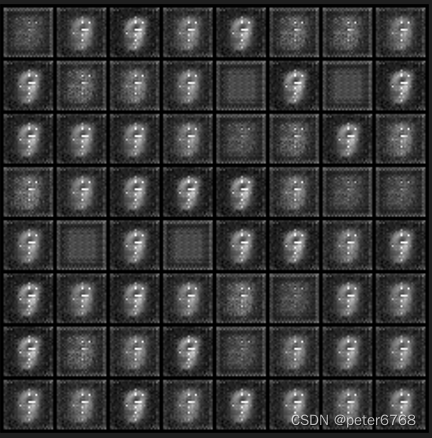
发现图片很模糊,可能是均方误差算的是所有手写数字的平均值,且每个图像没有明显模式,倒是平均值就是很模糊。咋整呢?可以尝试用之前的手写数字图像识别器帮助矫正MSE
4 图像生成-生成器-识别器模型
5 图像生成-GAN
6 小结
声明:本文内容由网友自发贡献,不代表【wpsshop博客】立场,版权归原作者所有,本站不承担相应法律责任。如您发现有侵权的内容,请联系我们。转载请注明出处:https://www.wpsshop.cn/article/detail/47258?site
推荐阅读
相关标签

