
热门标签
热门文章
- 1Node.js Express框架 写后台接口API_node express 写后端api
- 2【Pytorch】利用PyTorch实现图像识别_pytorch图像识别
- 3CSS中强大的EM(转)_写一个公用的em转换 css
- 4Docker笔记之DockerCompose+yaml详解_docker-compose.yaml
- 5S3C2440驱动开发(四)_s3c2440蜂鸣器驱动原理
- 6SpringSecurity - WebFlux环境下动态角色权限_resouceconfig reactiveauthorizationmanager
- 7【备考05组02号】第一届蓝桥杯高职组省赛题解_蓝桥杯专科院校题目
- 8( python )OpenCV特征匹配函数错误cv2.xfeatures2d_SURF.create()_python cv2提取特征不成功
- 9汇编语言 统计一组16位二进制数据中的正负数个数并显示结果_汇编语言统计x中正数个数送y,负数个数送z,零的个数送w,并显示y,z,w
- 10python代码雨_pygame实现烟雨蒙蒙下彩虹雨
当前位置: article > 正文
统计字符串中字符出现的次数//通俗易懂!!!_hutool 统计某个字符出现的次数
作者:思考机器5 | 2024-01-29 23:04:56
赞
踩
hutool 统计某个字符出现的次数
话不多说!
先看小题!!
如下字符串:
String str = “The String class represents character strings. All string literals in Java programs, are implemented as instances of this class. Strings are constant; their values cannot be changed after they are created. String buffers support mutable strings. Because String objects are immutable they can be shared.”;
统计各个字符出现的次数,-----------------并排序!!!
(方法不是唯一的,适合自己的或者更易理解的才是前期学习java的通路)
小解方式一:
使用HashMap或者TreeMap===========================================>>>>>>>>
    public void test3(){
        String str = "The String class represents character strings. All string literals in Java programs, are implemented as instances of this class. Strings are constant; their values cannot be changed after they are created. String buffers support mutable strings. Because String objects are immutable they can be shared.";
        //String replace = str.replace(" ", "");//去掉空格,如果不想比较空格/符号之类的可以使用这句代码/后面代码str改为replace
        char[] chars = str.toCharArray();
        //字符出现的次数,排序
        Map<Character,Integer> map = new TreeMap<>();
        for (int i = 0; i <chars.length ; i++) {
            if(!map.containsKey(chars[i])){
                map.put(chars[i],1);//键值对---key-->出现的字符
            }else{							//value-->同个字符出现的次数
                map.put(chars[i],map.get(chars[i]) +1);
            }
        }
        List<Map.Entry<Character,Integer>> list = new ArrayList<>(map.entrySet());
        Collections.sort(list, new Comparator<Map.Entry<Character, Integer>>() {//使用比较器比较value的大小排序
            @Override
            public int compare(Map.Entry<Character, Integer> o1, Map.Entry<Character, Integer> o2) {
                return -o1.getValue().compareTo(o2.getValue());
            }
        });
        for(Map.Entry<Character,Integer> entry : list){
            System.out.println(entry.getKey() + "=" + entry.getValue());
        }
    }

- 1
- 2
- 3
- 4
- 5
- 6
- 7
- 8
- 9
- 10
- 11
- 12
- 13
- 14
- 15
- 16
- 17
- 18
- 19
- 20
- 21
- 22
- 23
- 24
- 25
- 26
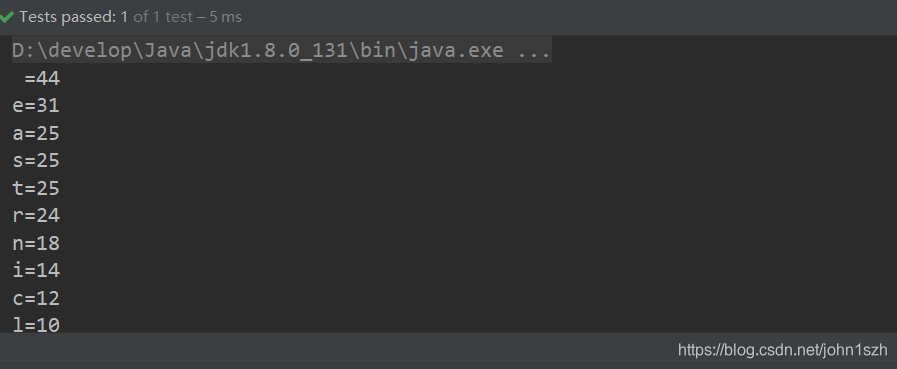
小解方式二:
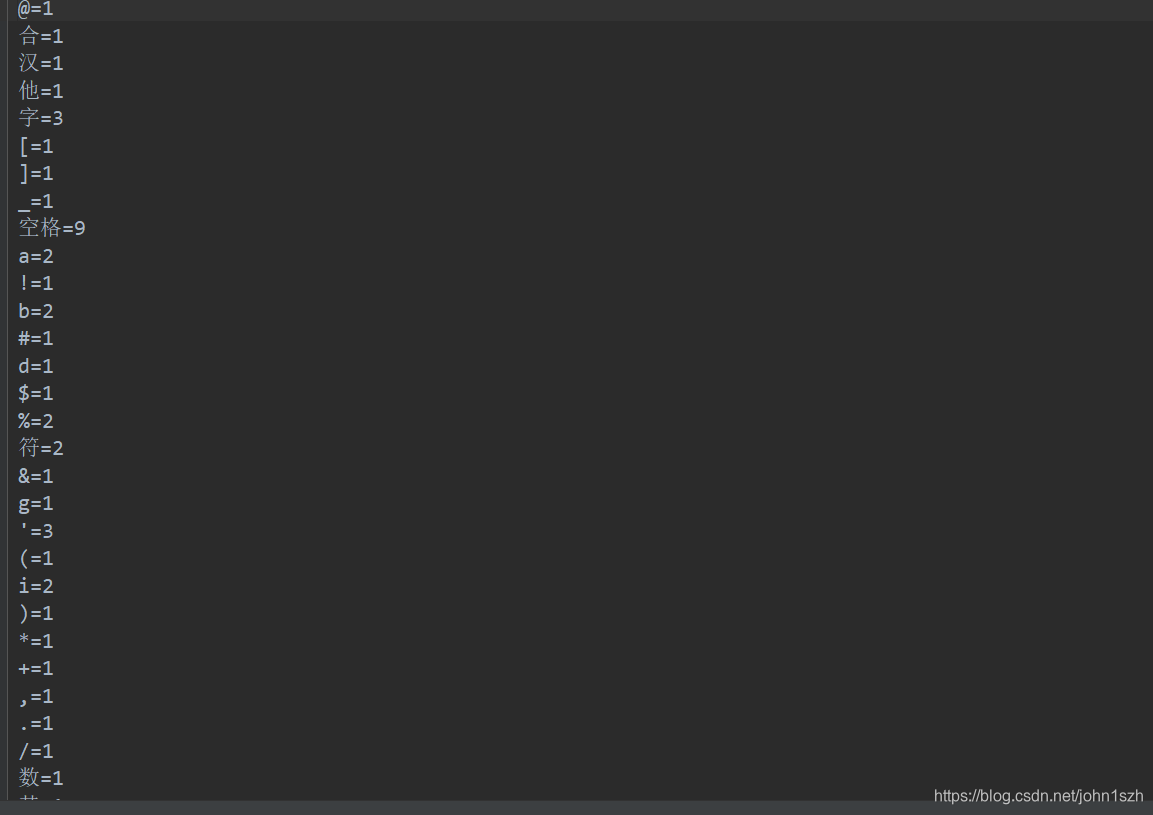
使用io流:====================================================>>>>>>>>>>>>>>>
public class MyStringTest {
    @Test
    public void test1(){
        String str = " ai bbiadg 字符 数字 汉字 符合 其他 .'',/';][%%$#@!&*()_+ ";
        FileWriter fw = null;
        try {
            fw = new FileWriter(new File("MyStringTest.txt"));//一步到位,创建字符输出流
            fw.write(str.toCharArray());//将字符串写入一个文件
        } catch (IOException e) {
            e.printStackTrace();
        } finally {
            try {
                if(fw != null)
                fw.close();
            } catch (IOException e) {
                e.printStackTrace();
            }
        }
    }
    @Test
    public void test2(){

        BufferedReader br = null;
        BufferedWriter bw = null;
        try {
            Map<Character,Integer> map = new HashMap<>();//使用Map便于保存 字符--次数
            br = new BufferedReader(new FileReader("MyStringTest.txt"));//创建字符输入缓冲流
            int len = 0;
            while ((len = br.read()) != -1){//读取文件中的内容,返回-1表示读取完毕
                char ch = (char)len;

                if(!map.containsKey(map.get(ch))){//统计各个字符出现的次数
                    map.put(ch,1);
                }else{
                    map.put(ch,map.get(ch) + 1);
                }
            }
            bw = new BufferedWriter(new FileWriter("MyStringCount.txt"));//创建字符输出缓冲流
            Set<Map.Entry<Character, Integer>> entrySet = map.entrySet();
            for(Map.Entry<Character,Integer> entry : entrySet){//增强for遍历集合
                switch (entry.getKey()){
                    case ' ':
                        bw.write("空格=" + entry.getValue());//依次写出key--value
                        break;
                    case '\t':
                        bw.write("tab=" + entry.getValue());
                        break;
                    case '\r':
                        bw.write("回车=" + entry.getValue());
                        break;
                    case '\n':
                        bw.write("换行=" + entry.getValue());
                        break;
                    default:
                        bw.write(entry.getKey() + "=" + entry.getValue());
                        break;
                }
                bw.newLine();//换行操作
            }
        } catch (IOException e) {
            e.printStackTrace();
        } finally {
            try {
                if(bw != null){
                    bw.close();
                }
            } catch (IOException e) {
                e.printStackTrace();
            }
            try {
                if(br != null){
                    br.close();
                }
            } catch (IOException e) {
                e.printStackTrace();
            }
        }
    }
}
- 1
- 2
- 3
- 4
- 5
- 6
- 7
- 8
- 9
- 10
- 11
- 12
- 13
- 14
- 15
- 16
- 17
- 18
- 19
- 20
- 21
- 22
- 23
- 24
- 25
- 26
- 27
- 28
- 29
- 30
- 31
- 32
- 33
- 34
- 35
- 36
- 37
- 38
- 39
- 40
- 41
- 42
- 43
- 44
- 45
- 46
- 47
- 48
- 49
- 50
- 51
- 52
- 53
- 54
- 55
- 56
- 57
- 58
- 59
- 60
- 61
- 62
- 63
- 64
- 65
- 66
- 67
- 68
- 69
- 70
- 71
- 72
- 73
- 74
- 75
- 76
- 77
- 78
- 79
- 80
点赞或者评论,让弯路往前稍稍
有问题可以留言或者私信,看到后第一时间回复
初学或者零基础者的弯路!

下篇文章见!
声明:本文内容由网友自发贡献,不代表【wpsshop博客】立场,版权归原作者所有,本站不承担相应法律责任。如您发现有侵权的内容,请联系我们。转载请注明出处:https://www.wpsshop.cn/article/detail/45558
推荐阅读

相关标签

