
- 1ubuntu-Pytorch环境配置_ubuntu下pytorch环境的搭建
- 2Java 中MongoDB 聚合查询,涉及分页,分组,去重_springboot mongo 聚合去重 查询
- 3Dockerfile reference_file transfer is either not supported or not enabl
- 4【刷题】 leetcode 2 .两数相加
- 5C++中::作用域运算符用法详解_c++作用域运算符
- 6docker 常用命令_docker stop命令
- 7利用ArcGIS处理土地利用数据:计算fishnet每个格网中不同地类的面积_arcgis格网挂接面积数据
- 8蓝易云:Linux系统【Centos7】如何配置完整的CC攻击防护策略_centos插件拦截cc
- 9捉迷藏之一-第10届蓝桥杯Scratch国赛真题第6题程序1
- 10掌握实时数据流:使用Apache Flink消费Kafka数据_2、 使用flink消费kafka中changerecord主题的数据,当某设备30秒状态连续为“预
剑指offer 解题思路简述总结篇1-10_剑指offer解题思路速览
赞
踩
- 面试题3,数组中重复的数字

方法一:排序后从头开始依次比较相邻的两个是否相等,相等即重复,nlogn
- class Solution(object):
- def findRepeatNumber(self, nums):
- """
- :type nums: List[int]
- :rtype: int
- """
- nums.sort()
- pre = nums[0]
- for index in range(1, len(nums)):
- if pre == nums[index]:
- return pre
- pre = nums[index]
方法二:利用新的存储空间set类型,挨个取数据看是否已经存在set中,存在return,不存在add,n
方法三:从头开始遍历num,将每个数的数值x和它的下表i进行比较,不等则将num[i]和num[x]进行比较,相等则return,不相等则交换,交换后仍重复上述过程,直到数值和下表相等,n
- class Solution(object):
- def findRepeatNumber(self, nums):
- """
- :type nums: List[int]
- :rtype: int
- """
- for i in range(len(nums)):
- while nums[i] != i:
- if nums[nums[i]] == nums[i]:
- return nums[i]
- nums[nums[i]] , nums[i] = nums[i] , nums[nums[i]]
-
- return None
-
- 面试题4,二维数组中的查找

方法:从右上角的数x开始比较,若需要查找的数大于x,则行数加1,若小,则列数减1
也可以选左下角
- # -*- coding:utf-8 -*-
- class Solution:
- # array 二维列表
- def Find(self, target, array):
- # write code here
- if len(array[0])==0:return False
- hang = len(array[0])
- lie = len(array[1])
- i=0
- j=lie-1
- while(i<hang and j>=0):
- if array[i][j]==target:return True
- if array[i][j]>target:
- j=j-1
- else:
- i=i+1
-
- return False

- 面试题5,替换空格

方法1:‘We are happy’.replace(' ','%20')
方法2:遍历空格的数量,求出字符串变化之后的长度,从字符串的后面开始复制和替换,设置两个指针,一个是变换后的长度的最后p1,一个是字符串的最后p2,当碰到空格,p1处加上替换字符,p2处往前挪一个,当p1和p2只向同一个位置说明可以结束。字符串都是不可变的类型,这个方法的意义在哪里。。。。
方法3:将字符串变成list,从头开始遍历把‘ ’换成‘%20’;或者建一个空list,扫瞄到空格就append‘%20’,否则就append对应的s
- class Solution(object):
- def replaceSpace(self, s):
- """
- :type s: str
- :rtype: str
- """
- s = list(s)
- for i in range(len(s)):
- if s[i] == ' ':
- s[i] = '%20'
- return ''.join(s)
相似题目:

- 面试题6,从尾到头打印链表

方法一:从头读取链表,保存在list中,每次指定位置insert新的节点值list.insert(位置,数值)
方法二:用俩个list,一个从头到尾存储值,结束后,pop出每个值到另一个list中
方法三:在方法二前半段的基础上直接调用reverse()或者[::-1]
- 面试7,重建二叉树

方法:递归,每次从根据前序遍历中的根节点将中序遍历和前序遍历分成两部分,递归处理这两部分
- class Solution:
- # 返回构造的TreeNode根节点
- def reConstructBinaryTree(self, pre, tin):
- # write code here
- if len(pre) == 0 or len(tin) == 0:
- return None
-
- if len(pre) == 1:
- return TreeNode(pre[0])
- root = TreeNode(pre[0])
-
- index = tin.index(pre[0])
- left_pre = pre[1:index+1]
- left_tin = tin[0:index]
- root.left = self.reConstructBinaryTree(left_pre, left_tin)
-
- right_pre = pre[index+1:]
- right_tin = tin[index+1:]
- root.right = self.reConstructBinaryTree(right_pre, right_tin)
- return root
- 面试题8:二叉树的下一个节点

方法:分情况讨论,如果有右子树的话,找到右子树中的左子叶节点,如果没有的话,找到第一个该节点是其左子节点的节点
- class Solution:
- def GetNext(self, pNode):
- # write code here
- if not pNode:
- return None
- if pNode.right: #有右子树
- res = pNode.right
- while res.left:
- res = res.left
- return res
- while pNode.next:#无右子树,则找第一个当前节点是父节点左孩子的节点
- temp = pNode.next
- if temp.left == pNode:
- return temp
- pNode = temp#沿着父节点向上遍历
- return None
- 面试题9:两个栈实现队列

方法:分别创建两个list,stack1和stack2,append方法直接往stack1中append,delete方法中先判断stack2是否为空,是的话将stack1中的元素全部压到stack2中,输出stack2的栈顶元素
- # -*- coding:utf-8 -*-
- #栈1进栈,栈2出栈
- #当栈2为空,现将栈1的全部放入栈2
- class Solution:
- def __init__(self):
- self.stack1 = []
- self.stack2 = []
- def push(self, node):
- # write code here
- self.stack1.append(node)
- def pop(self):
- # return xx
- if self.stack2==[]:
- while self.stack1!=[]:
- temp=self.stack1.pop()
- self.stack2.append(temp)
- return self.stack2.pop()
相似问题:两个队列实现栈
方法:分别创建两个list,queue1和queue2,append方法直接往queue1中append,delete方法先 把queue1中的元素放入到queue2中只剩一个元素,弹出该元素,完成后将queue1和queue2互换,以供下一次用
- 面试题10:斐波那契数列
方法:不要用递归,当n大于2开始,设置m,n两个数,temp=m+n,m=n,n=temp
- # -*- coding:utf-8 -*-
- class Solution:
- def Fibonacci(self, n):
- # write code here
- '''
- if n==0:return 0
- if n==1:return 1
- return self.Fibonacci(n-1)+self.Fibonacci(n-2)
- '''
- if n==0:return 0
- if n==1:return 1
- a=0
- b=1
- for _ in range(2,n+1):
- a,b=b,a+b
- return b
相似问题:

方法:和斐波那契数列一模一样

方法:1-1,2-2,3个台阶时是2个台阶的2倍,4个台阶的时候是3个台阶的2倍

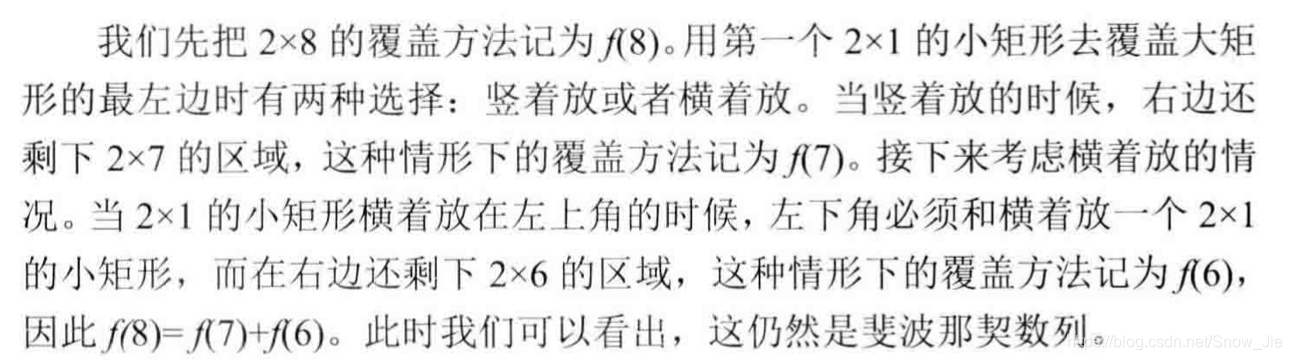
方法:斐波那契数列

