
热门标签
热门文章
- 1springboot和springsecurity整合OAuth2_springboot 集成springserurity和oauth2 授权模式案例
- 2神经网络之VGG
- 3python中print输出浮点数保留几位小数_print('%.2f'%x)
- 4Three.js一学就会系列:03 炫酷3D划线_float32bufferattribute
- 5esp8266定时重启命令_Ubuntu18定时任务脚本
- 6Pandas:to_excel 在原Excel表 追加写入数据_pandas to_excel参数 追加数据
- 7MFC实现Edit输入限制(只允许输入数字,负号和小数点)_mfc中edit control只能输入数字
- 8一个前端渣渣的node开发体验
- 9javascript中的class类构造函数_js class 构造函数
- 10进阶C语言-自定义类型
当前位置: article > 正文
华为OD机试 - 学生方阵 - 矩阵(Java 2023 B卷 200分)
作者:代码秘术家 | 2024-01-23 07:02:07
赞
踩
华为OD机试 - 学生方阵 - 矩阵(Java 2023 B卷 200分)

华为OD机试 2023B卷题库疯狂收录中,刷题点这里
专栏导读
本专栏收录于《华为OD机试(JAVA)真题(A卷+B卷)》。
刷的越多,抽中的概率越大,每一题都有详细的答题思路、详细的代码注释、样例测试,发现新题目,随时更新,全天CSDN在线答疑。
一、题目描述
学校组织活动,将学生排成一个矩形方阵。请在矩形方阵中找到最大的位置相连的男生数量。
这个相连位置在一个直线上,方向可以是水平的,垂直的,成对角线的或者呈反对角线的.注:学生个数不会超过10000。
二、输入描述
输入的第一行为矩阵的行数和列数,接下来的n行为矩阵元素,元素间用","分隔。
三、输出描述
输出一个整数,表示矩阵中最长的位置相连的男生个数。
1、输入
3,4
F,M,M,F
F,M,M,F
F,F,F,M
2、输出
3
四、解题思路
1、题目解析
本题的解题思路其实不难,遍历查找矩阵中每一个 M 点,然后求该 M 点的水平、垂直、正对角线、反对角线四个方向的 M 点个数,然后保留最大的个数
2、解体思路
- 定义矩阵matrix,并初始化;
- 定义矩阵中最长的位置相连的男生个数max;
- 遍历矩阵,并跳过女生M;
- 计算每行相连的男生个数;
- 计算每列相连的男生个数;
- 计算斜线相连的男生个数;
- 计算反斜线相连的男生个数;
- 相连最大值。
五、Java算法源码
public class OdTest03 {
    static int m, n = 0;

    public static void main(String[] args) {
        Scanner sc = new Scanner(System.in);
        String[] input = sc.nextLine().split(",");
        // m行
        m = Integer.valueOf(input[0]);
        // n列
        n = Integer.valueOf(input[1]);
        // 矩阵
        String[][] matrix = new String[m][n];
        for (int i = 0; i < m; i++) {
            String[] line = sc.nextLine().split(",");
            for (int j = 0; j < n; j++) {
                matrix[i][j] = line[j];
            }
        }

        // 矩阵中最长的位置相连的男生个数
        int max = 0;
        // 遍历矩阵
        for (int i = 0; i < m; i++) {
            for (int j = 0; j < n; j++) {
                String compare = matrix[i][j];
                // 跳过女生M
                if (compare.equals("F")) {
                    continue;
                }

                // 计算每行相连的男生个数
                int rowSame = getSameRowMax(matrix, compare, i, j);
                // 计算每列相连的男生个数
                int columnSame = getSameColumnMax(matrix, compare, i, j);
                // 计算斜线相连的男生个数
                int obliqueSame = getSameObliqueMax(matrix, compare, i, j);
                // 计算反斜线相连的男生个数
                int reverseObliqueSame = getSameReverseObliqueMax(matrix, compare, i, j);
                int maxSame = Integer.max(Integer.max(columnSame, rowSame), Integer.max(obliqueSame, reverseObliqueSame));
                if (maxSame >= max) {
                    max = maxSame;
                }
            }
        }
        System.out.println(max);
    }

    /**
     * 计算每行相连的男生个数
     *
     * @param matrix  矩阵
     * @param compare 待比较字符
     * @param i       行
     * @param j       列
     * @return 相连的男生个数
     */
    private static int getSameRowMax(String[][] matrix, String compare, int i, int j) {
        int same = 1;
        for (int k = j + 1; k < n; k++) {
            // 比较同一行中下一列字符
            if (compare.equals(matrix[i][k])) {
                same++;
            } else {
                // 如果不同,终止遍历,返回当前行相连的男生个数
                break;
            }
        }
        return same;
    }

    // 计算每列相连的男生个数
    private static int getSameColumnMax(String[][] matrix, String compare, int i, int j) {
        int same = 1;
        for (int k = i + 1; k < m; k++) {
            // 比较同一列中的下一行字符
            if (compare.equals(matrix[k][j])) {
                same++;
            } else {
                // 如果不同,终止遍历,返回当前列相连的男生个数
                break;
            }
        }
        return same;
    }

    // 计算斜线相连的男生个数
    private static int getSameObliqueMax(String[][] matrix, String compare, int i, int j) {
        int same = 1;
        for (int k = i + 1; k < m; k++) {
            for (int l = j + 1; l < n; l++) {
                // 比较下一行下一列处于斜线上的下一个字符
                if (compare.equals(matrix[k][l])) {
                    same++;
                } else {
                    // 如果不同,终止遍历,返回当前斜线相连的男生个数
                    return same;
                }
                break;
            }
        }
        return same;
    }

    // 计算反斜线相连的男生个数
    private static int getSameReverseObliqueMax(String[][] matrix, String compare, int i, int j) {
        if (i == 0) {
            return 1;
        }

        int same = 1;
        for (int k = i + 1; k < m; k++) {
            for (int l = j - 1; l >= 0; l--) {
                // 比较下一行下一列处于斜线上的下一个字符
                if (compare.equals(matrix[k][l])) {
                    same++;
                } else {
                    // 如果不同,终止遍历,返回当前斜线相连的男生个数
                    return same;
                }
                break;
            }
        }
        return same;
    }
}

- 1
- 2
- 3
- 4
- 5
- 6
- 7
- 8
- 9
- 10
- 11
- 12
- 13
- 14
- 15
- 16
- 17
- 18
- 19
- 20
- 21
- 22
- 23
- 24
- 25
- 26
- 27
- 28
- 29
- 30
- 31
- 32
- 33
- 34
- 35
- 36
- 37
- 38
- 39
- 40
- 41
- 42
- 43
- 44
- 45
- 46
- 47
- 48
- 49
- 50
- 51
- 52
- 53
- 54
- 55
- 56
- 57
- 58
- 59
- 60
- 61
- 62
- 63
- 64
- 65
- 66
- 67
- 68
- 69
- 70
- 71
- 72
- 73
- 74
- 75
- 76
- 77
- 78
- 79
- 80
- 81
- 82
- 83
- 84
- 85
- 86
- 87
- 88
- 89
- 90
- 91
- 92
- 93
- 94
- 95
- 96
- 97
- 98
- 99
- 100
- 101
- 102
- 103
- 104
- 105
- 106
- 107
- 108
- 109
- 110
- 111
- 112
- 113
- 114
- 115
- 116
- 117
- 118
- 119
- 120
- 121
- 122
- 123
- 124
- 125
感觉这道题,不至于这么复杂吧。
再重新读一遍题目,看看能否优化一下~
优化关键点:
- 定义方向二位数组direction;
- 遍历矩阵,如果前一个是M,表示此M已经计算过了,直接跳过;
- 简化上面的4种遍历方法,通过累加direction中的横纵坐标,计算每行、每列、斜线、反斜线相连的男生个数,并取相连最大值。
public class OdTest {
    static int m, n = 0;

    public static void main(String[] args) {
        Scanner sc = new Scanner(System.in);
        String[] input = sc.nextLine().split(",");
        // m行
        m = Integer.valueOf(input[0]);
        // n列
        n = Integer.valueOf(input[1]);
        // 矩阵
        String[][] matrix = new String[m][n];
        for (int i = 0; i < m; i++) {
            String[] line = sc.nextLine().split(",");
            for (int j = 0; j < n; j++) {
                matrix[i][j] = line[j];
            }
        }

        /**
         * 数组的第0位-行、数组的第1位-列
         * {0,1}寻找一行内连续的M
         * {1,0}寻找一列中连续的M
         * {1,1}寻找斜下中连续的M
         * {1,-1}寻找反斜下连续的M
         */
        int[][] direction = {{0, 1}, {1, 0}, {1, 1}, {1, -1}};

        // 矩阵中最长的位置相连的男生个数
        int max = 0;
        // 遍历矩阵
        for (int i = 0; i < m; i++) {
            for (int j = 0; j < n; j++) {
                if (matrix[i][j].equals("M")) {
                    for (int[] arr : direction) {
                        int reverseI = i - arr[0];
                        int reverseJ = j - arr[1];

                        // 如果前一个是M,表示此M已经计算过了,直接跳过
                        if (reverseI >= 0 && reverseI < m && reverseJ >= 0 && reverseJ < n && matrix[reverseI][reverseJ].equals("M")) {
                            continue;
                        }

                        int nextI = i + arr[0];
                        int nextJ = j + arr[1];
                        int same = 1;

                        // 计算每行、每列、斜线、反斜线相连的男生个数,并取相连最大值
                        while (nextI >= 0 && nextI < m && nextJ >= 0 && nextJ < n && matrix[nextI][nextJ].equals("M")) {
                            same++;
                            nextI += arr[0];
                            nextJ += arr[1];
                        }

                        max = Integer.max(max, same);
                    }
                }
            }
        }
        System.out.println(max);
    }
}
- 1
- 2
- 3
- 4
- 5
- 6
- 7
- 8
- 9
- 10
- 11
- 12
- 13
- 14
- 15
- 16
- 17
- 18
- 19
- 20
- 21
- 22
- 23
- 24
- 25
- 26
- 27
- 28
- 29
- 30
- 31
- 32
- 33
- 34
- 35
- 36
- 37
- 38
- 39
- 40
- 41
- 42
- 43
- 44
- 45
- 46
- 47
- 48
- 49
- 50
- 51
- 52
- 53
- 54
- 55
- 56
- 57
- 58
- 59
- 60
- 61
- 62
六、效果展示
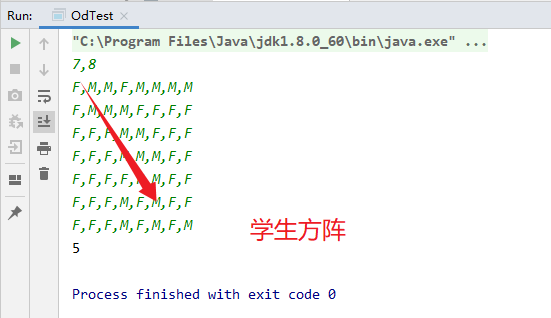
1、输入
7,8
F,M,M,F,M,M,M,M
F,M,M,M,F,F,F,F
F,F,F,M,M,F,F,F
F,F,F,M,M,M,F,F
F,F,F,F,F,M,F,F
F,F,F,M,F,M,F,F
F,F,F,M,F,M,F,M
2、输出
5
3、说明
声明:本文内容由网友自发贡献,不代表【wpsshop博客】立场,版权归原作者所有,本站不承担相应法律责任。如您发现有侵权的内容,请联系我们。转载请注明出处:https://www.wpsshop.cn/article/detail/41682?site
推荐阅读
![[ 云计算 | AWS 实践 ] 使用 Java 更新现有 Amazon S3 对象](https://img-blog.csdnimg.cn/direct/f6b4b45ef01445aa9a147e7c5f1a8f15.png?x-oss-process=image/resize,m_fixed,h_300,image/format,png)


相关标签
Copyright © 2003-2013 www.wpsshop.cn 版权所有,并保留所有权利。

