
热门标签
热门文章
- 1es 更新指定字段的方法_es更新某个字段
- 2js正则匹配密码:必须包含大写字母、小写字母、数字以及特殊字符_必须包含数字、大小写字母和特殊字符
- 3linux 下 BT Tracker服务器搭建_bterdnk
- 4Docker实战之Dockerfile解析及实战演示,使用环境变量方式改变启动端口_dockerfile port
- 5Jmeter使用技巧(三) : Jmeter调优日志查看方法_jmeter怎么查看日志
- 6启动zookeeper集群失败解决_zk节点启动无法加入集群
- 7寻找有向图的环_输入n条有向路径,求形成的环数
- 8R语言可视化小提琴图(violin plot)、使用vioplot包的vioplot函数可视化小提琴图、lineCol参数自定义小提琴图中的箱图区域线框线条的颜色
- 9ubuntu 安装python3.10
- 10python爬取新浪微博(爬取微博帐号所发内容,不爬取历史内容)_python爬取微博
当前位置: article > 正文
CVAE(条件自编码) Condition GAN (条件GAN) 和 VAE-GAN模型之间的区别之CVAE_vae与cvae区别
作者:思考机器5 | 2024-01-17 14:24:20
赞
踩
vae与cvae区别
# 使用CVAE(条件自编码) 训练fashion-mnist数据集
- import os
- import time
- import tensorflow as tf
- import numpy as np
-
- from ops import *
- from utils import *
-
- class CVAE(object):
- model_name = "CVAE" # name for checkpoint
-
- def __init__(self, sess, epoch, batch_size, z_dim, dataset_name, checkpoint_dir, result_dir, log_dir):
- self.sess = sess
- self.dataset_name = dataset_name
- self.checkpoint_dir = checkpoint_dir
- self.result_dir = result_dir
- self.log_dir = log_dir
- self.epoch = epoch
- self.batch_size = batch_size
- self.mean = 0
- self.var =1
-
- if dataset_name == 'mnist' or dataset_name == 'fashion-mnist':
- # parameters
- self.input_height = 28
- self.input_width = 28
- self.output_height = 28
- self.output_width = 28
-
- self.z_dim = z_dim # dimension of noise-vector
- self.y_dim = 10 # dimension of condition-vector (label)
- self.c_dim = 1
-
- # train
- self.learning_rate = 0.0002
- self.beta1 = 0.5
-
- # test
- self.sample_num = 64 # number of generated images to be saved
-
- # load mnist
- self.data_X, self.data_y = load_mnist(self.dataset_name)
-
- # get number of batches for a single epoch
- self.num_batches = len(self.data_X) // self.batch_size
- else:
- print("********there is no other dataset to do *********")
- raise NotImplementedError
-
- # 编码器中输入的是真实图像和噪音向量
- def encoder(self, x, y, is_training=True, reuse=False):
- with tf.variable_scope("encoder", reuse=reuse):
- y = tf.reshape(y, [self.batch_size, 1, 1, self.y_dim])
- x = conv_cond_concat(x, y)
-
- net = lrelu(conv2d(x, 64, 4, 4, 2, 2, name='en_conv1'))
- net = lrelu(bn(conv2d(net, 128, 4, 4, 2, 2, name='en_conv2'), is_training=is_training, scope='en_bn2'))
- net = tf.reshape(net, [self.batch_size, -1])
- net = lrelu(bn(linear(net, 1024, scope='en_fc3'), is_training=is_training, scope='en_bn3'))
- gaussian_params = linear(net, 2 * self.z_dim, scope='en_fc4')
-
- mean = gaussian_params[:, :self.z_dim]
- stddev = tf.nn.softplus(gaussian_params[:, self.z_dim:])
-
- return mean, stddev
-
- # 定义解码器的相关操作
- def decoder(self, z, y, is_training=True, reuse=False):
- with tf.variable_scope("decoder", reuse=reuse):
-
- z = concat([z, y], 1)
- net = tf.nn.relu(bn(linear(z, 1024, scope='de_fc1'), is_training=is_training, scope='de_bn1'))
- net = tf.nn.relu(bn(linear(net, 128 * 7 * 7, scope='de_fc2'), is_training=is_training, scope='de_bn2'))
- net = tf.reshape(net, [self.batch_size, 7, 7, 128])
- net = tf.nn.relu(
- bn(deconv2d(net, [self.batch_size, 14, 14, 64], 4, 4, 2, 2, name='de_dc3'), is_training=is_training,
- scope='de_bn3'))
-
- out = tf.nn.sigmoid(deconv2d(net, [self.batch_size, 28, 28, 1], 4, 4, 2, 2, name='de_dc4'))
-
- return out
-
- def build_model(self):
-
- image_dims = [self.input_height, self.input_width, self.c_dim]
- bs = self.batch_size
-
-
- self.inputs = tf.placeholder(tf.float32, [bs] + image_dims, name='real_images')
- self.y = tf.placeholder(tf.float32, [bs, self.y_dim], name='y')
- self.z = tf.placeholder(tf.float32, [bs, self.z_dim], name='z')
-
- # 编码器中返回的数据是均值和方差 经过运算之后返回数据
- mu, sigma = self.encoder(self.inputs, self.y, is_training=True, reuse=False)
- z = mu + sigma * tf.random_normal(tf.shape(mu), 0, 1, dtype=tf.float32)
-
- # 解码器输出真实图像
- self.out = self.decoder(z, self.y, is_training=True, reuse=False)
-
- # 定义loss函数
- marginal_likelihood = tf.reduce_sum(self.inputs * tf.log(self.out) + (1 - self.inputs) * tf.log(1 - self.out), [1, 2])
- KL_divergence = 0.5 * tf.reduce_sum(tf.square(mu) + tf.square(sigma) - tf.log(1e-8 + tf.square(sigma)) - 1, [1])
-
- self.neg_loglikelihood = -tf.reduce_mean(marginal_likelihood)
- self.KL_divergence = tf.reduce_mean(KL_divergence)
-
- # 这个损失函数不是很懂 生成结果好 就这样用吧
- self.loss = self.neg_loglikelihood + self.KL_divergence
-
- # 定义优化器
- t_vars = tf.trainable_variables()
- with tf.control_dependencies(tf.get_collection(tf.GraphKeys.UPDATE_OPS)):
- self.optim = tf.train.AdamOptimizer(self.learning_rate*5, beta1=self.beta1) \
- .minimize(self.loss, var_list=t_vars)
-
- # is_training设置为false生成图像 但是不参与模型修改参数
- self.fake_images = self.decoder(self.z, self.y, is_training=False, reuse=True)
-
- self.merged_summary_op = tf.summary.merge_all()
-
- def train(self):
-
- tf.global_variables_initializer().run()
-
- # 标签使用的是前batch_size个图像
- self.sample_z = np.random.normal(self.mean, self.var, (self.batch_size, self.z_dim)).astype(np.float32)
- self.test_labels = self.data_y[0:self.batch_size]
-
- start_epoch = 0
- start_batch_id = 0
- counter = 1
-
- start_time = time.time()
- for epoch in range(start_epoch, self.epoch):
-
- for idx in range(start_batch_id, self.num_batches):
- batch_images = self.data_X[idx*self.batch_size:(idx+1)*self.batch_size]
- batch_labels = self.data_y[idx * self.batch_size:(idx + 1) * self.batch_size]
- batch_z = np.random.uniform(-1, 1, [self.batch_size, self.z_dim]).astype(np.float32)
-
- _, summary_str, loss, nll_loss, kl_loss = self.sess.run([self.optim, self.merged_summary_op, self.loss, self.neg_loglikelihood, self.KL_divergence],
- feed_dict={self.inputs: batch_images, self.y: batch_labels, self.z: batch_z})
-
- counter += 1
- print("Epoch: [%2d] [%4d/%4d] time: %4.4f, loss: %.8f, nll: %.8f, kl: %.8f" \
- % (epoch, idx, self.num_batches, time.time() - start_time, loss, nll_loss, kl_loss))
-
- # save training results for every 300 steps
- if np.mod(counter, 300) == 0:
- samples = self.sess.run(self.fake_images,
- feed_dict={self.z: self.sample_z, self.y: self.test_labels})
- tot_num_samples = min(self.sample_num, self.batch_size)
- manifold_h = int(np.floor(np.sqrt(tot_num_samples)))
- manifold_w = int(np.floor(np.sqrt(tot_num_samples)))
- save_images(samples[:manifold_h * manifold_w, :, :, :], [manifold_h, manifold_w],
- './' + check_folder(self.result_dir + '/' + self.model_dir) + '/' + self.model_name + '_train_{:02d}_{:04d}.png'.format(
- epoch, idx))
- start_batch_id = 0
-
- @property
- def model_dir(self):
- return "{}_{}_{}_{}".format(
- self.model_name, self.dataset_name,
- self.batch_size, self.z_dim)

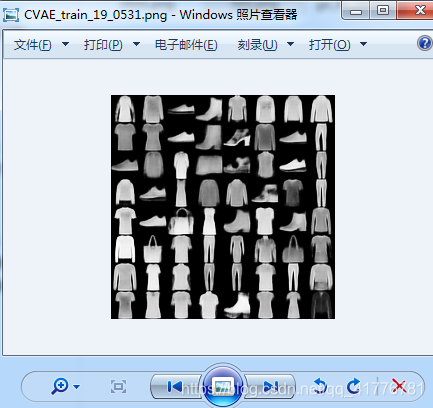
训练的结果:
声明:本文内容由网友自发贡献,不代表【wpsshop博客】立场,版权归原作者所有,本站不承担相应法律责任。如您发现有侵权的内容,请联系我们。转载请注明出处:https://www.wpsshop.cn/article/detail/41015
推荐阅读
相关标签

