
热门标签
热门文章
- 1正则表达式匹配数字、字母和下划线_正则表达式匹配下划线
- 2FlexArray 存储虚拟化软件_存储虚拟软件
- 3Django REST 框架详解 09 | 权限组件_django permission_classes
- 4编程实例分享,电玩城计时电玩店计时收费管理系统软件,可以控制电视电源计时程序
- 5十二届蓝桥杯python青少年组第五题——密室逃脱_有一个密室逃脱游戏,有100间密室连在一排。密室编号
- 6python threading和multiprocessing模块基本用法实例分析_python signal multiprocessing
- 7Elasticsearch 基本使用(四)聚合查询_es聚合查询
- 8在pytorch中的双线性采样(Bilinear Sample)
- 9Linux内核同步机制之Per-CPU变量___per_cpu_offset
- 10Problem-263A-Codeforces- Beautiful Matrix_you've got a 5
当前位置: article > 正文
动态规划-最长公共子序列(c语言)_最长公共子序列问题c语言
作者:程序自动化专家 | 2023-12-25 15:04:41
赞
踩
最长公共子序列问题c语言
实验3:最长公共子序列
内容:给定两个字符串str1和str2,输出两个字符串的最长公共子序列,如果最长公共子序列为空,则返回“-1”。目前给出的数据,仅仅会存在一个最长的公共子序列。
数据范围:0≤|str1|,|str2|≤2000
要求:空间复杂度O(n2)
具体思路:
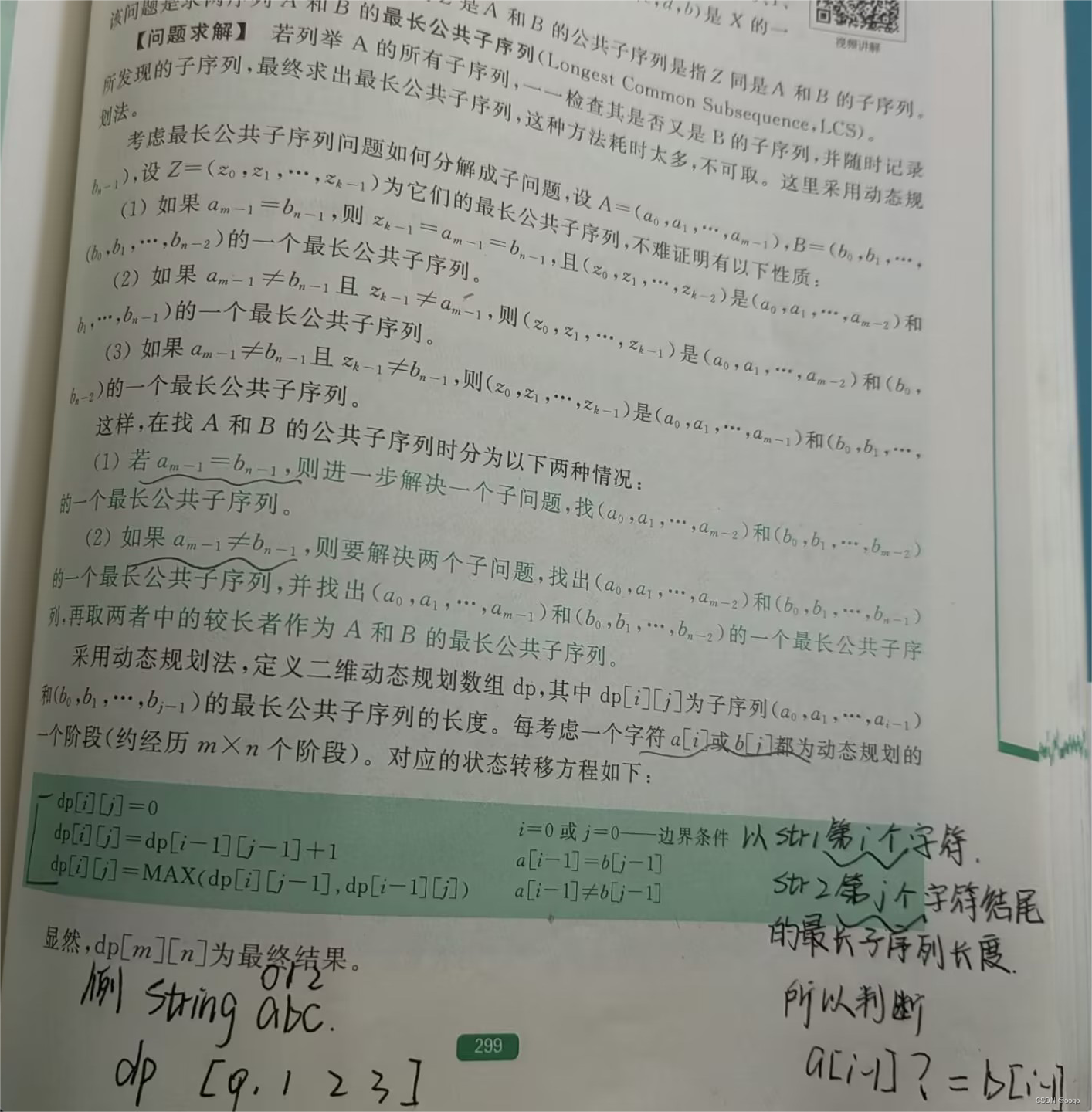
step1:dp[i][j]的含义是,以str1中的第i个字符,str2中的第j个字符结尾的最长子序列长度
step2:转移方程,对于dp[i][j]来说,
如果str1[i-1]与str2[j-1]相等,那么dp[i][j]=dp[i-1][j-1]+1,
如果不等,dp[i][j]=Math.max(dp[i-1][j],dp[i][j-1]);
step3:获取公共子序列,从dp数组的最后一个位置开始遍历,如果每次比较当前位置与其左、上、左上的关系,然后将符合要求的字符加入栈中,符合要求即来自dp表格左上方的字符。然后将栈中的字符拼接即可得到最长公共子序列,注意检查子序列是否为空
- #include <stdio.h>
- #include <string.h>
- #define MAX 50
- char str1[MAX];
- char str2[MAX];//两个字符串
- int n1,n2;//计字符串长度
- int dp[MAX][MAX];
- char s[MAX];//存最长序列
- int count;//存最长序列的长度
- void view();
- void LCS();
- int max(int a,int b);
- int main()
- {
- printf("请输入两个字符串\n");
- scanf("%s %s",&str1,&str2);
- n1=strlen(str1);
- n2=strlen(str2);
- LCS();
- view();
- printf("第一个字符串:%s\n第二个字符串:%s\n",str1,str2);
- printf("长度:%d\n",dp[n1][n2]);
- printf("最长子序列:%s\n",s);
- return 0;
- }
- int max(int a,int b)
- {
- return a>b?a:b;
- }
-
- void LCS()
- {
- //初始化dp数组
- for(int i=0;i<=n1;i++)
- {
- dp[i][0]=0;
- }
- for(int j=0;j<=n2;j++)
- {
- dp[0][j]=0;
- }
- //LCS
- //dp[i][j]=dp[i-1][j-1] (str1[i-1]==str2[j-1])
- //dp[i][j]=max(dp[i-1][j],dp[i][j-1]) (str1[i-1]!=str2[j-1])
- //dp[i][j] 分别是以str1第i个字符结尾,str2第j个字符结尾的最长序列长度
- // 0 1 2
- //例:char[] a b c
- //dp 0 1 2 3......其中0被初始化了
- for(int i=1;i<=n1;i++)
- {
- for(int j=1;j<=n2;j++)
- {
- if(str1[i-1]==str2[j-1])
- dp[i][j]=dp[i-1][j-1]+1;
- else
- dp[i][j]=max(dp[i-1][j],dp[i][j-1]);
-
- }
- }
- }
-
- //看是哪些序列
- void view()
- {
- int i=n1,j=n2;//倒着看
- count=dp[n1][n2]-1;//序列长度-1
- while(count>=0)
- {
- if(dp[i][j]==dp[i-1][j-1])
- {
- s[count]=str1[i-1];
- count--;
- i--,j--;
- }
- else if(dp[i][j]==dp[i][j-1])
- {
- j--;
- }
- else//dp[i][j]==dp[i-1][j]
- {
- i--;
- }
- }
-
- }
-
-

声明:本文内容由网友自发贡献,不代表【wpsshop博客】立场,版权归原作者所有,本站不承担相应法律责任。如您发现有侵权的内容,请联系我们。转载请注明出处:https://www.wpsshop.cn/article/detail/35290
推荐阅读
相关标签

